The final signature dried beneath my pen.
Vivian smiled gently.
“Congratulations.”
I looked around the empty living room one last time.
For forty years, that house had been my home.
Now it belonged to someone else.
Surprisingly, I didn’t cry.
Because somewhere between Patrick’s text message and the closing documents, I had realized something.
I hadn’t sold my memories.
I had simply stopped allowing other people to treat them like an inheritance they had already claimed.
Michael Henderson extended his hand.
“We promise to take care of it.”
“I know you will.”
Ruth handed me a small envelope.
“We found something while measuring the attic.”
Inside was a faded photograph.
George stood beside six-year-old Patrick, both covered in sawdust after building the dock together.
On the back, George had written:
A home belongs to the people who care for it—not the people who expect to inherit it.
I smiled.
George had always known exactly what to say.
Three days later, I moved into a lakeside cottage nearly two hours away.
Small.
Peaceful.
Entirely mine.
I gave only Vivian my new address.
No one else.
On the eighth day, the cruise docked exactly on schedule.
At 4:18 p.m., my phone vibrated.
Patrick.
I let it ring.
Then Megan.
Then Patrick again.
Voicemail after voicemail filled my inbox.
“Mom, where are you?”
“The movers are here.”
“What happened to the house?”
“You changed the locks?”
I listened to none of them.
Instead, Vivian called.
“I think you’ll want to hear this.”
She had just left the property.
“What happened?”
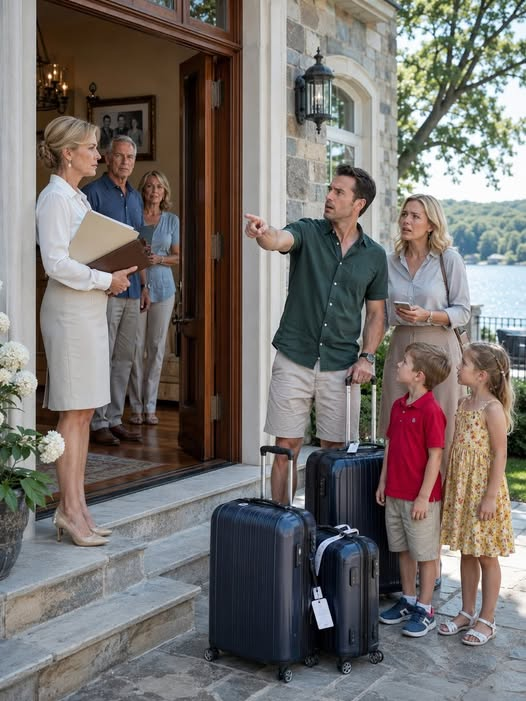
“They arrived with eleven suitcases.”
“And?”
“Patrick tried his key.”
“It didn’t work.”
I closed my eyes.
The image almost painted itself.
Megan standing on the porch.
The children asking why they couldn’t go inside.
Patrick trying the key again.
Harder.
Nothing.
Vivian continued.
“The Hendersons answered the door.”
I couldn’t help smiling.
“How did that go?”
“Patrick told them they were in the wrong house.”
“And?”
“Michael calmly introduced himself as the owner.”
Silence.
Then Vivian laughed softly.
“I’ve never seen someone’s face lose color so quickly.”
According to the neighbors, Megan immediately accused the Hendersons of breaking in.
She demanded they leave.
Michael simply pointed toward the county deed hanging in a protective frame inside the entryway.
“We bought this home legally last week.”
Patrick refused to believe it.
“My mother would never sell this house.”
Michael answered with one sentence.
“She already did.”
By then, several neighbors had gathered outside.
Everyone knew Patrick.
Everyone knew he often referred to the property as “our lake house.”
None of them knew he had never owned it.
The moving truck sat in the driveway with boxes labeled:
Patrick Dawson
Megan Dawson
Storage Unit 47.
One month prepaid.
Inside the front door, exactly where I had left it, rested a sealed envelope.
Patrick opened it with shaking hands.
Inside was a single key.
Not to the house.
To the storage unit.
Along with one handwritten note.
Dear Patrick,
The house was never yours.
The payments were never obligations.
The generosity was never permanent.
You asked me to stay behind because your wife wanted “family only.”
I’ve respected that decision.
From now on, your family will take care of itself.
Love,
Mom
Vivian paused.
“There was something else.”
“What?”
“Megan started crying.”
I waited.
“Not because the house was gone.”
“Because she’d already signed a remodeling contract using this address.”
I remembered the folder in Patrick’s closet.
The paint samples.
The kitchen designs.
The expanded master suite.
She had been renovating a home she didn’t own.
Patrick called Vivian after that.
Demanded to know where I was.
She refused to tell him.
Then my phone rang again.
This time I answered.
“Mom.”
His voice sounded nothing like the confident man who had texted me from the cruise ship.
“You sold the house?”
“Yes.”
“You didn’t even tell me.”
“I wasn’t told about the cruise.”
A long silence followed.
“Megan didn’t think…”
“I know exactly what Megan thought.”
“The kids are devastated.”
“So was I.”
He inhaled sharply.
“You’ve destroyed this family.”
“No, Patrick.”
I looked across the quiet lake outside my window.
“You confused support with ownership.”
“You could have talked to me.”
“I waited for that conversation for years.”
He had no answer.
Finally he whispered,
“Where are you living?”
“I’m home.”
“Where?”
“The first place I’ve had in a long time where no one feels entitled to it.”
He began crying.
Real tears.
Not because he had lost his mother.
Because he had lost what he assumed would one day belong to him.
“Can we fix this?”
I remembered the text message.
Plans changed. You’re not coming.
No apology.
No explanation.
Only an expectation that I would keep paying.
“There is nothing to fix.”
I ended the call.
Six months later, I invited the grandchildren to spend part of their summer with me.
Just the grandchildren.
Patrick was welcome to call before visiting.
Megan never did.
The Hendersons restored George’s old dock exactly as he had built it decades earlier.
They planted flowers where my mother once gardened.
And every Christmas, Ruth mailed me a photograph of the lake covered in snow.
People sometimes asked whether I regretted selling the family home.
I always gave the same answer.
“It stopped being a family home the moment I was no longer treated like family.”
The house found owners who loved it.
I found peace.
And for the first time since George passed away…
I stopped confusing sacrifice with love.
