The mill fell silent.
Tomás stepped through the doorway with Doña Eulalia behind him, her black shawl pulled tightly around her shoulders and her expression sharpened by greed.
“That corn belongs to my family,” he repeated.
Marisol placed herself between them and the sack.
“No. I found it in my mother’s house.”
Doña Eulalia laughed.
“Everything a married woman owns belongs to her husband.”
Don Jacinto closed his weathered hand around the kernels he had picked up.
“That may be how you run your household, Eulalia, but it is not the law.”
She turned toward him.
“No one asked you.”
“The land belonged to Carmen,” he continued. “And Carmen left it to her daughter.”
Tomás looked at Marisol.
“You are still my wife.”
“Three days ago, you watched your mother throw me out while I was carrying your child.”
“I was angry.”
“You were silent.”
His face tightened.
“That does not give you the right to steal from us.”
Marisol felt the baby move again.
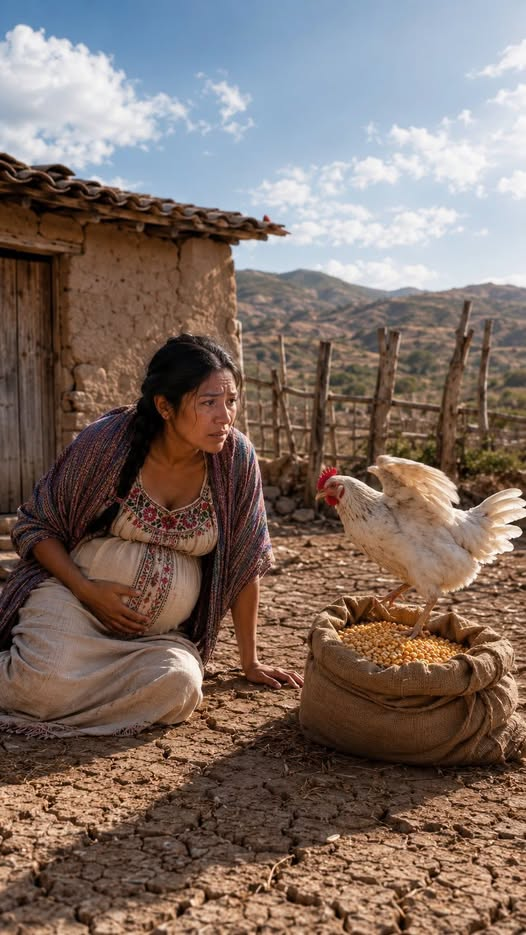
The white hen pressed itself against her ankles, feathers raised as if it understood the danger.
“I am not giving you the sack,” Marisol said.
Tomás reached for it.
The hen launched itself at his hand.
He cried out as its beak struck his knuckles.
The women in the mill gasped.
Doña Eulalia grabbed a broom.
“Filthy animal!”
She raised it to strike, but Don Jacinto caught the handle.
“Touch that hen and you answer to me.”
The old farmer’s voice carried enough authority to stop even Eulalia.
The miller pulled the sack behind the counter.
“No one takes anything until ownership is clear.”
Doña Eulalia pointed at Marisol.
“You will regret humiliating us.”
Marisol met her eyes.
“I have already survived the worst thing you could do.”
She placed the remaining kernels back inside the sack and carried them home with Don Jacinto walking beside her.
The white hen followed closely.
On the way, Jacinto explained that the corn appeared to be a rare blue-black variety once cultivated by families in the region before commercial seed replaced it.
“It survives with little water,” he said. “Your mother’s father used to grow it.”
“My grandfather?”
Jacinto nodded.
“He refused to sell his seed to a company that wanted exclusive ownership. After he died, everyone believed the last harvest had been lost.”
Marisol looked down at the sack.
“Why would my mother hide it?”
“Perhaps she was waiting for someone who would understand its value.”
Marisol glanced at the hen.
“Then that someone was almost too hungry to understand anything.”
Back at the adobe house, Don Jacinto inspected the dead plot.
The soil was hard, but he found a low section where rainwater once collected.
He taught Marisol how to break the crust, mix dry leaves into the earth, and plant only a portion of the seed.
“Never risk the entire sack,” he warned. “Keep enough safe in case the first crop fails.”
For the next two weeks, Marisol worked before sunrise and after sunset.
She repaired the roof with discarded tiles.
She collected water from neighbors in exchange for sewing.
She planted one hundred and twenty kernels in careful rows.
At night, she slept on a straw mattress while the white hen nested beside the sack of remaining corn.
Marisol named her Blanca.
People continued laughing.
They called Marisol the pregnant farmer of the dead plot.
They said she would give birth before a single seed emerged.
Then, after ten days, a thin green blade broke through the dirt.
By the next morning, there were seven.
A week later, there were more than eighty.
Don Jacinto knelt between the rows and touched one leaf with trembling fingers.
“It survived.”
Marisol began to cry.
Not because the plants were worth money.
Because something everyone had declared useless had chosen to live.
Just like her.
The news spread quickly.
An agricultural specialist from the state university visited the plot. She collected samples and confirmed that the corn carried genetic traits rarely found in modern varieties.
It tolerated heat.
It required less water.
And preliminary tests suggested it resisted a fungus that had damaged crops across the region.
“This seed could be extremely important,” the specialist told Marisol. “But you must protect it legally.”
Doña Eulalia heard those words before sunset.
The next morning, Tomás arrived with a notary.
He carried flowers and wore the clean shirt Marisol had once ironed for him every Sunday.
“I came to take you home,” he said.
Marisol remained behind the wooden gate.
“I do not have a home with you.”
Tomás lowered his voice.
“My mother was wrong.”
“And you?”
“I should have defended you.”
“But you did not.”
He looked toward the growing corn.
“We can start again. Our daughter deserves both parents.”
For one weak second, Marisol remembered the man he had been when they first married.
Then she noticed the papers beneath the notary’s arm.
“What did you bring?”
Tomás hesitated.
“Only documents to register the seed under the family name.”
“Whose family name?”
“Ours.”
Doña Eulalia stepped out from behind the truck.
“The boy is trying to save you from making another foolish decision.”
Marisol looked at her.
“You threw me out.”
“That was before we knew what you were hiding.”
There it was.
Not regret.
Not concern for the baby.
Only hunger for what had grown from the earth.
The notary opened the folder.
“If Mrs. Marisol signs, her husband will become co-administrator of the seed and any future commercial rights.”
Marisol laughed softly.
“So that is why you came.”
Tomás moved closer.
“We are married. Half of everything is mine.”
Don Jacinto emerged from the house.
“Not an inheritance received directly from her mother.”
The notary looked uncomfortable.
Doña Eulalia’s face darkened.
“She has no proof that Carmen left her the corn.”
A woman’s voice answered from behind them.
“Yes, she does.”
Everyone turned.
A silver-haired woman wearing a plain linen dress stood beside the university specialist.
Marisol recognized her as Señora Ofelia Cruz, her mother’s former employer.
Ofelia carried a sealed envelope.
“Carmen gave me this eleven years ago,” she said. “She told me to deliver it only if Marisol ever returned to the dead plot and planted the corn.”
Marisol’s hands began to tremble.
Ofelia handed her the envelope.
Inside was a handwritten letter.
My beloved Marisol,
If you are reading this, then life has brought you back to the land everyone mocked.
The corn in the kitchen is the last seed your grandfather protected. It was never meant to make us rich. It was meant to ensure that no company or powerful landowner could erase what belonged to our people.
But there is something else you must know.
The dead plot is not only six hectares, as the town records claim.
Your grandfather purchased the neighboring land before his death. The true deed covers forty-two hectares, including the underground spring beneath the hill.
I hid the deed because Eulalia and her husband tried to force your father to surrender it when you were still a child.
Trust Jacinto.
Do not trust anyone who suddenly loves you after discovering what the land can produce.
Marisol stopped reading.
Her vision blurred.
“Forty-two hectares?” Tomás whispered.
Doña Eulalia rushed forward.
“That letter is false.”
Ofelia removed another document from her bag.
“The original deed was registered in the state archive. Carmen paid me to preserve a certified copy.”
The university specialist unfolded a map.
The property boundary extended far beyond the ruined adobe house.
It included the dry hill, a stone reservoir, and the land where Doña Eulalia’s family had grazed cattle for years without permission.
Don Jacinto pointed toward a mark on the map.
“The spring is here.”
Tomás stared at the document.
“If Marisol owns that hill…”
“Then your family has occupied part of her inheritance illegally for almost twenty years,” Ofelia finished.
Doña Eulalia turned pale.
She grabbed Tomás’s arm.
“Do not listen to them.”
But he was no longer looking at his mother.
He was calculating.
Marisol recognized the expression immediately.
The same man who had remained silent while she was expelled was now imagining himself as the husband of a wealthy landowner.
He stepped closer.
“Marisol, whatever happened between us, we can fix it.”
She folded the letter carefully.
“No.”
“Think about our child.”
“I am.”
His voice hardened.
“You cannot raise her alone.”
“I have already been alone for months. I simply did not realize it.”
Doña Eulalia pointed at the corn.
“You would have nothing if my son had not married you.”
Marisol looked around at the repaired roof, the green rows, and Blanca scratching proudly near the gate.
“I had nothing because I married your son.”
That afternoon, Marisol met with a lawyer recommended by the university.
The deed was authentic.
The forty-two hectares legally belonged to her through her mother.
The lawyer also discovered something worse.
Three years earlier, Doña Eulalia had attempted to register twelve hectares under Tomás’s name using a falsified sale contract supposedly signed by Carmen after her death.
The forged application had been rejected because one clerk noticed the date.
But no one had informed Marisol.
When the lawyer filed a formal complaint, investigators searched the ranch.
They found copies of Carmen’s signature, altered maps, and correspondence with a seed distributor.
Eulalia had known about the rare corn for years.
She believed Carmen had destroyed it.
That was why she called the hen useless and threw it out with Marisol.
She had no idea Blanca had been nesting beside the hidden sack for months, protecting it from rats.
The chicken had not stopped laying eggs because she was old.
She had stopped because she was guarding the seed.
By the time Marisol gave birth to a healthy daughter, the first corn plants had grown taller than her shoulders.
She named the baby Carmen.
Tomás came to the clinic carrying a stuffed rabbit.
He asked to hold his daughter.
Marisol allowed him to see her from the doorway.
But she did not allow him to take the child.
“I want another chance,” he said.
“You had one when I stood at the ranch gate carrying your daughter inside me.”
“My mother controlled everything.”
“You let her.”
“I can change.”
“Then change. But not for me.”
The divorce was finalized six months later.
Tomás received supervised visits after admitting he had helped his mother pressure Marisol into surrendering property rights.
Doña Eulalia was charged with document fraud and attempted land theft.
She lost the grazing land her family had used illegally and was ordered to compensate Marisol for years of occupation.
The rare corn produced a modest first harvest.
Marisol did not sell the rights to a private company.
Instead, she partnered with the university and created a community seed bank.
Farmers could receive seed without cost if they promised to return part of their harvest after each season.
Within three years, the variety was growing across several drought-stricken communities.
The dead plot became known as La Parcela del Renacer.
The Plot of Rebirth.
Marisol restored her mother’s house and planted fruit trees around the courtyard.
Don Jacinto became Carmen’s honorary grandfather.
And Blanca lived beside the kitchen, where no one ever again called her useless.
One evening, Marisol watched her daughter scatter grain for the old hen.
The child laughed as Blanca followed her between the rows of blue-black corn.
Ofelia sat nearby reading Carmen’s letter again.
“There is one line your mother added on the back,” she said.
Marisol turned the page.
In faded ink, Carmen had written:
People will tell you that worth depends on what you produce for them. Never believe it. A seed can look dry and still carry a field inside it. A woman can look defeated and still carry an entire future.
Marisol pressed the letter against her chest.
Doña Eulalia had expelled a pregnant woman and an old hen because she believed neither had anything left to offer.
But the hen had protected the last sack of corn.
The corn had revealed the hidden land.
And the land had returned to Marisol the inheritance others had spent years trying to steal.
They had thrown her away as though she were useless.
Instead, they had sent her directly toward everything that had always belonged to her.
