I made it three steps from the restaurant before my mother called after me.
“Olivia, wait.”
I stopped near the glass doors but did not turn around.
The hotel lobby was filling with morning guests. A pianist was beginning a soft melody near the windows. Behind me, my family remained at the table where they had arrived expecting a rescue.
My father spoke next.
“We handled this badly.”
That was the closest he had ever come to an apology.
I turned slowly.
My mother was crying. Harrison looked furious rather than ashamed. Naomi sat beside him with both hands wrapped around her coffee cup.
My father stood.
“Come home,” he said. “We can discuss everything privately.”
“There is nothing private about what you did.”
His jaw tightened.
“We made a family decision.”
“You threw my belongings into the snow.”
“The situation became emotional.”
“No. It became honest.”
Harrison pushed back his chair.
“You’re really going to destroy this family over a guest house?”
I looked at him.
“You still think this is about the guest house.”
“What else could it be?”
I walked back to the table and placed one hand on the folder he had given me.
His investment fund was not merely struggling.
It had been built on false reports, borrowed money, and promises he could never keep.
“You asked me for fifteen million dollars less than one day after learning I had money.”
“I asked for an investment.”
“You asked your sister to cover fraud.”
His expression changed.
My father immediately stepped between us.
“Be careful with that word.”
“I have been careful.”
I opened the folder.
“Harrison listed forty-two million dollars in managed assets. His actual controlled funds total less than six million.”
Naomi looked sharply at her husband.
“What?”
Harrison’s voice rose.
“Those figures do not account for expected commitments.”
“Commitments from investors who were told their money had already been secured.”
“You don’t understand private finance.”
“I understand insolvency.”
My mother wiped her tears.
“Olivia, your brother made mistakes.”
“He lied to investors.”
“He was under pressure.”
“So was I when you left my suitcase outside.”
The officers waiting near the entrance remained still, but Sergeant Major Brooks watched my family closely.
My father noticed him.
“You brought soldiers into a family dispute?”
“No. They were already scheduled to meet me.”
“For what?”
I glanced at the secure watch on my wrist.
“For an inspection at a communications facility.”
Harrison laughed bitterly.
“You expect us to believe you command all these people and run a company at the same time?”
“I did not run the company while on active duty. My partners managed operations through an independent structure approved by military ethics counsel.”
His expression fell.
He had been hoping to find something improper.
Something he could use.
There was nothing.
My business had been built legally.
My career had been earned honestly.
The difference between us had never been opportunity.
It had been character.
Naomi reached for the folder.
“Harrison, let me see the statements.”
He pulled them away.
“Not now.”
Her voice hardened.
“You told me the fund was stable.”
“It will be.”
“You used our house as collateral.”
My mother stared at him.
“What house?”
Naomi looked toward my parents.
“The property in Greenwich.”
My father’s face changed.
“That property is not yours.”
Harrison lowered his eyes.
The truth arrived before he admitted it.
He had borrowed against my parents’ home.
The country club dinners, expensive suits, and private office in the guest house had all been supported by debt.
My father grabbed the folder.
“You mortgaged our property?”
“It was temporary.”
“You had no authority.”
Harrison looked at me.
“Tell him that investments require risk.”
“No,” I said. “Theft requires secrecy.”
My mother sank into her chair.
For the first time that morning, she stopped looking at me as the solution.
She looked at the son she had protected for thirty-seven years.
“How much do we owe?”
Harrison said nothing.
Naomi answered.
“Nearly nine million.”
My father gripped the table.
“Our home is worth four.”
“The loan includes penalties,” she said.
My mother covered her mouth.
Harrison turned toward me again.
“That is why I need the fifteen million. You could solve everything and barely notice the difference.”
There it was.
Not an apology.
Not regret.
Only the belief that my success belonged to him.
“You are not asking me to save the family,” I said. “You are asking me to preserve your reputation.”
“What difference does it make if everyone benefits?”
“The difference is that you will do it again.”
He leaned closer.
“You owe us.”
The words were so absurd that even my father looked at him.
Harrison continued.
“You stayed on our property. You used the family name. You received opportunities because of who we are.”
I almost smiled.
“I paid every expense connected to that property.”
“You were still given a place to stay.”
“I repaired the place you just tried to take from me.”
My mother whispered, “Olivia, please.”
I looked at her.
“Did you know he used the house as collateral?”
“No.”
“Would you have thrown him into the snow if you had?”
She began crying again.
I already knew the answer.
Of course she would not have.
Harrison was allowed to fail because the family believed his failure was temporary.
I was expected to succeed quietly because acknowledging my success would force them to confront how badly they had treated me.
My secure phone vibrated.
I opened the message.
It came from my attorney.
PROPERTY TRANSFER CONFIRMED. FORECLOSURE NOTICE FILED.
I looked toward my father.
“There is something else you should know.”
He stared at me cautiously.
“Three years ago, when the property taxes became delinquent, I paid them.”
“We know.”
“You do not know the rest.”
The county had scheduled the property for tax seizure.
My parents could not obtain refinancing because Harrison had already damaged their credit.
To prevent the house from being sold, I had purchased the tax lien through a private trust.
Later, when more debts appeared, the trust acquired the primary mortgage too.
My father slowly sat down.
“What are you saying?”
“I am saying the bank does not control your mortgage anymore.”
Hope entered my mother’s face.
“You bought it?”
“My trust did.”
Harrison smiled for the first time.
“Then this is perfect. Cancel the debt.”
“No.”
His smile disappeared.
My father’s voice became low.
“You would evict your own parents?”
“I did not create the debt.”
“But you control it.”
“Yes.”
The word frightened them.
For the first time, I possessed the kind of power they had always respected.
Not emotional power.
Not moral power.
Financial power.
And suddenly they wanted kindness from the daughter they had never offered kindness to.
My mother reached across the table.
“We made a terrible mistake last night.”
“You made the same mistake for years.”
“We didn’t understand your career.”
“You did not try.”
“We thought you were hiding things from us.”
“I was protecting classified information.”
“You could have told us you were important.”
I looked at her hand but did not take it.
“I should not have needed a title or millions of dollars to deserve respect.”
She withdrew her hand.
That was the truth none of them could argue against.
My father straightened his jacket.
“What happens now?”
“The foreclosure process continues.”
My mother gasped.
“But where will we live?”
“You have sixty days.”
Harrison slammed his palm against the table.
“You cannot be serious.”
“I am.”
“You will let our parents lose their home?”
“No. You did that when you used it to support a fraudulent fund.”
He stood so quickly that the chair fell backward.
Sergeant Major Brooks immediately stepped forward.
Harrison looked at the uniform, then sat down again.
I closed the folder.
“The trust will not pursue a deficiency judgment against Mom and Dad. Once the property is sold, any legitimate remaining equity will be returned to them.”
My father stared at me.
“You are selling the house?”
“Yes.”
“That house has been in our family for forty years.”
“And last night, you reminded me that paying for it did not make it mine.”
His own words landed between us.
He looked away.
Naomi began gathering her purse.
Harrison turned toward her.
“Where are you going?”
“To my sister’s house.”
“You are my wife.”
“And you lied to me about everything.”
She removed her wedding ring and placed it beside his untouched coffee.
“I signed documents because you told me they were routine investor forms. If my name appears on anything illegal, I will cooperate with investigators.”
His face became pale.
“You would testify against me?”
“You used my signature.”
For once, Harrison was experiencing what it felt like to become disposable in someone else’s plan.
Naomi left without saying goodbye.
My mother watched her go.
Then she looked at me with a strange mixture of fear and grief.
“Are the police involved?”
“Not yet.”
Harrison exhaled.
I continued.
“But the financial regulators will be by noon.”
His relief vanished.
“You reported me?”
“I sent the evidence to my attorney before coming downstairs.”
“You’re my sister.”
“And those investors trusted you with their savings.”
“Some of them are already wealthy.”
“One is a retired teacher. Another is a military widow.”
He stopped speaking.
That second investor was the reason I had reviewed his fund in the first place.
She had contacted a veterans’ financial assistance office after losing nearly everything.
Her documents carried Harrison’s name.
When I saw it, I ordered a complete independent review.
He had not only stolen from strangers.
He had profited from the same military community he mocked whenever he spoke about my career.
My father read the summary page again.
“How long could Harrison go to prison?”
“I am not his judge.”
My mother whispered, “Can’t you help him?”
“I am helping the people he hurt.”
She closed her eyes.
The distinction broke something in her.
For years, helping the family had meant protecting Harrison.
Now it meant allowing consequences to reach him.
Two men entered the restaurant.
They wore dark suits and carried federal credentials.
Harrison saw them and stood.
“Olivia.”
For the first time, he said my name without arrogance.
Only fear.
“Please.”
I met his eyes.
“You had eighty-three chances to leave a message apologizing.”
His face tightened.
“You listened to them?”
“All of them.”
The first calls demanded that I return.
The next ones praised my success.
Then came the requests.
Money.
Introductions.
Contracts.
A place for Harrison in my company.
Not one message asked whether I had been safe after they threw me out.
Not one asked where I had slept.
Not one said they were sorry until they discovered the number in my account.
The agents approached.
“Mr. Harrison Bennett?”
He looked at my father.
Then my mother.
Finally, me.
No one moved to protect him.
He was escorted from the restaurant for questioning.
My mother began sobbing.
My father remained still, staring at the table where Harrison’s folder lay open.
“I failed both of you,” he said.
It was the first real admission he had ever made.
I studied him.
“You protected Harrison from becoming responsible.”
He nodded slowly.
“And taught you that love had to be earned.”
I did not answer.
Because he was right.
My mother looked at me.
“Can we ever repair this?”
“I don’t know.”
It was not forgiveness.
But it was honest.
I stood and buttoned my coat.
The officers near the entrance prepared to leave with me.
My father looked toward them.
“Are you really one of the Army’s highest-ranking commanders?”
“Yes.”
Pride briefly entered his expression.
I stopped it before it could settle.
“That title belongs to my service. It does not erase what happened between us.”
He lowered his eyes.
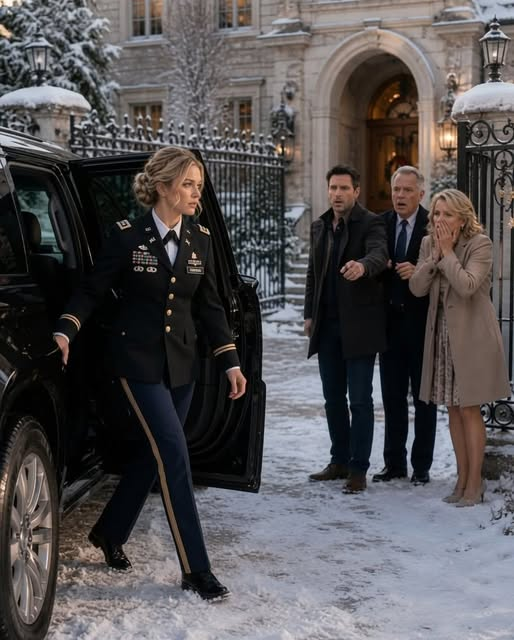
Outside, snow had begun falling again.
Sergeant Major Brooks opened the sedan door.
Before getting inside, I looked back through the restaurant windows.
My parents sat alone at the table.
Without Harrison.
Without the house they had used as a symbol of success.
Without the certainty that I would always pay for their choices.
For the next sixty days, I arranged temporary housing for them.
Not a mansion.
Not a country club property.
A comfortable two-bedroom condominium owned by the trust.
They paid their own utilities.
My father sold his luxury car.
My mother resigned from the country club before the membership fees came due.
Neither complained.
Harrison’s fund collapsed under investigation. Several assets were recovered and returned to investors. He eventually pleaded guilty to fraud and forgery.
I did not attend the sentencing.
Naomi cooperated fully and was not charged.
The family house was sold to a foundation that converted the estate into transitional housing for veterans and their families.
The guest house became a career counseling center.
My mother cried when she learned what I had done.
Not because she wanted the property back.
Because she finally understood that the home had become more useful after it stopped being a monument to appearances.
One year later, I attended the opening ceremony in uniform.
My parents stood near the back.
They did not introduce themselves as the general’s mother and father.
They volunteered at the registration table.
After the ceremony, my father approached me.
“We were proud of the wrong things,” he said.
I looked toward the veterans entering the main building with their children.
“I know.”
“We should have been proud when you left at eighteen.”
“You should have loved me before I gave you a reason to be proud.”
His eyes filled with tears.
“Yes.”
My mother joined us and handed me a small box.
Inside was a house key.
The old guest house key.
“We kept it after the sale,” she said. “But it belongs here now.”
I carried it inside and placed it in a display case beside the entrance.
Under it, the foundation installed a simple plaque:
NO ONE WHO SERVED SHOULD EVER BE LEFT OUT IN THE COLD.
My parents had thrown my suitcase into the snow because they believed I had nowhere else to go.
They were wrong.
I had a career I had built through discipline.
A fortune I had earned through courage and patience.
And a life that had never depended on their approval.
But the greatest thing I gained was not forty-six million dollars.
It was the knowledge that walking away from disrespect was not abandonment.
It was self-respect.
And this time, when I left the property, nobody asked me to come back and save them.
They simply stood at the door and saluted.
