The lawyer’s name was Marcus Hale.
He did not congratulate me on the lottery ticket.
He did not smile.
He simply placed it inside a transparent evidence sleeve and called two witnesses into the room.
“Until this is secured through a trust,” he said, “you do not tell anyone. Not your parents. Not your sister. Not even the lottery office without me present.”
Jake sat beside me, still wearing the oil-stained jacket he used at the repair shop.
“The surgery is Thursday,” he said. “Can she get the money before then?”
Marcus looked at my brace.
“How much is needed?”
“Five thousand dollars.”
He picked up the phone.
Within twenty minutes, the hospital had received payment in full.
Not only for the surgery.
For rehabilitation, follow-up treatment, and any additional procedures my military insurance refused to cover.
I stared at the confirmation email.
For two days, five thousand dollars had felt like the price of my entire future.
To my parents, it had been less important than a party.
To Jake, it had been worth selling everything he owned.
I turned toward him.
“Your tools are coming back.”
He shook his head.
“They’re probably gone.”
Marcus glanced up from his computer.
“Who bought them?”
“A mechanic outside Fredericksburg.”
“Give me the name.”
Jake looked confused.
“Why?”
“Because the first money spent from this trust should repair what your sister’s emergency cost you.”
My surgery took place Thursday morning.
When I woke, Jake was asleep in the chair beside my bed with his arms folded across his chest.
My parents had not called.
Madison had posted twenty-three photographs from the yacht.
In one, she stood on the deck holding a bottle of champagne beneath a caption:
BEST EASTER GIFT EVER. SOME PARENTS REALLY KNOW HOW TO LOVE THEIR CHILDREN.
I closed the application.
Three days later, Marcus arrived with the first results of the financial investigation.
He placed a thick folder on my hospital table.
“Your parents are not as wealthy as they appear.”
I almost laughed.
“They bought a yacht for one hundred fifty thousand dollars.”
“They financed it.”
“How much do they actually own?”
“Almost nothing.”
Their house carried two mortgages.
My father’s luxury vehicles were leased.
The country club membership was six months behind.
Madison’s boutique had not made a profit in three years.
The yacht had been purchased with a loan secured against an investment account.
An account that did not belong entirely to my parents.
Marcus turned the page.
My grandfather had created two education and emergency trusts before he died.
One for Jake.
One for me.
Each had originally contained nearly four hundred thousand dollars.
I stared at the numbers.
“That’s impossible.”
“No. It is documented.”
“I joined the Army because Dad said there was no money for college.”
Marcus nodded.
“Your parents withdrew from the trust repeatedly while serving as trustees.”
The list of payments filled six pages.
Madison’s private university tuition.
Her destination wedding.
The down payment for her boutique.
Luxury vacations.
Credit-card debts.
And finally, the yacht.
Jake read the last transaction twice.
“They used Emily’s trust to buy Madison’s boat?”
Marcus leaned back.
“They used what remained of both trusts.”
The room became painfully quiet.
Jake had left technical school because he could not afford tuition.
He worked nights at a garage and weekends at a tire warehouse.
He had sold Grandpa’s tools to save my leg.
All that time, money intended for both of us had financed Madison’s lifestyle.
“How much is left?” I asked.
“Less than twelve thousand dollars.”
My hands tightened around the blanket.
My parents had not refused to help because they lacked five thousand dollars.
They had refused because saving my leg would have required admitting they had already stolen the money meant to protect me.
Marcus slid another document across the table.
“There is more.”
My father had submitted annual reports claiming the trust money had been spent on my education, medical care, and housing.
Several forms carried my signature.
I had never seen them.
“He forged these.”
“Yes.”
“And Jake’s?”
“Also forged.”
Jake stood abruptly.
“I’m going to their house.”
“No,” I said.
He stared at me.
“They stole everything Grandpa left us.”
“I know.”
“And they let you sit alone thinking you might never walk again.”
“I know.”
His face crumpled.
For years, Jake had been the quiet one.
The child who repaired everyone’s cars, carried groceries, and apologized whenever someone else hurt him.
I reached for his hand.
“We’re not going there angry.”
“Why not?”
“Because anger is what they expect from people they believe they can discredit.”
Marcus nodded.
“We proceed with evidence.”
The lawsuit was filed under seal.
The court froze the remaining trust accounts, the yacht loan, and several properties connected to my parents.
The lottery money remained hidden inside a private trust managed by Marcus’s firm.
Publicly, I was still an injured officer recovering in a small apartment.
That was exactly what my family believed when they finally called.
My mother’s voice was unusually sweet.
“Emily, darling, how did the surgery go?”
I stared at the phone.
“You knew I had surgery?”
“Jake mentioned it.”
“He asked you for help.”
“We thought he was exaggerating.”
“The doctor said I could lose normal movement in my leg.”
A pause.
“Well, everything worked out.”
Everything worked out.
As though the money had appeared by accident.
As though Jake had not sacrificed his future because they refused to sacrifice one bottle of champagne.
My mother continued.
“We’re having a family dinner Sunday. Madison wants to show everyone the yacht.”
“I’ll come.”
Her surprise was obvious.
“You will?”
“Yes.”
Marcus sat across from me and quietly activated the recorder.
Sunday afternoon, Jake drove us to the marina in a restored pickup truck.
His Snap-on tools had been returned the previous day.
Marcus had located the buyer, paid him fairly, and arranged delivery to Jake’s garage.
Jake cried when he opened the first drawer.
He tried to hide it by pretending to inspect the sockets.
At the marina, my parents stood beside the yacht with Madison and twelve guests.
My mother saw my crutches and frowned.
“You could have worn something nicer.”
I looked down at my plain black dress.
“I came directly from therapy.”
Madison stepped onto the dock wearing oversized sunglasses.
“Careful near the boat. The finish is new.”
Jake’s jaw tightened.
I touched his arm.
Not yet.
My father handed me a drink.
“So the Army covered the surgery?”
“No.”
His expression changed slightly.
“Then how did you pay?”
“A friend helped.”
Madison laughed.
“Someone actually lent you five thousand dollars?”
“Yes.”
She turned toward her friends.
“Emily has always been lucky. Even when she makes terrible choices, someone rescues her.”
I looked at the yacht.
“What did you name it?”
Madison smiled.
FAVORITE DAUGHTER was painted across the back in gold letters.
Jake looked away.
My mother laughed nervously.
“It’s only a joke.”
“No,” I said. “It’s honest.”
My father’s face hardened.
“Do not start today.”
“I only came to ask one question.”
Madison groaned.
“Can we please enjoy one family event without making it about your injury?”
I looked at my parents.
“Why did you use my trust to buy this yacht?”
The dock went silent.
My mother dropped her napkin.
My father did not react immediately.
That was how I knew Marcus’s evidence was correct.
Madison removed her sunglasses.
“What trust?”
My father stepped closer.
“You have been speaking to lawyers.”
“Yes.”
“You don’t understand those accounts.”
“I understand my signature was forged.”
My mother whispered, “Emily, lower your voice.”
“Why?”
“People are listening.”
“That never bothered you when you told them I was too irresponsible for college.”
My father grabbed my arm.
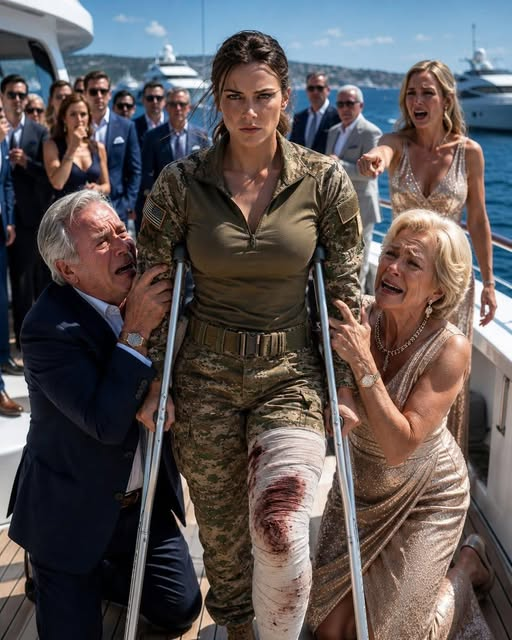
Jake moved instantly.
“Let her go.”
Dad released me.
“You two have no idea what it cost to raise this family.”
Marcus emerged from a nearby restaurant with two financial investigators and a process server.
My mother went pale.
My father stared at him.
“Who are you?”
“The attorney representing Emily Bennett and Jacob Bennett.”
The process server handed each of my parents a folder.
“You have been served.”
Madison began reading over my mother’s shoulder.
Her face changed.
“What does this mean?”
Marcus answered.
“It means the court has frozen assets purchased with misappropriated trust funds.”
Madison pointed toward the yacht.
“This was a gift.”
“It was purchased largely with money belonging to Emily and Jake.”
She turned toward our parents.
“You said the money came from an investment.”
My father’s voice rose.
“It did. Family money.”
“No,” Marcus said. “Protected beneficiary funds.”
My mother began crying.
“We intended to repay everything.”
“With what?” Jake asked.
No one answered.
The investigators boarded the yacht to document it pending seizure.
Madison followed them.
“You cannot take my boat!”
One officer turned.
“Ownership is disputed.”
“It has my name on it!”
Jake looked at the gold lettering.
“So did our trust accounts.”
Madison stared at him.
For the first time, she seemed to understand that the life she had been given had been built from things taken from us.
Then she looked at me.
“Did you plan this because you’re jealous?”
I almost felt sorry for her.
Almost.
“I asked for five thousand dollars to save my leg.”
She crossed her arms.
“And you got it.”
“That is not an answer.”
“You always make everything sound dramatic.”
My father stepped between us.
“That is enough. Emily, call off the lawsuit, and we’ll work something out.”
Marcus opened another folder.
“There is nothing to call off. Forgery and fiduciary theft are now being reviewed by prosecutors.”
My mother’s crying became louder.
“Prosecutors?”
“You stole from accounts created for your children,” Marcus said. “Then falsified reports to conceal it.”
Dad looked at me.
“You would send your own parents to prison?”
“You were willing to let me lose my ability to walk.”
“That is not the same.”
“No.”
I met his eyes.
“It’s worse.”
The yacht was seized two weeks later.
The house was sold during the civil settlement.
Madison’s boutique collapsed when my parents could no longer cover its losses.
She blamed me publicly until the trust documents became part of the court record.
Then her friends stopped calling.
My father pleaded guilty to fraud and forgery.
My mother admitted signing false trustee reports in exchange for a reduced sentence and restitution agreement.
Neither of them went to prison for decades.
But they lost the life they had built from our money.
Every remaining asset was sold.
The recovered funds did not replace everything.
But they paid Jake’s technical-school tuition, restored part of both trusts, and compensated us for a portion of the theft.
My lottery winnings remained private until the criminal case ended.
By then, I had completed rehabilitation.
The doctors could not promise I would return to the exact role I had held before the injury.
But I could walk.
Slowly at first.
Then without crutches.
On the day I took my first unassisted steps across the therapy room, Jake stood at the far wall holding the same wrinkled lottery ticket inside a frame.
“You bought us a miracle,” I told him.
He shook his head.
“You bought the ticket.”
“You sold Grandpa’s tools.”
“You would have done the same.”
He was right.
That was the difference between us and the family we had grown up in.
We did not calculate whether the other person was worth saving.
We simply showed up.
I used part of the lottery money to open a rehabilitation and career center for injured veterans.
Jake built an automotive workshop beside it, offering apprenticeships to former service members and young people who could not afford trade school.
Above the entrance, we placed Grandpa’s restored tool chest.
Madison came to the opening.
She stood at the edge of the crowd wearing an inexpensive coat and none of the jewelry she used to display online.
“I didn’t know,” she said.
“You never asked.”
She looked down.
“Mom and Dad always said you didn’t want anything.”
“I wanted five thousand dollars.”
Her eyes filled with tears.
“I’m sorry.”
I believed she was sorry.
But regret was not the same as repair.
“I hope you build something that belongs to you,” I said.
She nodded and left quietly.
My parents sent letters from the small rental apartment where they now lived.
My father apologized for valuing appearances over his children.
My mother wrote that she had mistaken giving Madison everything for love.
I did not answer immediately.
Forgiveness, like recovery, could not be demanded on someone else’s schedule.
The following Easter, Jake and I stood beside a lake with a group of recovering veterans.
There was no yacht.
No champagne tower.
No gold lettering declaring who was loved most.
We ate barbecue from paper plates while children ran across the grass.
At sunset, Jake handed me a small wooden box.
Inside was the original lottery ticket.
“I thought this belonged to you,” he said.
I closed the box and gave it back.
“No. Keep it in the workshop.”
“Why?”
“Because the money was never the miracle.”
He understood.
The miracle was an eighteen-year-old brother arriving with eight hundred forty dollars and the only valuable thing he had left.
The miracle was learning that my future was not measured by what my parents were willing to spend on me.
And the miracle was discovering, at the worst moment of my life, that being treated as worthless did not make me worthless.
My parents bought my sister a one-hundred-fifty-thousand-dollar yacht and told me my leg was not worth five thousand.
By the next Easter, the yacht was gone.
The lies were exposed.
And I walked into the life they had tried to convince me I did not deserve.
On my own two feet.
