Chief Reed’s jaw tightened.
For the first time since the punch, the mess hall no longer belonged to him.
It belonged to the silence.
He glanced toward the recruits, measuring how much of his authority remained. Men like Reed understood rooms the way predators understood open ground. He knew exactly when fear was turning into doubt.
So he laughed.
But the sound came out thinner than before.
“You think memorizing a few medical terms makes you impressive?”
“No,” I said. “I think your personnel file does.”
The laughter died completely.
His eyes narrowed.
“You don’t have access to my file.”
I looked toward the red stripe beneath his boots.
“That depends on why I’m here.”
The corpsman had moved closer without being told. He held gauze in one hand and kept his other near his radio.
Chief Reed noticed.
“Stand down, Petty Officer.”
The corpsman froze.
I pointed toward the floor.
“Don’t.”
Reed turned back to me.
“Don’t what?”
“Don’t give another order until you understand the situation.”
His face darkened.
“You walk into my training facility without insignia, provoke an instructor, and now you’re giving commands?”
“I didn’t provoke you.”
“You disrespected the chain of command.”
“I asked why three recruits had identical bruising patterns.”
A murmur passed through the room.
Reed’s expression changed again.
This time, everyone saw it.
At the rear table, the nineteen-year-old recruit lowered his sandwich.
Chief Reed stepped closer.
“That is none of your business.”
“It became my business when their medical reports described accidental falls in three different locations.”
His voice dropped.
“You need to leave.”
“No.”
He looked toward the nearest instructor.
“Escort her out.”
The instructor did not move.
That hesitation was small.
But it was fatal.
Reed stared at him.
“I gave you an order.”
The man swallowed.
“Chief, she mentioned an investigation.”
Reed’s eyes returned to me.
“What investigation?”
I reached into the inside pocket of my civilian jacket.
Three instructors shifted at once.
The corpsman raised his radio.
I removed a laminated credential and placed it on the nearest table.
Nobody could read it from across the room.
Chief Reed could.
The blood drained from his face.
Across the top were the words:
DEPARTMENT OF THE NAVY — INSPECTOR GENERAL
Beneath them was my photograph.
And beneath that:
COMMAND INVESTIGATIONS DIVISION
The room changed instantly.
Backs straightened.
Coffee cups lowered.
The nervous recruits stopped looking at Reed and started looking at me.
I wiped the blood from my mouth with the gauze the corpsman finally handed me.
“My name is Commander Lena Ward.”
Reed stared at the credential.
Then at my face.
“No.”
“Yes.”
“You said no rank.”
“I wore no visible rank.”
“That’s deception.”
“It’s an inspection.”
His mouth opened, but no sound came out.
I continued.
“Seventy-eight recruits entered this phase of training six weeks ago. Eleven reported injuries serious enough to require medical treatment. Eight later withdrew their complaints. Three changed their statements after closed-door counseling with you.”
Reed looked toward the ceiling cameras.
One above the entrance.
One near the serving line.
One aimed directly at the red stripe.
His eyes stopped there.
Finally, he understood.
I had not mentioned the stripe because it marked a dining boundary.
It marked the center of the camera’s clearest recording zone.
Every instructor knew it.
He had stepped inside it before he hit me.
“You arranged this,” he said.
“I arranged nothing.”
“You stood there deliberately.”
“I walked through a mess hall carrying lunch.”
“You wanted me to react.”
“I expected you to follow regulations.”
His fists tightened.
“You came here to destroy me.”
“No, Chief.”
I let the room hear every word.
“I came here to determine whether the complaints against you were true.”
I looked at the blood on the gauze.
“You answered that question yourself.”
The recruit at the rear table suddenly stood.
The movement was so abrupt that his chair scraped loudly against the tile.
Chief Reed turned.
“Sit down, Mercer.”
The young man remained standing.
His hands shook.
“My name isn’t Mercer.”
Reed’s expression sharpened.
“What did you say?”
“My name is Daniel Mercer, Chief. But you always call me ‘Charity Case.’”
No one moved.
Daniel’s face had gone pale, but he continued.
“You said recruits who entered through hardship programs didn’t belong here.”
Reed pointed at him.
“Sit down before you make this worse for yourself.”
Daniel looked at me.
I gave him one small nod.
He breathed in.
Then he pulled the collar of his brown training shirt aside.
Dark bruising covered the top of his shoulder.
Not fresh.
Not accidental.
“I didn’t fall from the obstacle wall,” he said.
A second recruit stood.
Then a third.
The mess hall became painfully quiet.
The second recruit lifted his sleeve.
“He made us fight after lights-out.”
The third spoke without looking at Reed.
“If we refused, he said he’d mark us as mentally unfit.”
Reed laughed again.
“These kids are weak. Training is uncomfortable. That doesn’t make it abuse.”
I picked up my credential.
“No. But falsifying injury reports does.”
His eyes flashed.
“I never touched those reports.”
I reached into my jacket again and removed a small black device.
A secure recorder.
Then I pressed play.
Reed’s voice filled the mess hall.
Change the wording. Put ‘self-inflicted training error.’ If medical asks questions, send them to me.
The recording continued.
Another man answered.
What if one of them complains outside the command?
Reed replied:
Then we make sure he never graduates.
The chief’s face became rigid.
“That recording is fabricated.”
“No.”
I stopped the playback.
“It was obtained yesterday from an instructor who requested whistleblower protection.”
Reed’s gaze swept across the nine instructors.
For the first time, they looked afraid of him for a different reason.
Not because of what he might do.
Because of what he might reveal.
“You’re all finished,” he said.
The threat was quiet.
Automatic.
The kind he had probably delivered a hundred times in private.
This time, seventy-eight recruits heard it.
I turned toward the security office near the entrance.
“Master-at-Arms.”
Two uniformed personnel stepped out.
They had been waiting behind the frosted glass since before I entered.
Chief Reed took one step backward.
Then another.
“This is political.”
“No.”
“You need someone to blame because the training numbers look bad.”
“The numbers look bad because recruits are leaving injured.”
“They leave because they’re soft.”
Daniel Mercer spoke again.
“No, Chief.”
Reed looked toward him.
Daniel’s voice shook, but he did not sit down.
“They leave because you teach everyone that silence is the only way to survive.”
Something flickered across Reed’s face.
For half a second, I thought he might finally understand what he had done.
Then his eyes hardened.
He turned toward the nearest exit.
The Master-at-Arms blocked it.
“Chief Reed, remain where you are.”
Reed’s hand moved toward his belt.
Every instructor tensed.
The corpsman stepped in front of the recruits.
I did not move.
“Don’t make another mistake,” I said.
Reed looked at me.
His breathing became heavy.
Then he slowly lowered his hand.
The Master-at-Arms approached.
“Chief Walker Reed, you are being temporarily relieved of duty pending investigation.”
The words seemed to hit him harder than any punch could have.
“You cannot relieve me.”
“The command can.”
“I built this program.”
“No,” I said. “You hid inside it.”
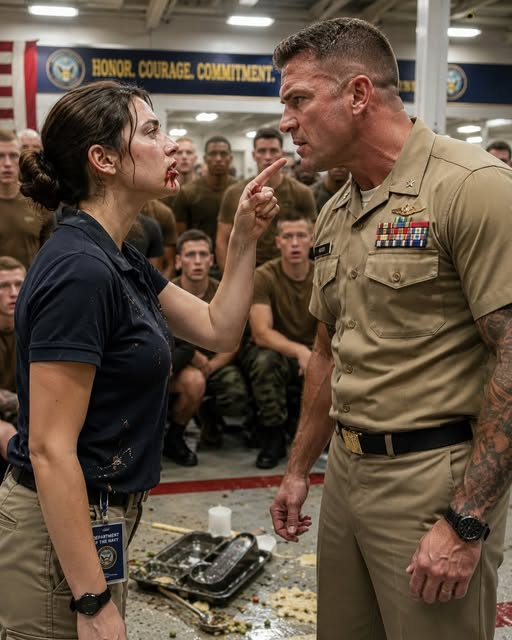
They removed his access badge.
Then his instructor credentials.
When one officer reached for the Trident above his pocket, Reed jerked away.
“Don’t touch that.”
The officer paused.
I stepped closer.
“No one is taking your qualification.”
His breathing eased slightly.
Then I added:
“But you used it as permission to become exactly the kind of man it was supposed to stop.”
His eyes filled with hatred.
“You don’t know what I’ve done for this country.”
“I know more than you think.”
That stopped him.
Only for a second.
But I noticed.
Reed leaned closer as the officers took his arms.
“You should have stayed in Washington.”
I held his gaze.
“Why?”
“Because this place is bigger than one angry chief.”
The officers began leading him away.
He smiled.
Not the arrogant smile from before.
This one was knowing.
Almost relieved.
“You still think the injury reports are the secret.”
I watched him carefully.
“What are you talking about?”
He glanced toward the three ceiling cameras.
Then toward the red stripe.
“The cameras don’t record continuously.”
The security officer frowned.
“Yes, they do.”
Reed laughed.
“Check the server.”
The mess hall doors closed behind him.
For a few seconds, no one spoke.
Then the instructor who had hesitated earlier approached me.
His name tag read HOLLIS.
“Commander, he’s lying.”
“About what?”
“The cameras.”
He looked toward the recruits.
“They were upgraded last year. Everything is archived.”
I took out my secure phone and called the inspection team stationed in the administration building.
“This is Ward. Verify mess hall footage and preserve the full server.”
A voice answered immediately.
“Already checking, ma’am.”
I waited.
The recruits waited.
Thirty seconds passed.
Then the investigator on the line spoke again.
His tone had changed.
“Commander, we have a problem.”
“What kind?”
“The main archive has been wiped.”
Hollis went pale.
“That’s impossible.”
“When?”
I asked.
“Approximately four minutes ago.”
Four minutes.
While Reed had been standing in front of me.
He could not have done it himself.
“Trace the access.”
“We are.”
A pause followed.
Then:
“The deletion came from inside the command office.”
I looked across the mess hall toward the officers’ corridor.
The door at the far end was closing.
A figure had just disappeared behind it.
Not a recruit.
Not Chief Reed.
An officer.
I started toward the corridor.
Behind me, Daniel called out.
“Commander!”
I stopped.
He was holding something beneath the table where Reed had been standing.
A small silver drive.
It must have fallen from the chief’s pocket during the confrontation.
Daniel handed it to me.
A strip of red tape had been wrapped around the casing.
On it were three handwritten words:
WARD — FINAL REVIEW
My name.
I had never seen the drive before.
Hollis stared at it.
“He knew you were coming.”
I connected it to an isolated inspection tablet.
Only one file appeared.
A video.
The timestamp was from six months earlier.
I opened it.
The footage showed Chief Reed inside a dark training room with another man.
The second man wore an officer’s uniform, but his face remained outside the camera frame.
Reed placed a folder on the table.
“The recruits are asking questions,” he said.
The unknown officer replied:
“Then break the ones who won’t stop.”
My blood ran cold.
Reed hesitated.
“And Commander Ward?”
The officer leaned forward.
For the first time, his hand entered the frame.
On his finger was a Naval Academy class ring.
A ring I recognized.
Because I had given it to him twenty years earlier.
The unknown officer spoke again.
“If she arrives, make the incident look personal.”
The video ended.
Hollis looked at me.
“Commander, who was that?”
I stared at the frozen image of the ring.
The man behind the operation was not a stranger.
He was Vice Admiral Robert Ward.
My older brother.
And before I could answer, the lights in the mess hall went out.
