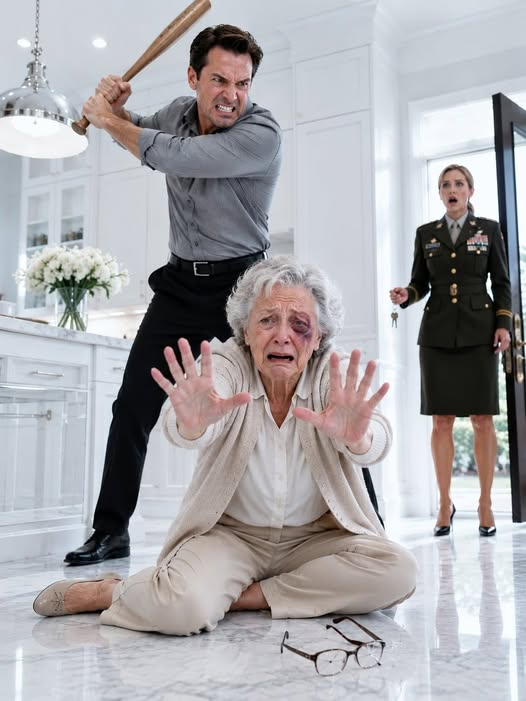
At the hospital, my mother was taken for X-rays while I sat alone beneath the harsh fluorescent lights, holding her broken glasses inside an evidence bag.
The gold frame was bent almost in half.
One lens was missing.
The other was stained with blood.
For fifteen years, I had believed Ryan was impatient, controlling, and sometimes cruel with his words.
But I had never believed he was capable of attacking a seventy-one-year-old woman with a baseball bat.
That belief died at 3:41 that morning.
The emergency physician stepped into the waiting area carrying a tablet.
“Lieutenant Colonel Morgan?”
I stood immediately.
“How is she?”
“She has two fractured ribs, a dislocated shoulder, and a deep cut above her eyebrow. There is no internal bleeding, but we are admitting her for observation.”
My breathing became tight.
“Will she recover?”
“We expect her to. But the pattern of injury concerns me.”
“What pattern?”
The doctor lowered his voice.
“The impact to her shoulder appears deliberate. It was not a wild defensive swing. Whoever struck her aimed downward with considerable force.”
My hand closed around the evidence bag.
Ryan had not panicked.
He had chosen where to hit her.
“Can I see her?”
“In a few minutes.”
Before the doctor left, I asked one final question.
“Did you photograph everything?”
“Yes.”
“Preserve every image and every medical note. No one receives a copy without my mother’s written permission.”
He studied my uniform, then nodded.
“You believe someone may try to interfere?”
“I believe someone already has.”
My phone rang.
Ryan.
I watched his name flash across the screen until the call ended.
He called again.
Then a message arrived.
Your mother attacked me. Do not let her manipulate you.
A second message followed.
Come home. We need to discuss this privately before your career gets dragged into it.
That was Ryan’s favorite weapon.
My career.
Whenever I questioned a missing payment, a strange business trip, or one of his unexplained absences, he reminded me that scandal could destroy an officer faster than a bullet.
I had always assumed he was protecting me.
Now I wondered whether he had simply been protecting himself.
Sergeant Christopher arrived twenty minutes later.
He was carrying another evidence bag.
Inside were Ryan’s boots.
Mud covered the soles.
The glass fragment remained lodged near the heel.
“I requested the security footage from your mother’s neighborhood,” he said. “There are city cameras at the intersection and two private systems on neighboring homes.”
“Ryan claimed he arrived at nine-thirty.”
“He did.”
“And?”
“He left once at 10:06.”
My body became still.
“My mother said he walked out through the kitchen door and came back with the bat.”
Christopher shook his head.
“He did not just step into the backyard. He drove away.”
“For how long?”
“Twenty-three minutes.”
“Where did he go?”
“We are tracing the route.”
I looked at the boots again.
The mud was reddish brown.
My mother’s backyard had pale gravel and dry summer soil.
“That dirt didn’t come from her property.”
“We noticed.”
He turned the bag beneath the light.
Something metallic was embedded between the grooves of the right boot.
Not glass.
A tiny copper-colored disc.
Christopher used tweezers to remove it.
It looked like the broken corner of an electronic tag.
“What is that?” I asked.
“We don’t know yet.”
My mother’s voice came from behind us.
“Kelsey.”
A nurse was wheeling her into a private recovery room.
I followed immediately.
Mom looked smaller beneath the hospital blanket, but her eyes were clear.
I sat beside her and took her hand.
“Did Ryan leave the house before he came back with the bat?”
She nodded.
“He said he needed something from his truck.”
“He was gone for twenty-three minutes.”
Her expression changed.
“That long?”
“Did you see where he went?”
“No. But I heard him talking on the phone before he returned.”
“What did he say?”
She closed her eyes, struggling to remember.
“He said, ‘She found the folder.’”
A chill moved through me.
“What folder?”
Mom looked toward the door.
Then she whispered, “The reason he came to my house.”
I leaned closer.
“Tell me.”
Three weeks earlier, she had been cleaning the guest room when she found an old leather briefcase inside a storage cabinet.
Ryan had placed it there during our kitchen renovation, claiming he needed temporary space.
My mother had forgotten about it.
Inside were property documents, photographs, invoices, and copies of bank transfers.
“I thought they belonged to you,” she said. “But then I saw your signature.”
“My signature?”
“It looked wrong.”
She had called Ryan first.
That had been her mistake.
He told her not to touch anything and promised to collect it later.
Instead, my mother photographed every page.
“Where are the pictures?”
“On my tablet.”
“Where is the tablet?”
Her face went pale.
“In the house.”
Ryan still had access to her property.
I stood.
“I’m going there.”
Mom gripped my wrist.
“No.”
“I need the evidence.”
“He was searching for something else.”
“What?”
She looked at the broken glasses in my hand.
“When I fell, he knelt beside me. He didn’t check whether I was breathing. He kept asking where I had hidden the key.”
“What key?”
“I don’t know.”
Sergeant Christopher stepped closer.
“Did he search the house?”
“Yes. The kitchen drawers. My purse. Even the lining of my coat.”
Then my mother said something that made my stomach tighten.
“He kept saying you had no idea what was beneath the property.”
I stared at her.
“What property?”
“He never said.”
Christopher’s phone rang.
He answered, listened for several seconds, and looked directly at me.
“We found where Ryan went during those twenty-three minutes.”
“Where?”
“A self-storage facility near the harbor.”
“Why would he go there?”
“The facility’s camera caught him entering Unit 314.”
He opened a photograph on his phone.
Ryan was standing in front of a storage unit, holding a long black case.
The same case police later found empty in the trunk of his car.
Christopher enlarged the image.
On the floor behind Ryan sat several wooden crates marked with the logo of a medical technology company.
I recognized it immediately.
“Northbridge Biomedical.”
Ryan had worked for Northbridge as a regional financial consultant for six years.
He had always told me the company produced hospital imaging equipment.
Christopher swiped to the next photograph.
One crate was open.
Inside were stacks of sealed documents and small silver containers.
Each container carried a government warning label.
CONTROLLED RESEARCH MATERIAL — FEDERAL AUTHORIZATION REQUIRED.
“What was he storing?” I asked.
“We don’t know. The unit was empty by the time officers arrived.”
“He moved everything?”
“Except this.”
Christopher displayed another image.
A torn invoice had been found beneath a shelf.
The document listed a payment of 4.8 million dollars to an offshore company called Blue Meridian Holdings.
The approving signature belonged to Ryan.
The authorization code beneath it belonged to me.
I stared at the screen.
“That is my military identification number.”
“Could he have accessed it?”
“My personnel records are restricted.”
“Then someone helped him.”
The room became unbearably quiet.
Ryan had not only forged my signature.
He had used my military credentials to authorize multimillion-dollar transactions involving controlled materials.
My phone vibrated again.
This time, the message came from an unknown number.
It contained a photograph.
Ryan was standing inside our kitchen.
He was holding my mother’s tablet.
Beneath the photograph was one sentence.
COME HOME ALONE IF YOU WANT TO KNOW WHY YOUR NAME IS ON THE CONTAINERS.
Mom saw my face.
“What is it?”
I did not answer.
Another image arrived.
It showed the inside of our basement.
The concrete floor had been broken open.
Beneath it was a steel door I had never seen before.
Ryan stood beside it with a shovel in one hand and a pistol in the other.
Then the final message appeared.
YOUR MOTHER DIDN’T FIND A FINANCIAL SECRET, KELSEY.
SHE FOUND THE ENTRANCE.
