Michael remained silent on the other end of the call.
For years, silence had been one of his favorite weapons.
He used it after frightening Emily, forcing her to sit in uncertainty until she apologized for whatever he had done. He used it during family dinners whenever she contradicted him. He used it in courtrooms, pausing before an answer so juries would mistake calculation for confidence.
But this silence was different.
This time, he was not controlling the room.
He was realizing the room had been recording him.
When he finally spoke, his voice had softened.
“General Carter, I believe Emily has given you a distorted account of our marriage.”
I looked at my daughter.
Her shoulders tightened immediately.
Even from miles away, his tone still had power over her.
“Then explain the protective order,” I said.
“She exaggerated an argument.”
“The hospital documented injuries in different stages of healing.”
“She bruises easily.”
Emily closed her eyes.
That sentence had clearly been used before.
Michael continued.
“She has been emotionally unstable since Lily was born. I have medical concerns about her ability to parent.”
The victim advocate seated across the kitchen table began writing.
A police detective listening through a secure speaker did the same.
Michael thought he was speaking only to frightened relatives.
He had no idea that every accusation was being preserved in front of witnesses.
“You mentioned custody papers,” I said. “When did you prepare them?”
He hesitated.
“I prepare for every possibility. That is what responsible attorneys do.”
“Before or after tonight’s protective order?”
“That is privileged.”
“Your personal custody strategy is not attorney-client privilege.”
His breathing grew louder.
“You said you would take Lily away and prevent Emily from seeing her.”
“I said no such thing.”
Emily stared at the phone.
Her fear gave way to something else.
Recognition.
He was denying words he had spoken less than two minutes earlier.
For three years, he had trained her to distrust her own memory.
Now the red recording symbol was still glowing.
“You did say it,” she whispered.
Michael ignored her.
“General, I respect your service, but you are involving yourself in a private domestic disagreement.”
“I am supporting my daughter while civilian authorities investigate documented violence.”
“You cannot use your position to intimidate me.”
“I have not used my position at all.”
That was important.
I had called no judge.
I had contacted no prosecutor outside the normal reporting process.
I had requested no favor.
Rank did not grant me authority over a civilian case, and I would not hand Michael an excuse to claim otherwise.
“My daughter went to a hospital,” I continued. “A forensic nurse documented her injuries. Local police opened an investigation. A court issued an emergency protective order. Those actions occurred through ordinary legal procedure.”
Michael’s voice sharpened.
“And you expect me to believe your name had nothing to do with it?”
“I expect you to obey the order.”
“I am Lily’s father.”
“You are also the subject of an investigation.”
He laughed again, but the sound was strained.
“Investigations disappear.”
The detective across the table lifted his eyes.
I leaned closer to the phone.
“Is that what you tell Emily?”
Michael realized his mistake.
“I am ending this call.”
“Please do.”
He hung up.
The kitchen became quiet.
Emily stared at the dark screen as if she expected it to come alive again.
Then she whispered, “He’ll come here.”
The detective shook his head.
“Officers are already watching the property.”
“He knows another entrance.”
“We have that covered too.”
“He’ll call his partners.”
“That does not invalidate a protective order.”
“He knows judges.”
The detective closed his notebook.
“Attorneys know judges professionally. That does not mean they control them.”
Emily’s eyes filled with tears.
“You don’t know Michael.”
“No,” the detective replied. “But I know evidence.”
He pointed gently toward the phone.
“And tonight he gave us more.”
At 9:06 p.m., Michael violated the protective order for the first time.
He sent Emily an email.
The subject line read:
RETURN MY DAUGHTER BEFORE THIS BECOMES UGLY.
The message warned that he would seek emergency custody, report Emily as mentally unstable, and accuse me of using military influence.
At 9:21, he contacted Lily’s preschool director and demanded access to security footage from the afternoon pickup.
At 9:44, he called Emily’s doctor’s office and attempted to obtain information about her treatment.
At 10:12, he drove past my house.
The patrol vehicle parked near the corner recorded his license plate.
He did not stop.
But the message was clear.
He wanted Emily to know he could still reach her.
The detective filed an immediate violation report.
By midnight, the temporary order had been expanded.
Michael was prohibited from approaching my property, the preschool, Emily’s workplace, or any temporary residence where she and Lily stayed.
His firearms, which he had registered for sport shooting, were ordered surrendered pending review.
Emily sat on the guest-room bed while Lily slept beside her.
I remained near the doorway.
“Dad,” she said, “what happens if he loses his job because of this?”
I felt a familiar ache.
Even now, she was worried about protecting him.
“What happens to his career will depend on his actions.”
“He worked his whole life to become a partner.”
“And you spent three years trying to survive inside your own home.”
She looked down.
“He wasn’t always like this.”
“I believe you.”
“In the beginning he was gentle.”
“I believe that too.”
The early kindness did not erase what followed.
That was something people often misunderstood.
A harmful marriage did not begin with danger clearly announced. It began with affection, promises, and a gradual narrowing of freedom.
Michael had not struck Emily on their first date.
He had first offered to manage her money because she was “too busy.”
He discouraged friends because they were “bad influences.”
He installed location tracking for “safety.”
He criticized her clothes, then her work, then her memory.
By the time the violence began, he had already built a world in which she believed she had nowhere to go.
“I should have noticed,” I said.
Emily looked up.
“You lived three states away.”
“I should have asked better questions.”
“He made everything look perfect.”
“I know.”
“He told me you would be ashamed.”
That hurt more than I expected.
“Of you?”
She nodded.
“He said a general would never accept a daughter who allowed herself to be treated this way.”
I entered the room and sat beside her.
“Emily, listen to me carefully. The shame belongs entirely to the person who hurt you.”
She began crying.
“I kept going back.”
“That does not make it your fault.”
“I told Lily everything was fine.”
“You were trying to keep her calm.”
“I defended him.”
“You were surviving.”
She covered her face.
I held her the way I had when she was small and frightened by storms.
For years, I had commanded thousands of soldiers.
I had made decisions under pressure that affected entire operations.
But nothing had prepared me for the helplessness of realizing my daughter had been fighting a private war while believing she had to hide it from me.
The next morning, Michael filed an emergency custody petition.
Just as he had threatened.
His filing described Emily as unstable, impulsive, and dangerous.
He claimed she had removed Lily from school without authorization.
He stated that I had used my position to “seize” the child.
He attached photographs of Emily crying.
Pictures taken inside their home.
Some were from nights after he had hurt her.
He used evidence of her suffering as evidence against her.
But Michael had prepared his case too early.
He did not yet know what the hospital had documented.
He did not know about the recorded call.
He did not know police had already collected threatening emails, location data, and footage of him driving past my house.
And he did not know Lily had begun speaking.
A child psychologist interviewed her that afternoon.
Emily and I were not in the room.
Lily was four, and nobody asked her to choose between parents.
The psychologist used toys, drawings, and simple questions.
When the interview ended, the psychologist looked deeply troubled.
Lily had described her father shouting.
She said Mommy sometimes slept on the bathroom floor.
She said Daddy told her not to speak about the “red marks.”
Then she repeated a sentence no child should have known.
“Daddy says judges believe him because he wears a suit.”
The emergency hearing was scheduled for the following morning.
Michael arrived at the courthouse wearing navy blue.
His hair was perfectly combed.
He carried a leather folder and walked beside two attorneys from his firm.
Emily wore a simple gray dress.
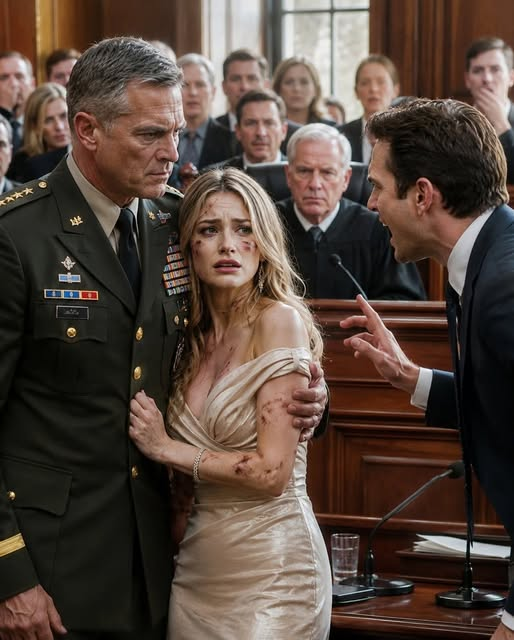
The bruising near her ribs remained hidden, but the mark beside her neck was visible.
She wanted to cover it.
The victim advocate advised her not to.
Not because she needed to perform her pain.
Because she no longer needed to hide the evidence for Michael’s comfort.
The judge entered at 8:30.
Michael’s attorney spoke first.
He described a marriage under stress.
He said Emily had become irrational.
He accused me of turning a family disagreement into a military spectacle.
The judge looked toward me.
“General Carter, have you contacted any court employee, prosecutor, police official, or government agency outside standard reporting procedures?”
“No, Your Honor.”
“Have you requested preferential treatment based on rank?”
“No.”
“Have you threatened Mr. Michael Carter?”
“No.”
Michael looked disappointed.
He had built his argument around corruption he could not prove.
Emily’s attorney presented the hospital records.
Then the protective order.
Then Michael’s email.
Then the recording.
His voice filled the courtroom.
You really think a piece of paper will stop me?
Michael’s expression remained controlled.
But one of his attorneys slowly closed her folder.
The recording continued.
I’ll tell the judge you’re unstable. By the time I’m done, you’ll be lucky if you see Lily once a month.
The judge looked directly at him.
“Mr. Carter, is that your voice?”
Michael stood.
“It was a private conversation taken out of context.”
“What context makes threatening to disregard a court order appropriate?”
“I was distressed because my child had been removed.”
“Your child was collected from preschool by police under an emergency protection plan.”
“I did not know that at the time.”
“You were told there was a protective order.”
He glanced toward Emily.
“She has manipulated everyone.”
The judge’s voice cooled.
“Sit down.”
For the first time, Michael hesitated before obeying.
The psychologist’s preliminary statement was introduced under seal.
The courtroom was cleared of unnecessary observers while the judge reviewed it.
When the hearing resumed, Michael’s request for emergency custody was denied.
The protective order remained in place.
Emily received temporary sole custody.
Michael was granted no direct contact until the criminal investigation and a full psychological evaluation were completed.
He stood abruptly.
“This is outrageous.”
His attorney touched his arm.
“Michael.”
He shook her off.
“You are taking my daughter based on rehearsed accusations.”
The judge stared at him.
“You have just demonstrated precisely why caution is necessary.”
He looked toward Emily.
The mask slipped.
Only for a second.
But everyone saw it.
The contempt.
The anger.
The promise of punishment.
A deputy stepped closer.
Michael noticed and forced himself to sit.
Outside the courtroom, reporters had gathered.
Someone had learned that the father of an abuse survivor was a senior Army general.
I refused every interview.
This was not a military story.
It was Emily’s life.
But Michael’s firm issued a statement before noon.
It claimed the allegations arose from a contentious custody dispute and emphasized his respected legal career.
That strategy failed when a second woman contacted police.
Her name was Rachel Monroe.
She had worked as a junior associate under Michael five years earlier.
She told investigators that he had threatened and assaulted her during a brief relationship before he married Emily.
Rachel had never reported it.
Michael warned that he would destroy her legal career.
When she saw the news, she recognized the language in his threats.
A third woman came forward two days later.
Then a former employee produced emails in which Michael discussed using private medical information to pressure a client’s spouse during a divorce.
His behavior was not confined to our family.
It was a pattern.
Carter, Hayes & Brooks placed him on administrative leave.
Michael accused Emily of orchestrating the professional complaints.
The dates proved otherwise.
Some records predated their marriage.
The state bar opened an ethics investigation into his use of confidential information, intimidation of witnesses, and dishonesty in court filings.
The criminal case moved more slowly.
Investigators searched the marital home under warrant.
They recovered surveillance files from cameras Michael had installed without Emily’s knowledge.
He claimed the system existed for security.
But the folders were organized by room and date.
Some recordings captured arguments.
Others captured Emily crying after he left.
One showed him blocking a doorway while Lily watched from the hallway.
The files he created to control Emily became evidence against him.
Police also found drafts of custody declarations written months before she left.
They included false statements from supposed witnesses.
One declaration was attributed to their former housekeeper.
When investigators contacted her, she denied ever writing it.
Michael had prepared to discredit Emily long before she came home.
The first criminal hearing occurred three months later.
By then, Emily had moved into a secure apartment with Lily.
She attended therapy.
She reopened a bank account in her own name.
She began working remotely for a nonprofit that supported military families with legal referrals.
Some mornings she seemed like herself again.
Other mornings, a door closing too loudly made her freeze.
Healing did not move in a straight line.
Michael’s defense argued that the injuries resulted from consensual conflict and accidents.
The forensic nurse testified that their location, age, and pattern were inconsistent with ordinary falls.
The prosecution played the recorded threats.
Rachel testified.
So did the former housekeeper.
Then Emily took the stand.
I sat behind her.
She was afraid.
I could see it in the way she gripped the edge of the witness box.
Michael watched her with the calm expression he had used for years.
His lawyer asked why she remained married if the abuse was so serious.
Emily’s voice shook.
“Because he told me leaving would cost me my daughter.”
“Did he physically prevent you from leaving every day?”
“No.”
“So you had opportunities?”
She looked toward Michael.
Then back at the attorney.
“A locked door is not the only thing that keeps someone trapped.”
The courtroom became still.
She explained the bank cards.
The surveillance.
The threats.
The custody papers.
The apologies after every incident.
The flowers.
The promises.
The way he held Lily afterward and acted like a loving father.
Michael’s attorney attempted to portray her delayed report as proof that she was lying.
Emily answered quietly.
“I stayed silent because he convinced me silence was the only way to keep my child.”
That sentence carried more truth than any title or rank in the room.
The jury convicted Michael of multiple offenses connected to the assaults, coercive control, stalking, witness intimidation, and violation of the protective order.
He was sentenced to prison.
The state bar revoked his license after a separate disciplinary proceeding.
Carter, Hayes & Brooks removed his name from the firm.
The partners who had defended him publicly issued apologies after internal records showed that complaints about his behavior had been ignored for years.
Emily did not receive the dramatic satisfaction people imagine comes from a verdict.
She cried when the sentence was read.
Not because she wanted him free.
Because the man being led away was still the man she had once loved.
The father of her child.
The person she had believed she would grow old beside.
Relief and grief can exist together.
The permanent custody order gave Emily sole legal and physical custody.
Michael was denied contact until Lily reached an age when qualified professionals could evaluate whether communication was safe.
Emily changed Lily’s surname to her own after a later court process.
Not to erase her father.
To give her daughter a name unconnected to fear.
A year after the scars were discovered, Emily and Lily returned to my house for the weekend.
This time, they arrived with suitcases.
Lily ran into the garden.
Emily stood in the hallway where she had once whispered that Michael got angry.
The marks on her back had faded.
Some remained.
She no longer tried to hide them from me.
“I used to think they proved I was weak,” she said.
“What do you think now?”
She considered the question.
“That I survived long enough to leave.”
I nodded.
“That sounds accurate.”
She smiled.
Then she looked toward the old photographs on the wall.
“You never told me you were afraid.”
“During deployments?”
“When you found out.”
I thought back to the bedroom.
The bruises.
The terror in her voice.
“I was more afraid than I had ever been.”
“You looked so calm.”
“Calm is sometimes only fear with a task.”
She leaned her head against my shoulder.
For a moment, she was my little girl again.
But she was also something more.
A woman rebuilding a life Michael had tried to reduce to evidence of instability.
Over the next few years, she completed training as a victim advocate.
She never used her story to claim every case was identical.
She listened.
She helped people preserve records safely.
She reminded them that reporting was their choice and that leaving often required planning.
Lily grew into a bright, observant child.
For a while, she drew every house without doors.
Then one day, she drew our family standing outside a yellow home with three open windows.
Emily placed the picture on her refrigerator.
I kept a copy in my office.
Michael once believed he understood power because he knew judges and wore expensive suits.
He believed fear made people unreliable.
He believed tears made women look unstable.
He believed professional respect could erase private cruelty.
He was wrong about all of it.
My rank did not defeat him.
I did not command his arrest.
I did not influence the judge.
I did not use the Army to destroy his career.
His own actions did that.
The medical records.
The threatening calls.
The forged statements.
The surveillance files.
The women he believed would never speak.
The daughter he assumed would remain afraid forever.
When I introduced myself on the phone, Michael thought the danger was that a general had entered the fight.
He never understood that the title changed nothing.
The real danger was that Emily had finally stepped into a hospital, told the truth, and allowed evidence to exist outside his control.
Michael believed powerful men were protected by the system.
He learned too late that the system becomes far more powerful when the people he silenced begin preserving the truth.
