The police officer’s words seemed to drain the air from the hospital corridor.
“This investigation begins now.”
Linda stared at him as though he had spoken in another language.
“Investigation?” she repeated. “I was helping her.”
The pediatrician’s expression hardened.
“You restrained an infant so tightly that she could not breathe properly.”
“I raised three children,” Linda snapped. “I know more about babies than these young mothers who read nonsense on the internet.”
I stepped between her and the doctor.
“Do not speak about my daughter as though this was a parenting disagreement.”
My voice was low, but it carried the authority of every command I had ever given.
“You nearly killed her.”
Linda’s lips parted.
For the first time, she seemed to understand that I was not going to soften the truth to protect her.
Ryan remained against the wall with his gaming headset hanging around his neck.
He had not taken it off completely.
That detail stayed with me.
Our daughter was fighting for her life behind two hospital doors, and part of him was still connected to a game.
One of the officers turned toward him.
“Were you home when this happened?”
Ryan swallowed.
“Yes.”
“Were you supervising the child?”
“My mother was watching her.”
“That was not the question.”
Ryan glanced at me.
“I was in another room.”
“Doing what?”
He hesitated.
“Playing online.”
The officer wrote something in his notebook.
“For how long?”
“I don’t know. A few hours.”
“A few hours?” I repeated.
Ryan’s face tightened.
“It was a tournament.”
I stared at him.
“A tournament.”
“Emily, not now.”
His words struck me with such force that I almost laughed.
Not now.
As though there would ever be a better time to discuss why he had abandoned his infant daughter while sitting twenty feet away.
The officer asked Linda to step aside for questioning.
She immediately looked toward Ryan.
“Tell them I would never hurt Sophie.”
Ryan said nothing.
“Ryan,” she insisted.
He lowered his eyes.
The silence was answer enough.
Linda’s face changed.
“You’re blaming me?”
“You tied her to a bed, Mom.”
“She would not stop moving!”
“She is a baby!”
His voice cracked as he finally shouted the words.
Several people in the corridor turned toward us.
Linda recoiled, more offended by his tone than horrified by what she had done.
“I was trying to help you,” she said.
“No,” I answered. “You were trying to make my daughter convenient.”
The officer led Linda into a private consultation room.
The second officer asked Ryan to follow.
He looked at me desperately.
“Emily, come with me.”
“No.”
“We need to explain this together.”
“There is no ‘together’ in what happened.”
His face went pale.
“You think this is my fault?”
I looked through the small window in the resuscitation-room door.
Doctors and nurses moved around Sophie’s bed.
Machines surrounded her tiny body.
“You promised me you would care for her.”
“I thought Mom could handle it.”
“You did not ask me.”
“I didn’t think it mattered.”
“That is the problem.”
I turned toward him.
“You did not think feeding your daughter mattered. You did not think changing her mattered. You did not think choosing a safe caregiver mattered.”
“That’s not fair.”
“No, Ryan. What happened to Sophie was not fair.”
A nurse stepped into the corridor before he could answer.
“Colonel Carter?”
I immediately approached.
“Is she awake?”
“Her vital signs are improving. The doctors have stabilized her, but she needs to remain in intensive care for observation.”
My knees nearly gave way.
The nurse gently touched my arm.
“You saved her life.”
I closed my eyes.
Relief came first.
Then anger.
Then a wave of guilt so heavy that I could barely breathe.
“I left her there,” I whispered.
“You went to work after arranging for her father to care for her,” the nurse said. “What happened was not your fault.”
But those words did not reach the part of me that kept replaying the moment I had opened the guest-room door.
I had led soldiers through emergencies without hesitation.
Yet I had trusted the wrong people with the one life that mattered more than my own.
Several hours later, I was allowed into the pediatric intensive care unit.
Sophie looked impossibly small beneath the hospital blanket.
A thin oxygen tube rested beneath her nose, and sensors were attached to her chest.
I sat beside her and placed one finger inside her hand.
Her fingers slowly closed around it.
That tiny movement broke something inside me.
“I’m here,” I whispered. “Mommy is here.”
Ryan entered quietly behind me.
He stopped near the door.
“Can I see her?”
I did not answer.
He moved closer anyway.
When he saw Sophie, he covered his mouth.
“Oh God.”
I looked at him.
“Take off the headset.”
He seemed confused.
Then he realized it was still hanging around his neck.
He removed it and placed it on a chair.
“I’m sorry.”
“Sorry for what?”
“For leaving her with Mom.”
“That is not enough.”
“I should have checked on her.”
“That is still not enough.”
His eyes filled with tears.
“Then tell me what you want me to say.”
“I want you to understand without being instructed.”
He sank into the chair across from me.
“I made a mistake.”
“No.”
I had said those same words to soldiers who tried to excuse deliberate negligence.
“A mistake is putting the wrong date on a form.”
I kept my voice calm.
“You made a series of choices.”
“You chose a game over your daughter.”
“You chose not to tell me you were leaving her with Linda.”
“You chose to ignore the silence in the house.”
“And when you finally came into the hallway, you looked annoyed.”
Ryan stared at the floor.
“I didn’t know.”
“You did not want to know.”
He began to cry.
For years, his tears would have softened me.
That night, they did not.
The door opened, and a hospital social worker entered with one of the police officers.
She explained that child protective services had been notified.
Because Ryan had been responsible for Sophie and had failed to supervise her, he would not be permitted to take her home without an approved safety plan.
Ryan shot to his feet.
“You’re saying I can’t see my own daughter?”
“That is not what she said,” I replied.
The social worker spoke carefully.
“You may visit under hospital rules. But once Sophie is discharged, Colonel Carter will be designated as the primary protective parent while the investigation continues.”
Ryan looked at me.
“You agreed to this?”
“I requested it.”
His expression collapsed.
“Emily.”
“I will not gamble with her safety twice.”
The next morning, Linda was formally arrested.
Security footage from the guest room and kitchen confirmed everything.
The cameras showed Linda carrying Sophie into the room while the baby cried.
They showed her returning to the kitchen alone.
They also showed Ryan walking past the guest-room door twice without entering.
He had not been completely unaware.
He had heard Sophie crying.
He had simply chosen not to stop playing.
When the detective showed me the footage, I felt colder than I had during any deployment.
Ryan sat beside me in the interview room.
“I thought Mom was calming her down,” he whispered.
“You never checked.”
“I trusted her.”
“So did I.”
I turned toward him.
“But I trusted you first.”
He had no answer.
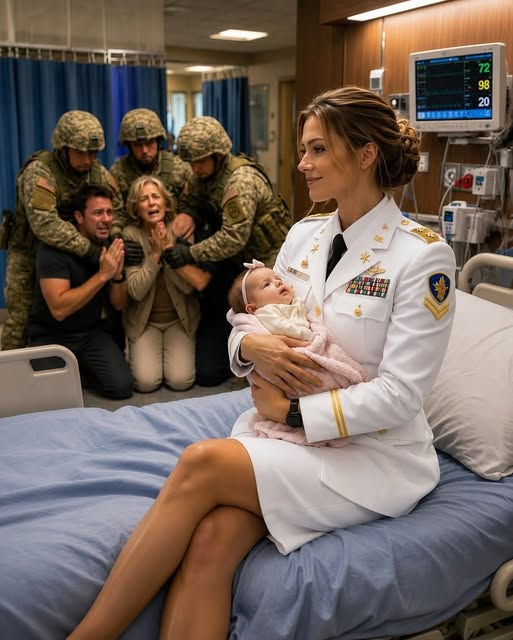
Sophie remained in the hospital for four days.
I did not leave except to shower in the family restroom and speak with investigators.
My commanding officer, Brigadier General Marcus Bell, arrived on the second day.
He stood outside Sophie’s room in uniform.
“You should take as much time as you need,” he told me.
“I just returned from maternity leave.”
“You are a soldier, Colonel. You are also a mother.”
He glanced through the window.
“Your duty right now is in that room.”
In my marriage, I had spent years hearing that the Army demanded too much from me.
Yet when everything collapsed, my command showed more concern for my child than her own father had.
General Bell helped arrange temporary military housing with enhanced security.
He also placed me in contact with a family-law attorney who regularly represented service members.
By the time Sophie was discharged, I had made my decision.
Ryan met me near the hospital exit.
He looked exhausted.
“I cleaned the house,” he said. “I threw away the gaming system. I changed the locks so Mom can’t return.”
“We are not going back.”
His face fell.
“What?”
“Sophie and I are staying elsewhere.”
“For how long?”
“Permanently.”
He stared at me.
“You’re leaving me?”
“I’m protecting our daughter.”
“I’m her father.”
“Then start behaving like one.”
“I can change.”
“Perhaps.”
I adjusted Sophie’s blanket inside the carrier.
“But she will not be your test case while you learn.”
He reached for my arm, then stopped himself.
“Are you filing for divorce?”
“Yes.”
His eyes widened.
“You can’t end our marriage over one day.”
“Our marriage did not end in one day.”
I looked at him.
“It ended in every moment when you assumed I would carry the responsibilities you ignored.”
“It ended every time you called caring for Sophie ‘helping me,’ as though she belonged only to me.”
“And it ended when I found our child unable to breathe while you were playing a game in the next room.”
Ryan began sobbing.
“I love you.”
“You loved the life I organized for you.”
“That isn’t true.”
“Then tell me the name of Sophie’s pediatrician.”
He froze.
“What?”
“Tell me when she last ate before I went to work.”
Silence.
“Tell me which formula she uses.”
He stared at the floor.
“Tell me where her emergency medical information is stored.”
He could not answer a single question.
I nodded slowly.
“That is what your love looked like.”
Then I carried Sophie outside.
The divorce proceedings began two weeks later.
Ryan contested everything at first.
He demanded equal custody and claimed that I was using my rank to intimidate him.
But the evidence was overwhelming.
The gaming records showed that he had been online for nearly seven uninterrupted hours.
His voice chat had even captured Sophie crying in the background.
At one point, another player had asked whether he needed to check on the baby.
Ryan’s recorded answer was simple:
“My mom has her. She’ll deal with it.”
After hearing that recording in court, Ryan stopped fighting for immediate unsupervised custody.
Linda pleaded not guilty and insisted that restraining babies was an old family technique.
Medical experts explained that no safe childcare practice resembled what she had done.
The judge found her guilty of child endangerment and aggravated assault.
She received a prison sentence, mandatory psychiatric evaluation, and a permanent order prohibiting contact with Sophie.
Even as she was led away, she blamed me.
“You destroyed my family!” she shouted.
I stood without responding.
She had not lost her family because I spoke.
She lost it because, for the first time, her actions had consequences.
Ryan received supervised visitation after completing parenting classes and therapy.
At first, he treated the requirements as punishment.
Over time, something changed.
He learned how to prepare bottles.
He attended medical appointments.
He learned how to recognize distress.
He began showing up early instead of offering excuses.
But change did not restore our marriage.
Some damage could be repaired.
Trust was not always among it.
The divorce became final eleven months later.
I retained primary custody.
Ryan was permitted scheduled visitation, which gradually became unsupervised after professionals agreed that he had demonstrated consistent responsibility.
We became better co-parents than we had ever been spouses.
Two years after the incident, Sophie stood in the front row during my promotion ceremony.
She was healthy, energetic, and constantly moving.
The Army chief of staff pinned a star to my uniform, promoting me to brigadier general.
When the ceremony ended, Sophie ran toward me with her arms raised.
I lifted her into the air.
She laughed loudly, kicking her legs with all the restless energy Linda had once tried to silence.
Ryan stood several feet away.
He watched her for a moment, then approached.
“She never stops moving,” he said.
I held Sophie closer.
“No.”
For the first time, he smiled without sadness.
“That’s a good thing.”
“Yes,” I replied. “It is.”
That night, after Sophie fell asleep, I stood beside her crib and watched her chest rise and fall.
For months after the hospital, I had woken repeatedly to check whether she was breathing.
The fear never vanished completely.
But it no longer controlled me.
I had once believed strength meant enduring everything without breaking.
The Army had taught me discipline, courage, and command.
Motherhood taught me something harder.
Strength also meant leaving.
Reporting the truth.
Refusing to protect adults from the consequences of endangering a child.
I could not change what had happened inside that silent house.
But I could decide what happened afterward.
Linda would never touch my daughter again.
Ryan would never again mistake fatherhood for an optional responsibility.
And Sophie would grow up knowing that her safety mattered more than appearances, family pressure, or anyone’s comfort.
That first day back on duty, I had nearly lost her.
But in saving Sophie, I also saved us from a home where negligence had been disguised as trust.
The house had once been the place where my daughter almost died.
I sold it before the divorce was finalized.
Our new home was smaller.
Quieter.
Safer.
And every evening, when Sophie’s laughter filled its rooms, I remembered the truth that changed my life:
A family is not defined by the people who demand forgiveness.
It is defined by the people who make sure its most vulnerable members are protected.
