The boarding announcement echoed through the executive lounge.
I should have stood.
I should have gathered my bag, switched off my phone, and walked toward the gate without looking at the screen again.
Instead, I opened the email.
The sender was my own address.
The subject line read:
IF ADRIAN BETRAYS YOU, SEND THIS TO THE BOARD.
For several seconds, I could only stare.
Then I remembered.
Six months earlier, while reviewing old project files, I had discovered irregularities inside the accounts connected to Adrian’s department.
Payments had been approved for outside consultants who did not appear to exist.
Design invoices were duplicated.
Travel expenses had been disguised as client-development costs.
At first, I assumed it was poor accounting.
Then I found Vanessa’s name attached to one of the vendor accounts.
I began collecting evidence quietly.
I had scheduled the email to reach me on the morning of our anniversary because I had planned to confront Adrian after the project launch.
Part of me had still hoped there would be an innocent explanation.
That hope died the moment Vanessa sent the photograph.
I opened the attachments.
Bank records.
Internal messages.
Invoice approvals.
Hotel reservations.
Audio files.
And one document that made my blood turn cold.
The Bali trip had not been a vacation funded by Adrian.
The company had paid for everything.
Their flights.
The beachside suite.
Private transportation.
Even the red bikini Vanessa wore in the photograph had been purchased using a corporate entertainment account.
But that was not the worst part.
The final attachment contained confidential design proposals for the company’s largest client.
Those files had been forwarded from Adrian’s account to a competitor three weeks earlier.
The email included a message from Vanessa:
Once they approve our transfer payments, we leave. Emma can finish the project and take the blame when it collapses.
I read the sentence twice.
They had not simply betrayed me.
They had planned to destroy my career.
The project I had worked through the night to complete was already compromised. If the competing company released a similar campaign first, our client would accuse us of stealing.
And because my name appeared as lead designer, the scandal would fall directly on me.
I looked toward the airport windows.
My plane waited beneath the pale morning sky.
For years, Adrian had accused me of being overly cautious.
He laughed whenever I saved copies of emails or insisted on written approvals.
Now those habits were the only reason I had proof.
I forwarded everything to the chief executive officer, Human Resources, the legal department, and the company’s external auditors.
Then I added one sentence:
I resign effective immediately, but I will cooperate fully with any criminal or civil investigation.
My flight was boarding.
I switched off my phone and left the country.
By the time Adrian and Vanessa returned from Bali, their access badges no longer worked.
They stood in the lobby with their suitcases while employees passed behind them.
Some pretended not to stare.
Others made no effort to hide their disgust.
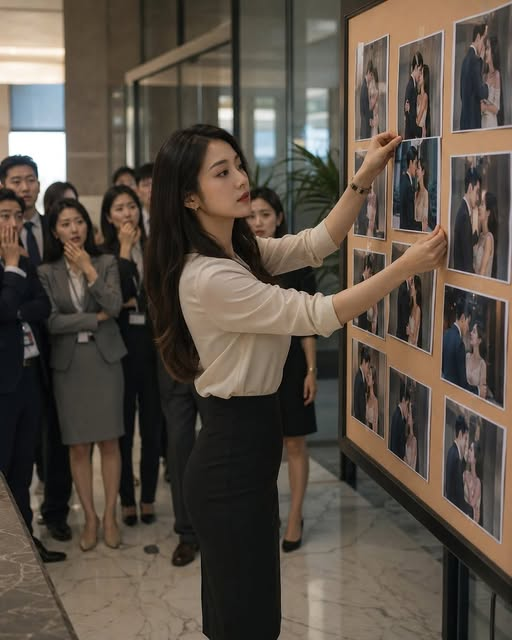
Every photograph had been removed from the seventeenth floor, but the damage could not be erased.
Pictures of the display had already spread through the company.
Adrian called the chief executive directly.
The call lasted less than two minutes.
“You abandoned a critical project without authorization,” the CEO told him. “You misused company funds, violated the conflict-of-interest policy, and possibly transferred confidential information to a competitor.”
Adrian tried to blame Vanessa.
Then he tried to blame me.
Neither worked.
Security escorted them into separate interview rooms.
Vanessa broke first.
She insisted that Adrian had promised to marry her.
She claimed he had created the fake vendors and ordered her to approve the invoices.
She handed over their messages, believing cooperation would protect her.
Adrian responded by producing evidence that Vanessa had contacted the competitor.
Within hours, the two people who had smiled like lovers in Bali were accusing each other of fraud.
I knew none of this while it was happening.
I landed in Lisbon sixteen hours later.
My sister, Rachel, was waiting outside the terminal.
She had moved to Portugal two years earlier and had been asking me to visit ever since.
The moment she saw me, she wrapped both arms around me.
“You look exhausted.”
“I am.”
“What happened?”
“My marriage ended.”
She pulled back.
“Do you want to talk about it?”
“Not yet.”
She nodded.
“Then we won’t.”
That simple answer nearly made me cry.
For seven years, I had lived with a man who demanded immediate explanations whenever my feelings inconvenienced him.
Rachel simply took my suitcase and led me toward her car.
For the next three days, I slept.
I did not read messages.
I did not check company news.
I did not look at social media.
On the fourth morning, Rachel placed coffee beside me on the balcony.
“You should turn on your phone.”
“Why?”
“Because your husband is on television.”
I stared at her.
She handed me her tablet.
A local business channel was reporting that two senior employees at a major design company had been suspended pending investigation into corporate espionage and financial misconduct.
Adrian’s photograph appeared on the screen.
Vanessa’s followed.
Then mine.
The reporter described me as the lead designer who had submitted evidence protecting the company and its client from a potentially catastrophic breach.
I almost laughed.
For years, Adrian had treated my caution as weakness.
Now the same caution had saved the business he nearly destroyed.
My phone contained hundreds of messages.
Colleagues apologized for judging me.
Members of the design team thanked me for preserving copies of the original project timeline.
The CEO asked me to reconsider my resignation.
And Adrian had sent sixty-three emails.
I opened only the most recent one.
Emma, please come home. Vanessa manipulated me. The photograph meant nothing. We can fix this. I need you to tell the company that I never intended to steal anything.
Not once did he ask whether I was all right.
Not once did he apologize for humiliating me.
He needed me because I still possessed the evidence that might reduce his punishment.
I replied with five words:
Contact me through my attorney.
Then I blocked his email address.
The investigation continued for almost three months.
The auditors discovered that Adrian and Vanessa had created four shell companies and diverted more than two million dollars through false consulting contracts.
They had also sold confidential campaign concepts to two competitors.
The Bali trip had been arranged as both a celebration and an escape plan.
They expected the stolen payments to clear while they were overseas.
Then they planned to resign before the project failure was discovered.
Vanessa had sent me the photograph because she wanted to humiliate me before disappearing with Adrian.
She had assumed I would spend the night crying.
Instead, her photograph created a public timeline proving that they were together when confidential files were transferred.
The image she sent to destroy me became one of the most important pieces of evidence against them.
Adrian tried to claim that I had accessed his accounts illegally.
But every file I used came from company systems I was authorized to review as project lead.
He then argued that our marriage entitled him to copies of my work.
The legal department rejected that immediately.
Marriage was not permission to steal intellectual property.
When the criminal charges were announced, Adrian was arrested outside his apartment.
Vanessa was detained the same afternoon.
Both faced charges involving fraud, theft of trade secrets, conspiracy, and misuse of corporate funds.
Adrian’s mother called me that evening.
She had never liked me.
According to her, I worked too much, spoke too little, and failed to make Adrian feel important.
“You have ruined his life,” she said.
“No.”
I stood beside Rachel’s balcony window, watching the evening light fall across the rooftops.
“He ruined his own life.”
“You could withdraw your statement.”
“The evidence would still exist.”
“But you could help him.”
“I spent seven years helping him.”
“He is your husband.”
“Not for much longer.”
She began crying.
I felt nothing.
Her son had betrayed me, stolen from his employer, and planned to leave me responsible for the collapse.
Yet she still believed my duty was to rescue him.
I ended the call.
The divorce was finalized six months later.
Adrian attempted to claim half of my savings, but the financial investigation exposed accounts he had hidden throughout our marriage.
He had been transferring part of his salary to Vanessa for almost two years.
The judge considered his concealment of assets and awarded me the apartment, my retirement accounts, and full ownership of the intellectual property connected to my independent work.
He received only his personal belongings and a portion of the debt created in his name.
Vanessa accepted a plea agreement and testified against him.
During the hearing, she admitted that Adrian had told her I was too devoted to leave.
“He said Emma would forgive anything,” Vanessa confessed.
“He said she had spent too many years building his career to destroy it.”
That sentence stayed with me.
Adrian had not betrayed me because he believed I was weak.
He betrayed me because he believed my loyalty made me controllable.
He had mistaken love for surrender.
The court sentenced Vanessa to four years in prison.
Adrian received nine.
Before the officers led him away, he looked across the courtroom at me.
“You really chose the company over me,” he said.
I shook my head.
“No.”
“I chose myself over the man who planned to destroy me.”
One year after leaving the seventeenth floor, I returned to the same building.
The CEO had asked me to become creative director after the investigation ended.
I refused at first.
I did not want Adrian’s former position.
Then the design team contacted me directly.
They reminded me that the department had never belonged to him.
It belonged to the people whose work he had taken credit for.
So I accepted under one condition.
The department would be restructured.
Transparent expense approvals.
Independent project audits.
Strict protection for junior employees reporting misconduct.
And no executive would be allowed to hide personal abuse behind professional authority again.
On my first morning, I stepped out of the elevator and looked toward the bulletin board.
It had been replaced.
The new board displayed completed campaigns, employee achievements, and handwritten notes from clients.
There was no photograph of Adrian.
No trace of Vanessa.
At the center was a framed copy of the project my team had managed to save.
The campaign won three international awards.
Beneath it, someone had placed a small caption:
Created by the people who stayed.
I stood there for a long moment.
Then Mr. Howard from the printing shop appeared beside me carrying a package.
“One hundred copies,” he said with a smile. “A3 size. Glossy paper.”
I looked at him in confusion.
He opened the wrapping.
Inside were posters announcing the department’s newest campaign.
My name appeared at the bottom as creative director.
Mr. Howard winked.
“I thought this time we could cover the floor with something worth celebrating.”
I laughed.
Together, we placed the first poster on the board.
One year earlier, I had covered those walls with proof of my husband’s betrayal.
I thought I was ending my life.
In reality, I was exposing the lie that had prevented my real life from beginning.
Vanessa sent one photograph to humiliate me.
I printed one hundred copies because I refused to carry their shame in silence.
But the copies did more than reveal an affair.
They forced everyone to look at the truth.
And once the truth was visible, Adrian could no longer hide behind his title, his marriage, or the work he stole from me.
He had believed the photograph would break my heart.
Instead, it became the first page of my freedom.
