Andrew’s eyes found Claire first.
He smiled.
Then he saw me.
The smile vanished.
For one second, his hand tightened around the guidon.
Claire noticed.
“What?” she whispered.
I didn’t answer.
The master of ceremonies began reading the official order.
“Lieutenant Colonel Andrew Hayes relinquishes command effective today…”
Applause followed.
Andrew stepped forward, saluted the colors, and handed over the guidon.
Everything still looked normal.
Then the announcer continued.
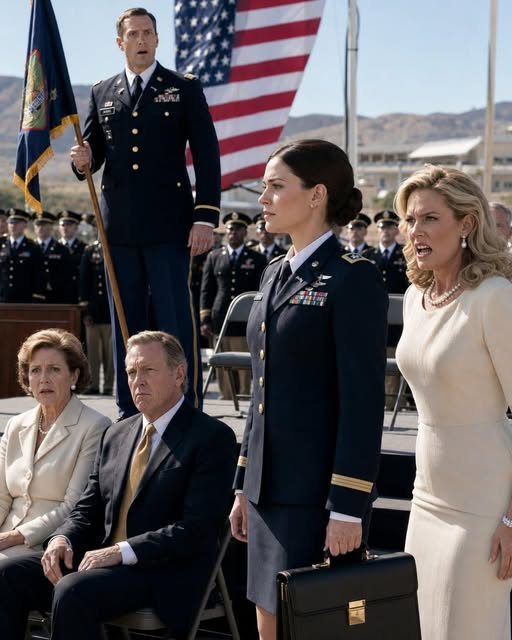
“And by order of the Department of the Army, command will be assumed by Lieutenant Colonel Emily—”
Claire stopped breathing.
My mother grabbed the edge of her chair.
My father turned toward me so quickly his program fell to the ground.
Andrew simply stared.
The announcer finished my name.
Then said:
“Ma’am, please come forward.”
I stepped into the aisle.
Claire caught my wrist.
“You?”
I looked down at her hand.
She released me immediately.
“You’re taking Andrew’s command?”
“Yes.”
“But he said—”
“I know what he said.”
I walked toward the stage.
Every step felt strangely quiet.
Six years earlier, Andrew had told my family that my career was finished.
That I had suffered some kind of breakdown during an overseas assignment.
That I had become unreliable.
Dangerous.
Obsessed with blaming other officers for my own mistakes.
My mother believed him.
My father believed him.
Claire believed him most eagerly of all.
The truth was simpler.
Andrew had made a decision during a classified operation that violated written guidance.
When the consequences reached headquarters, he needed someone else’s name on the authorization.
He chose mine.
I was a captain then.
He was my senior.
And because the operation was compartmented, almost nobody could see the entire record.
Andrew submitted a memorandum bearing my digital signature.
I was investigated.
My promotion was delayed.
My clearance was temporarily reviewed.
And when I protested, Andrew told everyone I was unstable because I could not accept responsibility.
There was only one problem.
He had never known I kept the original file.
Not on a personal computer.
Not hidden illegally.
It remained preserved through the proper classified records process after I disputed the document.
Years later, when an inspector general review reopened several decisions from that deployment, the original metadata surfaced.
The signature on Andrew’s version had been added after the fact.
Mine had not.
Today was not only his change of command.
It was the day the final investigative findings were being delivered.
He simply didn’t know that yet.
I reached the stage.
The senior general presiding over the ceremony shook my hand.
“Lieutenant Colonel.”
“Sir.”
He handed me the guidon.
For the first time, Andrew spoke.
“This can’t be right.”
The microphone caught it.
A ripple moved through the crowd.
The general looked at him.
“Excuse me?”
Andrew’s face had gone pale.
“I was told Colonel Ramsey was taking command.”
“He was.”
The general’s expression remained unreadable.
“Until the final assignment order changed.”
Andrew looked at me.
“You knew?”
“Yes.”
“For how long?”
“Long enough.”
Claire stood from the audience.
“Andrew, what is going on?”
He ignored her.
He stepped closer to me.
“You shouldn’t even have been eligible.”
That was the sentence that destroyed him.
The general turned slowly.
“Why wouldn’t she be eligible?”
Andrew realized too late what he had said.
“I meant…”
Nothing followed.
The general looked at me.
I said nothing.
I did not need to.
The ceremony continued.
I accepted command.
The soldiers saluted.
And when I returned the salute, I saw my father standing in the front row with tears in his eyes.
Not pride.
Not yet.
Shock.
Because for six years, he had been told I was the daughter whose career had collapsed.
Now hundreds of soldiers were standing beneath my command.
After the ceremony, Andrew tried to leave.
Two officers from the inspector general’s office met him beside the headquarters building.
Claire followed.
“What are they doing?”
Andrew’s expression hardened.
“It’s administrative.”
One investigator handed him a document.
“Lieutenant Colonel Hayes, you are directed to report for formal questioning concerning falsified operational records and obstruction during the prior review.”
Claire stared at him.
“What falsified records?”
Andrew looked at me.
He knew.
I was standing twenty feet away with the general and my incoming command sergeant major.
Claire followed his gaze.
Then she marched toward me.
“Emily.”
I excused myself.
“What did you do to him?”
There it was.
Not what did Andrew do?
What did I do?
“Nothing.”
“Don’t lie to me.”
“I submitted evidence when investigators requested it.”
Her eyes widened.
“What evidence?”
I looked toward Andrew.
“The file he told you never existed.”
Claire’s face changed.
“No.”
“He told us you blamed him because you couldn’t handle what happened overseas.”
“I know.”
“He said you forged documents.”
“No.”
“He said you were investigated.”
“That part was true.”
Her voice became quieter.
“Because of him?”
“Yes.”
Andrew approached.
“Claire, don’t listen to this.”
She turned.
“Did you sign Emily’s name?”
“No.”
I opened my briefcase.
Not to reveal classified material in public.
Only to remove the cover sheet from the inspector general’s unclassified finding.
I handed it to Claire.
The conclusion was short.
Andrew Hayes had submitted altered documentation during the original investigation.
He had misrepresented the timeline.
And he had knowingly allowed another officer to face professional consequences for an authorization she had never issued.
Claire read the first paragraph.
Then the second.
Her hands started shaking.
“Andrew…”
“It’s more complicated.”
“Is it true?”
He looked at me.
Then at her.
“It was a bad operation.”
“That isn’t what I asked.”
He lowered his voice.
“I was protecting the unit.”
I almost laughed.
“You were protecting yourself.”
My mother and father had joined us now.
Mom looked frightened.
“What is happening?”
Claire handed her the paper.
Mom read it.
Then looked at me.
“Oh my God.”
For six years, she had told me to stop “making military drama.”
For six years, she had invited Andrew to Christmas and asked me not to ruin the mood.
For six years, my own family had treated the man who damaged my career like the reasonable one.
My father looked at Andrew.
“You told us Emily had a breakdown.”
Andrew said nothing.
Dad’s voice cracked.
“You told me my daughter was unstable.”
Still nothing.
I closed the briefcase.
“I have work.”
Mom reached for me.
“Emily, wait.”
I stepped back.
Not cruelly.
Just enough.
“I waited six years.”
Then I walked into headquarters.
The investigation did not end Andrew’s life.
But it ended the version of it built on a lie.
His retirement was delayed while the case was resolved.
He lost eligibility for a senior command position.
Formal administrative findings were placed in his record.
Other decisions from the same period were reviewed.
No conspiracy.
No dramatic arrest.
Just documentation.
Consequences.
Claire moved out two months later.
Not because I asked her to.
Because she discovered something else.
Andrew had not merely lied about me.
He had used my supposed instability to isolate Claire from me.
Whenever she questioned him about late nights, unexplained travel, or money, he said:
“Don’t become like Emily. She sees betrayal everywhere.”
He had turned my name into a warning inside their marriage.
Once Claire saw that, other things stopped making sense too.
The perfect husband began looking very different when she stopped accepting his explanations automatically.
She called me one evening.
I almost didn’t answer.
“Emily.”
“Yes?”
“I owe you an apology.”
I waited.
“I humiliated you at the ceremony.”
“Yes.”
“I did it because Andrew told me you were jealous of us.”
“I know.”
“I thought you stared at him because you still cared.”
I laughed once.
“Claire, I was watching the officer whose command I was about to assume.”
“I know that now.”
Silence.
Then she whispered:
“Why didn’t you tell me?”
That question hurt.
“Would you have believed me?”
She started crying.
Neither of us spoke for several seconds.
Finally she said:
“No.”
At least she was honest.
“I’m sorry.”
“I know.”
“Can we fix this?”
“Not quickly.”
“I understand.”
That was the first correct answer she had given me in years.
My parents were harder.
My mother arrived at my house carrying food, as if casserole could repair six years of choosing someone else’s version of me.
“I should have defended you.”
“Yes.”
“I thought Andrew was trying to protect Claire.”
“You always thought somebody else needed protection from me.”
She began crying.
I did not rush to comfort her.
“I’m your mother.”
“I know.”
“That should matter.”
“It does.”
I looked at her.
“That’s why it hurt.”
My father apologized differently.
He sat across from me and said:
“I believed the man with the easier story.”
I said nothing.
“He was calm. You were angry.”
“I had reason to be.”
“I know.”
He looked down.
“I confused your anger with guilt.”
That sentence stayed with me.
“How do I fix that?”
“You stop asking me to make the truth comfortable for you.”
He nodded.
And slowly, he did.
A year after the change of command, I stood on the same parade field.
Different ceremony.
Same Texas heat.
My soldiers were returning from an extended training rotation.
Claire stood in the audience.
No pearls.
No performative smile.
Just my sister.
Our relationship was not magically repaired.
But she showed up.
That mattered.
Afterward, she walked toward me.
“You look happy.”
“I’m tired.”
She smiled.
“That sounds more believable.”
Then she glanced toward headquarters.
“Do you ever think about Andrew?”
“Sometimes.”
“Do you hate him?”
“No.”
She seemed surprised.
I adjusted my cover beneath my arm.
“Hating him would still give him too much authority over my life.”
Claire nodded.
Then she looked embarrassed.
“I still think about what I said that day.”
“Stop staring at my husband?”
She covered her face.
“Please never repeat it.”
I laughed.
For the first time in years, we laughed together.
Then she asked:
“What were you actually thinking when you stared at him?”
I looked toward the parade field.
“Honestly?”
“Yes.”
“I was thinking he was standing in my chair.”
Claire blinked.
Then she laughed again.
Andrew eventually left active service.
I heard he moved into consulting.
We never spoke privately again.
That was fine.
I did not need a confession.
The file did not become true because he admitted it.
It was true before anyone believed me.
That was the lesson I carried longest.
For years, my family’s disbelief had made me question whether truth mattered if the wrong people refused to see it.
It did.
Facts survived their opinions.
Records survived Andrew’s story.
My career survived the delay.
And I survived the years when everyone I loved thought surviving loudly made me difficult.
The day of Andrew’s change of command, my sister tried to humiliate me because she believed I had come to watch the man who had “won.”
She was wrong.
I had not come to stare at her husband.
I had come to replace him.
And when the announcer called my name, I finally understood something I should have learned years earlier:
You do not have to convince everyone that you deserve your place.
Sometimes you simply keep working until the chair they said you would never reach—
is the one waiting for you on the stage.
