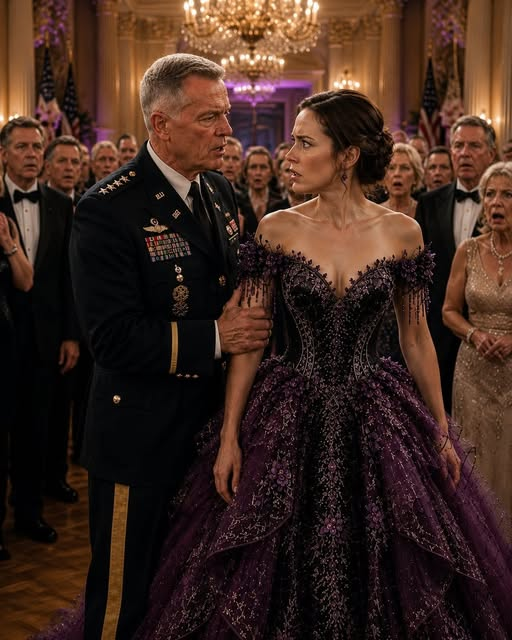
The four-star general’s hand remained lightly on my sleeve.
For a moment, nobody moved.
My father stood beside the birthday cake, his face frozen somewhere between confusion and irritation.
Then the general turned toward the room.
“My name is General Jonathan Hayes,” he said. “And before anyone here decides whether Colonel Rachel Parker is important enough to attend a birthday party, perhaps you should understand why I came to Lancaster tonight.”
A chair scraped against the floor.
My father blinked.
“Colonel?”
I closed my eyes briefly.
There it was.
The first truth he had somehow never bothered to learn.
General Hayes looked at me.
“May I?”
I knew exactly what he meant.
I nodded.
The general faced the guests again.
“Colonel Parker has spent the last twelve years working in Army medical logistics and operational support. Her assignments are not the kind that make local newspapers, and much of what she has done cannot be discussed publicly.”
The room was completely silent now.
No laughter.
No whispers.
Even Coach Reynolds had put down his coffee.
The general continued.
“Two years ago, during an overseas emergency, a field medical network responsible for hundreds of American personnel lost access to its normal supply routes.”
My father stared at me.
I remembered those seventy-two hours.
No sleep.
Constant calls.
Blood-storage units failing.
Vehicles delayed.
Medical teams requesting supplies faster than we could move them.
I had not carried anyone out under gunfire.
I had not kicked down doors.
I had simply done my job.
But sometimes a box arriving at the right place was the difference between someone coming home and someone becoming a folded flag.
General Hayes’s voice softened.
“Colonel Parker reorganized the entire supply chain under emergency conditions. She coordinated evacuation support, medical shipments, and replacement equipment while refusing relief for nearly three days.”
I looked down.
He was leaving out the parts that mattered to me.
The names.
The voices over the radio.
The nurse who cried when the blood finally arrived.
The young soldier whose mother later sent me a handwritten letter because her son came home alive.
General Hayes glanced toward my father.
“Thirty-seven critically injured service members were moved safely through that system.”
Nobody breathed.
“One of them,” he added, “was my son.”
My head snapped toward him.
That part I had not known.
Hayes smiled faintly.
“He was a captain attached to another unit. Colonel Parker never knew who his father was. She treated his evacuation exactly like every other soldier’s.”
My father gripped the edge of the table.
General Hayes looked at me.
“That is why I trust her.”
Then he reached into a leather folder.
“And that is not why I stopped her tonight.”
My stomach tightened.
“Sir?”
He handed me a sealed envelope.
I recognized the Army letterhead.
My pulse changed immediately.
I had been expecting a decision for months, but I had assumed I would receive it through command channels the following week.
Hayes spoke loudly enough for everyone to hear.
“Colonel Rachel Parker has been selected for promotion to brigadier general, pending final confirmation and completion of the required process.”
Someone gasped.
My father sat down.
Actually sat down.
As if his knees had simply stopped working.
The mayor whispered:
“My God.”
General Hayes continued.
“She has also been selected to lead a new medical-readiness initiative coordinating military and civilian emergency support across several regions.”
He looked around the room.
“So when Colonel Parker attempted to leave quietly because she had been told she was not important enough to remain…”
He paused.
“…I decided the truth had been quiet long enough.”
No one applauded immediately.
I was grateful for that.
The silence felt more honest.
Then Paula, the woman at the reception table, began clapping.
Slowly.
One pair of hands.
Then another.
The mayor stood.
Someone behind him stood too.
Within seconds, nearly the entire room was applauding.
I wanted the floor to open beneath me.
Not because I was ashamed.
Because this was exactly what I had never wanted.
I turned toward General Hayes.
“Sir, with respect, this is my father’s birthday.”
Hayes nodded.
“And I am not here to take that away from him.”
Then he looked at my father.
“But respect for one person never requires humiliation of another.”
The applause died.
My father looked older than seventy.
His eyes moved from the stars on Hayes’s shoulders to the insignia on my uniform, as though he were seeing both for the first time.
“Rachel,” he said.
I waited.
“Why didn’t you tell me?”
That question hurt more than everything else that night.
I laughed quietly.
“I did.”
He frowned.
“When?”
“Every time you asked what I was doing and interrupted before I finished.”
He opened his mouth.
I continued.
“When I made major, I called you.”
His face changed.
“You said you were busy.”
I remembered the conversation perfectly.
Dad had been repairing the tractor.
I had said, “I got promoted.”
He had answered, “That’s good, honey. Your brother just made regional sales manager.”
Then he talked about my brother for twenty minutes.
“When I became a lieutenant colonel, I sent you a photograph.”
“I don’t remember.”
“I know.”
My voice was not angry.
That somehow made it worse.
“When I took command, I came home for Thanksgiving.”
“You said you were supervising something.”
“I said I was assuming command.”
He stared at the floor.
“You never listened long enough to understand the difference.”
My aunt Susan quietly began crying.
Dad shook his head.
“I thought you were embarrassed because you never talked about your work.”
“No. I stopped talking because every conversation became a comparison.”
I glanced toward the banner.
VIP GUESTS ONLY.
“You wanted important children.”
His eyes met mine.
“And somewhere along the way, you decided importance meant being visible to people you wanted to impress.”
Nobody moved.
“My brother had newspaper articles. I had classified assignments.”
“Your sister had grandchildren.”
“I had soldiers.”
“The mayor knew your name because you were friends.”
“General Hayes knew mine because I did my job.”
Dad flinched.
I immediately wished I could take back the sharpness.
Not the truth.
Just the blade around it.
My mother would have known the difference.
For several seconds, my father said nothing.
Then his eyes dropped toward my uniform.
“That coin,” he whispered.
I reached into my pocket.
The challenge coin he had asked about that afternoon rested in my palm.
It had belonged to my mother.
Years earlier, during one of my first assignments, I had given her an Army coin. She carried it in her purse until she became too sick to leave the house.
After she died, Dad gave it back to me.
On one side was the Army emblem.
On the other, my mother had scratched three tiny letters with a sewing needle.
R.P.V.
Rachel Parker Vale.
My initials before I stopped using her maiden name professionally.
Dad stared at it.
“She told me you were going to do something important.”
My throat tightened.
“She never cared whether it was important.”
I closed my fingers around the coin.
“She cared whether it mattered to me.”
Something inside my father finally broke.
He looked around at the mayor, the banker, the coach, and all the people he had invited because their presence made him feel significant.
Then he looked at me.
The daughter he had not placed on the list.
“I was cruel to you.”
Nobody rescued him from the sentence.
Not me.
Not General Hayes.
Not Aunt Susan.
He had to sit with it himself.
Finally, I said:
“Yes.”
His eyes filled.
“I don’t know how to fix this.”
“You don’t fix twenty years in one birthday speech.”
He nodded slowly.
“Then where do I start?”
I looked toward the envelope I had dropped in the gift box earlier.
“Open your birthday card.”
Paula retrieved it.
Dad tore the envelope carefully.
Inside was a simple card.
No money.
No grand gift.
Just a photograph.
My mother, sitting at the kitchen table three months before she died.
Dad beside her.
Me behind them in uniform.
On the back, I had written:
You don’t have to understand my life to be proud that I lived it honestly. Happy 70th, Dad.
His hands began shaking.
“I don’t deserve this.”
“It’s a photograph, Dad. Not forgiveness.”
He nodded.
For the first time that evening, I saw no pride in his face.
Only regret.
And strangely, that gave me more hope than an apology.
Because pride always needed an audience.
Regret could exist in silence.
Six months later, my promotion became official.
My father attended the ceremony.
He did not tell anyone he knew important people.
He did not interrupt when officers spoke.
He did not explain my career for me.
He simply sat in the second row holding my mother’s old challenge coin.
Afterward, he approached slowly.
“General Parker.”
I smiled.
“Dad, you can still call me Rachel.”
“I know.”
He looked at the star on my shoulder.
Then at my face.
“I’m trying to learn the difference between being proud of what you are and being proud of who you are.”
That sentence sounded like something my mother might have taught him if she had been given more time.
“So?” I asked.
He swallowed.
“Who are you?”
I thought about it.
Then I smiled.
“Your daughter.”
His eyes filled.
This time, he did not add a title.
He did not mention the Army.
He did not mention the general standing twenty feet away.
He simply opened his arms.
I hesitated.
Then I hugged him.
Not because the past had disappeared.
It hadn’t.
But because forgiveness, I had learned, was not pretending the wound never existed.
It was deciding whether the person who caused it had finally stopped reaching for the knife.
My father once told an entire room that I was not important enough to attend his birthday.
Months later, when strangers asked him what his daughter did, his answer changed completely.
He no longer said:
“She’s in the military.”
He no longer mentioned my rank.
He simply smiled and said:
“Rachel serves people. I should have learned to see her long before everyone else did.”
