Julian stared at Dr. Vance.
“What do you mean she was never infertile?”
Dr. Vance removed several pages from the envelope.
“Exactly what I said.”
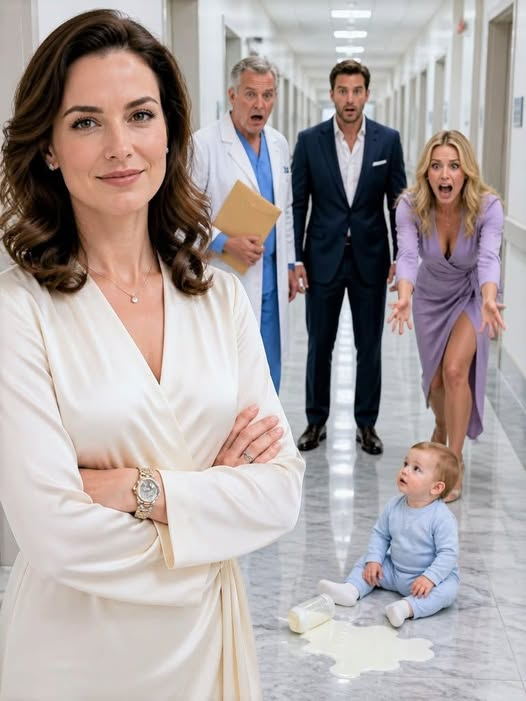
Sienna shifted the baby higher against her chest.
Her hands were trembling now.
Julian noticed.
“Sienna?”
She did not answer.
Dr. Vance continued.
“Clara’s ovarian reserve was normal. Her hormone levels were normal. Imaging showed no structural abnormality that would have prevented pregnancy.”
Julian laughed nervously.
“That’s impossible. We tried for years.”
“I know.”
“Then why didn’t it work?”
Dr. Vance looked at me.
I nodded.
He turned back to Julian.
“Because the problem was never Clara.”
Silence.
Julian’s face slowly changed.
“What are you saying?”
Dr. Vance handed him a laboratory report.
I had seen it three days earlier.
I had cried then.
Not because I still wanted Julian.
Because for years I had been taught to hate my own body for something it had never done wrong.
Julian read the page.
Then read it again.
His hand began shaking.
The report came from the fertility clinic we had used during our marriage.
It contained the results of a semen analysis performed almost two years before our divorce.
The conclusion was clear.
Julian’s chances of naturally fathering a child were extremely low.
He looked up.
“No.”
Dr. Vance remained calm.
“This test was performed twice.”
“I never took this test.”
“You did.”
“I would remember.”
“You were told the blood work was part of the standard fertility review.”
Julian turned toward me.
“Did you know?”
“No.”
That was the point.
Neither of us had known.
Someone had removed the report before it reached our shared file.
Dr. Vance produced another page.
“The clinic’s electronic log shows the result was opened by an employee account eleven minutes after being uploaded.”
Sienna stepped backward.
Julian saw it.
“Sienna.”
Her face crumpled.
“Julian…”
“Why are you looking like that?”
I spoke for the first time.
“Because that employee account belonged to her.”
His head snapped toward me.
“What?”
Sienna had worked at the clinic for fourteen months as an administrative coordinator.
She had been the one who recommended the fertility specialist.
The one who scheduled several of my appointments.
The one who hugged me after failed treatments and whispered that I should not blame myself.
All while knowing the truth.
Julian looked at her as though he no longer recognized her.
“You saw this report?”
She started crying.
“I was going to tell you.”
“When?”
No answer.
“When, Sienna?”
“I panicked.”
Julian’s voice dropped.
“You let me believe Clara was the problem.”
“I didn’t make you blame her.”
That sentence landed harder than anything else.
Because she was right.
Sienna had hidden evidence.
But Julian had chosen cruelty.
He had called me defective.
Broken.
A wife incapable of giving him a family.
He had repeated those words until I began believing them myself.
Dr. Vance looked at him.
“There’s more.”
Sienna closed her eyes.
Julian noticed.
“What else?”
Dr. Vance looked toward the baby.
Then back at Julian.
“Your son was conceived naturally, correct?”
Julian frowned.
“Yes.”
Sienna whispered:
“Please.”
Julian turned.
“Please what?”
Dr. Vance did not touch the child.
He did not need to.
“I cannot disclose another patient’s private medical information without authorization.”
Then he handed Julian one final document.
“But I can tell you why you were contacted.”
It was a consent form.
Signed by Sienna that morning.
Authorization to release a paternity result.
Julian stopped breathing.
“No.”
Sienna began sobbing.
“Julian, listen to me.”
He unfolded the page.
His eyes moved to the final line.
Probability of biological paternity: excluded.
The hallway went completely still.
The one-year-old boy in Sienna’s arms reached for her necklace, unaware that every adult around him had just watched his family change.
Julian looked at Sienna.
“He isn’t mine?”
She cried harder.
“I didn’t know at first.”
“At first?”
“There was someone else.”
His face went white.
“Who?”
She shook her head.
“It doesn’t matter.”
“It mattered when you told everyone I finally had a son!”
Her voice cracked.
“I thought he could be yours.”
“And when did you find out?”
Silence.
Julian’s voice became almost a whisper.
“When?”
“Three months ago.”
He took a step backward.
Three months.
Three months of family photographs.
Birthday preparations.
Interviews where Julian praised Sienna for “giving him the life Clara never could.”
Three months after Sienna already knew the truth.
I watched the arrogance drain out of his face.
But I felt no triumph.
The child was innocent.
And humiliation would not return the years they had taken from me.
I picked up my handbag.
Julian turned toward me.
“Clara.”
I stopped.
He looked completely lost.
“I didn’t know.”
“No.”
My voice remained calm.
“You didn’t.”
Then I looked at him directly.
“But you never needed proof before deciding I was worthless.”
He flinched.
“That was different.”
“No.”
I shook my head.
“That was exactly the problem.”
The truth about my treatment had started unraveling six months earlier.
After the divorce, I requested my complete medical file because I wanted closure.
Several pages were missing.
Dr. Vance noticed inconsistencies.
Dates without results.
Medication adjustments without corresponding laboratory reports.
One cycle in which my prescribed dose had been changed in the clinic system despite no physician signing the change.
That was what triggered the review.
The clinic conducted an internal audit.
Sienna’s employee credentials appeared repeatedly.
Not just on Julian’s hidden result.
On mine.
She had altered appointment notes.
Redirected laboratory correspondence.
And on two occasions, changed the timing instructions attached to my fertility medication schedule.
Dr. Vance could not say those changes were definitely why I did not become pregnant.
Too many medical variables existed.
But he could say one thing clearly:
My treatment had been interfered with.
And Sienna had access.
When confronted, she eventually admitted why.
She had been in love with Julian before our divorce.
She believed that if our treatments continued failing, our marriage would collapse.
She had been right.
Not because infertility destroyed us.
Because Julian allowed resentment to.
Sienna only needed to push where cracks already existed.
The clinic terminated her employment.
The case was referred to the appropriate professional and legal authorities.
I filed a civil claim related to the unauthorized alteration of my medical records.
I did not ask Dr. Vance to destroy anyone.
I asked for documentation.
That was enough.
The charitable foundation Julian and Sienna had taken over became another surprise.
I had founded it before marrying Julian.
Most of the original donor agreements listed me as the program director.
After the divorce, Julian had publicly implied that I stepped away because I was “emotionally unable to continue.”
I had never said that.
Once the truth about my treatment became public through legal proceedings, several major donors contacted me.
Not because they hated Julian.
Because they no longer trusted the story they had been told.
Within months, I established a new organization focusing on patient advocacy and medical-record transparency.
For the first time, the work felt personal in a good way.
Not because I was trying to prove something to my ex-husband.
Because I knew what it felt like to sit in a clinic believing your own body had betrayed you while someone else was quietly changing the information you depended on.
Julian and Sienna separated soon after the paternity result.
He originally wanted nothing to do with the child.
That angered me more than I expected.
One evening, Julian came to my office.
“Why do you care?”
I looked at him.
“About what?”
“The boy.”
“Because he’s one year old.”
“He isn’t mine.”
“He thought you were his father yesterday.”
Julian looked away.
“That isn’t my responsibility.”
I leaned back.
“You spent a year allowing a child to build his entire sense of safety around you.”
“I was lied to.”
“So was he.”
Julian said nothing.
I continued.
“You don’t have to remain his legal father if that isn’t appropriate. That is for the courts and his parents to resolve.”
Then I looked directly at him.
“But don’t turn your pain into cruelty and pretend it’s justice.”
That sentence silenced him.
Perhaps because he had done exactly that to me.
Weeks later, he began attending counseling.
Not for me.
For himself.
Eventually, he agreed to a gradual transition rather than disappearing from the boy’s life overnight while Sienna and the biological father worked out the legal situation.
For once, Julian chose not to punish someone innocent for another adult’s betrayal.
It did not make him a good husband retroactively.
But it was the first decent thing I had seen him do in a long time.
A year after the hospital encounter, Julian asked to meet me.
We sat in a quiet café.
No lawyers.
No Sienna.
No audience.
He looked older.
“I owe you an apology.”
“Yes.”
He almost smiled.
“You’re not going to make this easy.”
“I spent years making things easy for you.”
He nodded.
“Fair.”
Then he said:
“I blamed you because I was terrified the problem might be me.”
I listened.
“When every treatment failed, I needed someone to blame.”
“So you chose me.”
“Yes.”
“And Sienna?”
“She told me exactly what I wanted to hear.”
“That I deserved better.”
He lowered his eyes.
“Yes.”
I thought about the man in the hospital hallway proudly announcing that leaving me was the smartest decision of his life.
“Do you regret divorcing me?”
He looked at me.
“Yes.”
“I don’t.”
That hurt him.
But I meant it.
“If none of this had happened,” I continued, “we might have stayed married another ten years.”
“Would that have been bad?”
“Yes.”
I smiled sadly.
“Because I would have spent those years trying to earn kindness from someone who only gave it when life went the way he wanted.”
Julian closed his eyes.
“I really did love you.”
“I believe you.”
He looked surprised.
“Then why does that sound so final?”
“Because love without respect eventually becomes another form of loneliness.”
There was nothing more to say.
People often asked me later whether learning I was fertile made me want children again.
For a long time, I did not know.
Then, two years after the truth came out, I became a mother.
Not because I needed to prove anything to Julian.
Not because my body had to redeem itself.
I chose motherhood when my life was finally quiet enough that the decision belonged only to me.
My daughter was born on a rainy spring morning.
Dr. Vance sent flowers.
The card contained one sentence:
Some truths arrive late. They still matter.
I kept it.
I never saw Sienna again.
I heard she rebuilt her life somewhere else and eventually stopped fighting the consequences of what she had done.
I hoped she became better.
Not for me.
For her son.
Julian became less arrogant with time.
We were never friends.
But when we crossed paths, he no longer looked at me like the woman who had failed to give him something.
That woman had never existed.
She was a story he created because it protected his pride.
The hospital hallway destroyed that story in less than ten minutes.
He walked in believing he had won.
A new wife.
A son.
A perfect family.
And an infertile ex-wife he could humiliate one final time.
Then Dr. Vance opened a sealed envelope.
And suddenly Julian learned three truths at once.
I had never been infertile.
Sienna had known his diagnosis.
And the child he used to prove I was the problem was not biologically his.
But the greatest truth was mine.
For years, I thought my body had failed my marriage.
It hadn’t.
My marriage failed me.
And once I understood that, I stopped asking why Julian had chosen someone else.
I started being grateful that, eventually—
I had finally chosen myself.
