The following morning, Jacinta found an envelope pinned to her door with a knife.
The municipal court seal was enough to make her stomach tighten. Rogaciano had carried out his threat. He was requesting that she be declared incapable of managing her inheritance and asking to be appointed temporary administrator of the land.
Among the attached documents was a statement signed by her two cousins and a medical certificate describing her as suffering from “obsessive behavior, social isolation, and economically irrational decision-making.”
The doctor who signed it had never examined Jacinta.
She placed the document inside her bag, gathered Anselmo’s notebooks, and traveled to Zacatecas. There she found Soledad Vélez, an attorney from the agrarian public defender’s office, who read every page without raising her eyes.
“They want to make you look unstable before the debt comes due,” Soledad said. “If the bank seizes the property while your uncle controls the inheritance, he can arrange its sale to Evaristo.”
“Can they really do that?”
“They can try. But they will have to explain why a supposedly incapable woman keeps receipts, plans, photographs, and a daily record more organized than that of any wealthy landowner.”
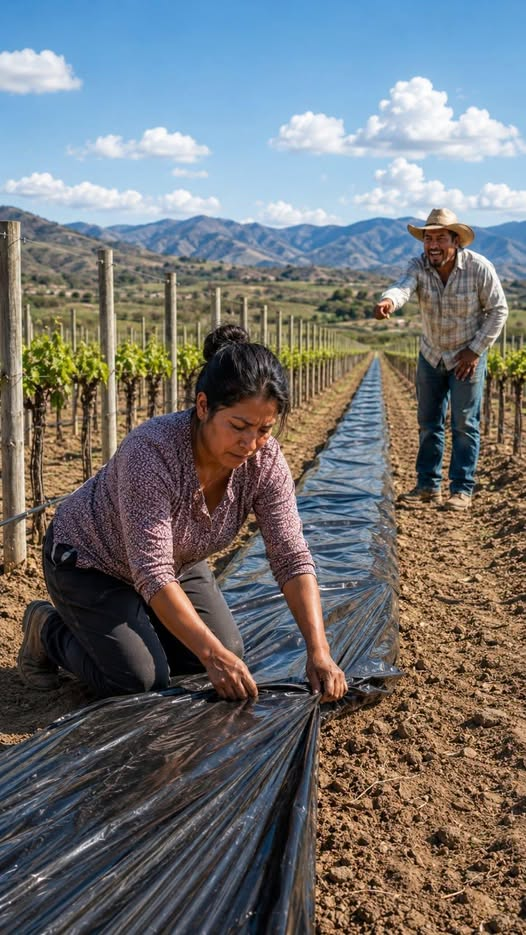
Soledad instructed her to document everything. Jacinta began photographing the trench, the geomembrane, the layers of soil, and even the wounds across her hands. She also filed a complaint against the doctor who had issued the false certificate.
Three weeks later, the first storm arrived.
The sky turned black above the hills, and water rushed through El Mezquite with enough force to drag stones along the streambed. Rogaciano appeared wearing a raincoat, accompanied by Evaristo, both of them convinced that the current would tear out the buried liner and expose Jacinta’s madness.
But the surface water passed.
The sand settled again.
Four days later, when Jacinta opened a test hole behind the barrier, she found dark, damp soil less than half a meter below the surface.
The dry stream was storing water beneath her feet.
She planted beans, amaranth, and squash in a narrow strip of land. The harvest was not abundant, but it was enough to pay part of the debt. When she carried the sacks to market, several neighbors who had once mocked her began asking questions.
Evaristo asked nothing.
He only watched.
One morning before sunrise, Jacinta discovered a twelve-inch cut near the upper edge of the geomembrane. Fresh footprints surrounded it, along with shovel marks and tire tracks from a truck that had entered through the northern boundary.
She repaired the damage without telling anyone.
Then she hung small bells among the mesquite trees and concealed an old camera nearby. Two nights later, the camera captured headlights approaching the stream. The image was blurry, but it showed a dark truck and a man wearing a wide-brimmed hat.
A chrome stripe gleamed along the door—identical to the one on Evaristo’s vehicle.
Soledad warned her not to confront him yet.
“Suspicion will not stop a man with money. We need to discover what he is truly looking for.”
Four years passed.
Jacinta paid off the debt, repaired the adobe house, and turned six bags of seeds into a community seed bank that supplied twelve families. She planted pomegranate trees, prickly pears, and peach trees above the damp ground.
The village stopped calling her crazy.
Now people came to her to learn how to preserve water.
Rogaciano, however, never spoke to her as family again. Every few months, he returned with another offer to buy the property, each one higher than the last. Evaristo did the same.
Jacinta rejected them all.
Then the worst drought the region had suffered in decades arrived.
Reservoirs emptied. Cattle collapsed beside the roads. Evaristo’s deep well lost pressure until it produced nothing but mud. By August, water trucks had to supply the village.
Yet beside El Mezquite, Jacinta’s trees remained green.
That narrow strip of life in the middle of the dead landscape awakened more greed than admiration.
Evaristo filed a complaint claiming that the underground dam was diverting water away from his property. Two inspectors arrived with old maps and an engineer from the state water authority.
“If there is a shared underground current, we will need to determine its source,” the engineer explained. “No one is allowed to take control of a waterway belonging to someone else.”
Jacinta showed him her father’s notebooks.
The engineer examined them for hours. When he reached the final pages, he frowned.
“Three sheets are missing.”
Jacinta already knew. Their edges had been cut cleanly with a blade years earlier.
“My father never told me what was written on them.”
The engineer spread a map from 1978 across the table. A blue line began in the hills, crossed Anselmo’s land, and disappeared beneath Evaristo’s ranch.
“This does not look like a natural stream,” he murmured. “It looks like a constructed channel.”
That afternoon, they excavated upstream. Nearly two meters below the surface, they found stones that had been carefully placed by hand. Beneath them ran an old clay pipe sealed with lime.
The pipe did not carry water toward Jacinta’s land.
It removed water from her property and redirected it toward Evaristo’s fields.
The engineer stopped the excavation and announced that he would return with an official court order. Before leaving, he pointed toward a rectangular stone slab hidden beneath the clay.
Two initials were carved into one corner:
A. L.
Anselmo Luján.
Jacinta could not sleep that night.
At nearly two in the morning, the bells among the mesquite trees began to ring.
She stepped outside carrying a flashlight and found Rogaciano beside the slab. Evaristo stood behind him, gripping an iron bar. They had lifted the stone and exposed a narrow cavity beneath it.
Inside rested a rust-covered iron box.
“Step away from it,” Jacinta ordered.
Rogaciano looked at her without surprise.
“Your father should have destroyed that when he had the chance.”
Jacinta raised her phone and began recording.
Evaristo moved one step closer.
“You have no idea what is inside.”
“Then let me see it.”
Rogaciano smiled, but there was no mockery left in his expression.
There was fear.
“If you open that box, you will discover that your father did not leave you only eighteen hectares.”
Jacinta slid the edge of her shovel beneath the rusted lid.
The metal gave way with a long groan.
Inside lay a map, a blackened key, and a document wrapped in leather. A notary’s seal appeared on the first page, beside a date written only three days before Anselmo’s death.
Jacinta barely managed to read the first line.
Then she felt the cold barrel of a shotgun press against her back.
“Close the box,” said a voice that belonged to neither Rogaciano nor Evaristo.
“That inheritance was never supposed to reach your hands.”
