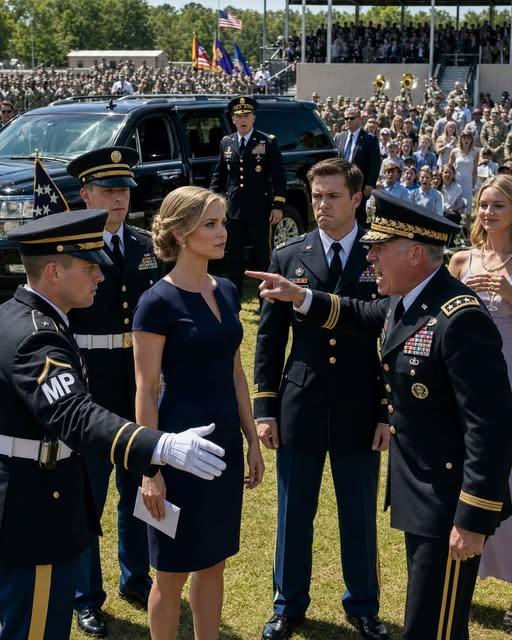
The black SUV stopped behind the reviewing stand.
Every officer near the platform straightened.
The rear door opened.
General Nathaniel Cross stepped out.
Four stars gleamed on his shoulders.
Harlan Wade’s expression changed instantly.
He turned away from me, adjusted his jacket, and moved forward with the polished smile of a man who had spent thirty-seven years knowing exactly when power had entered a room.
“General Cross,” Harlan called. “Sir, I wasn’t informed you would be attending.”
Cross barely looked at him.
His eyes were on me.
More specifically, on the way I stood.
My feet.
My shoulders.
The folded envelope in my hand.
Then his gaze dropped to a thin scar near my wrist.
He stopped walking.
The officers around him nearly collided.
For several seconds, the four-star general simply stared.
Then he whispered:
“Reaper Two.”
The young MP beside me went rigid.
Matthew’s head snapped toward the general.
Harlan frowned.
“Sir?”
Cross ignored him.
He walked directly toward me.
I had not seen Nathaniel Cross in almost nine years.
Back then, he had been a two-star with darker hair and an expression that made entire briefing rooms fall silent.
Now he stopped three feet away.
“Mercer?”
I swallowed.
“Yes, sir.”
His face tightened.
“We were told you were dead.”
The parade field seemed to lose all sound.
Harlan laughed awkwardly.
“I’m afraid there’s some confusion. This is Emma Wade. My son’s wife.”
Cross slowly turned toward him.
“No.”
His voice was quiet.
“This is Emma Mercer.”
Then he looked back at me.
“Former Chief Warrant Officer Mercer.”
Matthew’s face went white.
His sister lowered her champagne glass.
His mother finally looked up.
Harlan blinked.
“Chief Warrant Officer?”
Cross’s expression hardened.
“Reaper Two.”
That callsign meant nothing to most of the families gathered there.
It meant something to several senior officers.
I saw recognition moving through them one face at a time.
A colonel near the band whispered something to the officer beside him.
Another man straightened.
Harlan noticed.
“What exactly is going on?”
General Cross looked at the MPs.
“Stand down.”
Harlan’s face reddened.
“Sir, I ordered her removed.”
Cross stared at him.
“And I just countermanded that order.”
The MPs immediately stepped away.
Nobody looked at Harlan.
That might have been the first moment he truly understood that his retirement ceremony no longer belonged to him.
Matthew walked toward me.
“Emma… what is he talking about?”
I looked at my husband.
Six years.
Six years married to me.
He knew I hated fireworks.
He knew I woke instantly when doors opened at night.
He knew I never sat with my back toward a crowded entrance.
He knew I could read grid coordinates faster than he could.
He had simply never asked why.
“I served before we met.”
Matthew looked stunned.
“You told me you worked overseas.”
“I did.”
“As what?”
General Cross answered for me.
“She was attached to a joint reconnaissance program.”
Harlan scoffed.
“That makes no sense. Her records say she was a civilian contractor.”
“They were supposed to.”
Cross turned toward him.
“For operational reasons.”
A long silence followed.
Then Harlan said the worst possible thing.
“So she lied to my son.”
I almost smiled.
Of course.
Presented with evidence that everything he believed about me was wrong, Harlan still found a way to make me the problem.
General Cross did not smile.
“General Wade, some service records remain restricted for reasons far above your former clearance.”
Former.
The word landed hard.
Harlan heard it too.
Cross continued.
“Mrs. Wade was part of a small aviation reconnaissance element during operations overseas. Her aircraft helped identify a convoy moving toward an exposed American position.”
He looked at me.
“That warning gave us time to move.”
I lowered my eyes.
I did not want the story told here.
Not like this.
Not in front of children holding melting popsicles.
Cross understood.
He stopped.
No dramatic battle details.
No legends.
Just one sentence.
“People came home because she did her job.”
Nobody laughed after that.
Harlan stared at me as if I had become someone else.
But I hadn’t.
That was the point.
I had always been the same woman.
He had simply decided a mechanic’s daughter and former waitress could not possibly contain anything worth respecting.
Matthew stepped closer.
“Why didn’t you tell me?”
Before I could answer, Harlan interrupted.
“Exactly.”
He pointed at me.
“My son had a right to know who he married.”
I looked at him.
“So did I.”
Matthew froze.
My fingers tightened around the envelope.
That was why I had come.
Not for Harlan’s retirement.
Not for his approval.
For Matthew.
I held the envelope out.
His eyes dropped to it.
“What is that?”
“Your transfer request.”
His face changed.
Harlan looked sharply at his son.
Matthew didn’t take the envelope.
“Emma.”
“I found it three days ago.”
Matthew had applied for a prestigious assignment overseas.
Not unusual.
Except he had listed his marital status as separated.
We were not separated.
He had also named his father’s address as his permanent residence and removed me from the family accommodation request.
Then I found the messages.
His mother.
His sister.
Harlan.
All discussing how much easier Matthew’s career would become once I was gone.
And one other woman.
Lieutenant Colonel Rebecca Shaw.
The woman Harlan wanted his son to marry.
Matthew whispered:
“It wasn’t final.”
“You submitted it.”
“I was going to tell you.”
“When?”
He said nothing.
I looked toward his father.
“After today?”
Harlan’s jaw tightened.
“This is not the place.”
“No.”
I nodded.
“It became the place when you had MPs surround me in front of three hundred people.”
General Cross’s eyes moved to Matthew.
“Captain, did you knowingly submit false family information?”
Matthew went pale.
“Sir, I can explain.”
Cross’s expression became unreadable.
“That is generally what people say immediately before giving an explanation they should have offered earlier.”
Harlan stepped forward.
“Nathaniel, this is a family matter.”
General Cross turned.
Nathaniel.
The familiarity surprised everyone.
Cross studied him for a long moment.
“Harlan, that excuse has protected you for too many years.”
Now it was Harlan who went still.
I had wondered whether Cross knew him personally.
Apparently he did.
Cross lowered his voice.
“You contacted my office four months ago requesting consideration for your son’s assignment.”
Matthew looked at his father.
“What?”
Harlan said nothing.
Cross continued.
“You suggested Captain Wade’s marriage was unstable and implied certain family circumstances made him a better candidate if reassigned.”
The silence became brutal.
Matthew stared at Harlan.
“You did what?”
His mother finally spoke.
“Your father was helping you.”
“I didn’t ask him to.”
Harlan snapped:
“You didn’t have to.”
There it was.
The sentence that explained the entire Wade family.
Harlan decided.
Everyone else obeyed.
He decided where Matthew served.
Who belonged at family dinners.
What kind of woman deserved the Wade surname.
And apparently, whether my marriage should survive.
I almost felt sorry for Matthew.
Almost.
Then I remembered the transfer paperwork.
He had still signed it.
General Cross looked at me.
“Is that why you came?”
“Partly.”
I opened my handbag and removed another envelope.
Matthew recognized the legal letterhead immediately.
His face collapsed.
“Emma.”
“Divorce petition.”
His mother gasped.
His sister whispered:
“You can’t be serious.”
I looked at Matthew.
“I asked you last night whether there was anything you needed to tell me.”
He closed his eyes.
“I know.”
“You said no.”
“I was scared.”
“Of me?”
“Of losing everything.”
I looked around.
His father’s ceremony.
The officers.
The family name.
The career Harlan had designed for him.
“You were afraid of losing this.”
Matthew did not answer.
That was answer enough.
I placed the papers in his hand.
“I was afraid of losing you.”
My voice stayed calm.
“But fear is not an excuse to make someone else live inside a lie.”
For the first time, Harlan seemed almost uncertain.
“Emma, think carefully.”
I turned toward him.
“You ordered armed MPs to remove me from a retirement ceremony because I embarrassed your bloodline.”
His face reddened.
I continued.
“Your bloodline will survive my absence.”
A few people looked down to hide their reactions.
General Cross almost smiled.
Then Harlan noticed the insignia pin attached to the inside of my envelope.
Small.
Black.
A faded silver number two.
His eyes narrowed.
“What is that?”
Cross answered.
“A piece of a unit patch.”
Harlan looked between us.
“You kept that?”
I touched it once.
“It belonged to someone who didn’t come home.”
That ended the questions.
Cross’s expression softened.
“Mercer.”
“Yes, sir?”
“You disappeared after the program closed.”
“I wanted a normal life.”
He glanced toward Matthew.
“How’d that work out?”
Despite everything, I laughed.
One short laugh.
“Still evaluating, sir.”
Around us, tension finally cracked.
Then General Cross did something nobody expected.
He extended his hand.
Not ceremonially.
Simply.
From one veteran to another.
“It’s good to know you’re alive.”
I took it.
“Thank you, sir.”
He released my hand and faced Harlan.
“As for your ceremony, General Wade…”
Harlan straightened instinctively.
Cross looked at the reviewing stand.
The band.
The assembled soldiers.
Then back at the man who had tried to throw me away minutes earlier.
“Finish it.”
Harlan blinked.
“That’s all?”
“No.”
Cross’s voice sharpened.
“Afterward, my office will review the communications connected to Captain Wade’s assignment request.”
Matthew swallowed.
“And the attempt to use command influence in a personal family dispute.”
Harlan’s face drained.
“Sir—”
“Finish your ceremony.”
Cross walked away.
For thirty-seven years, Harlan Wade had built his identity around command.
That afternoon, he retired knowing the final official review connected to his career had begun because he could not resist using that authority against his own daughter-in-law.
I did not stay for the speeches.
Matthew followed me toward the parking lot.
“Emma.”
I stopped but did not turn.
“Please.”
I looked back.
His eyes were wet.
“I didn’t know.”
“About my service?”
“Yes.”
“That isn’t why we’re divorcing.”
He nodded slowly.
“I know.”
Good.
At least he understood one thing.
“I let my father make too many decisions for me.”
“Yes.”
“I thought if I could get the assignment first, I could figure everything else out later.”
“And I was everything else.”
His face broke.
“No.”
“That is exactly what I was.”
He stepped closer.
“I love you.”
I believed him.
That made it sadder.
“I love you too.”
Hope appeared.
Then I shook my head.
“But I don’t trust you.”
Hope vanished.
Love could survive embarrassment.
Arguments.
Distance.
It could not survive indefinitely without trust.
I handed him my wedding ring.
He stared at it.
“I don’t want this.”
“Neither did I.”
I closed his fingers around it.
Then I walked away.
Seven months later, our divorce was final.
Matthew did not fight it.
Harlan’s conduct review did not erase thirty-seven years of service, nor should it have.
But it documented inappropriate attempts to influence his son’s assignment process.
Matthew withdrew the request voluntarily.
For the first time in his career, he made a decision without asking his father.
His mother wrote me one letter.
I never answered.
General Cross wrote one too.
His was three sentences.
The last said:
YOU WERE NEVER FORGOTTEN.
I kept that one.
A year after Harlan’s retirement, I returned to Fort Bellamy for a completely different reason.
Not as anyone’s wife.
A veterans’ aviation program had asked me to speak privately with a group of young service members transitioning out of specialized assignments.
No cameras.
No ceremony.
Exactly how I preferred it.
When I finished, a young sergeant approached.
Rodriguez.
The MP who had been ordered to remove me.
He looked embarrassed.
“Ma’am, I’ve wanted to apologize.”
“For following an order?”
“For almost following the wrong one.”
I smiled.
“You stopped when you were told to stop.”
He nodded.
Then his eyes dropped to the small black pin on my jacket.
“Reaper Two?”
I looked at it.
For years, that name belonged to a version of me I thought had disappeared.
A woman before Matthew.
Before Harlan.
Before six years spent trying to fit inside somebody else’s definition of family.
“Yes.”
Rodriguez smiled.
“Good to finally meet you.”
I walked outside.
The same Georgia heat hung over the parade field.
Flags moved in the wind.
Somewhere in the distance, a helicopter crossed the sky.
I watched until it disappeared.
Harlan Wade had tried to throw me off his base because he thought I was nobody.
He had been wrong about two things.
It was never his base.
And I had never been nobody.
I simply spent six years loving a family that never bothered to ask who I was.
