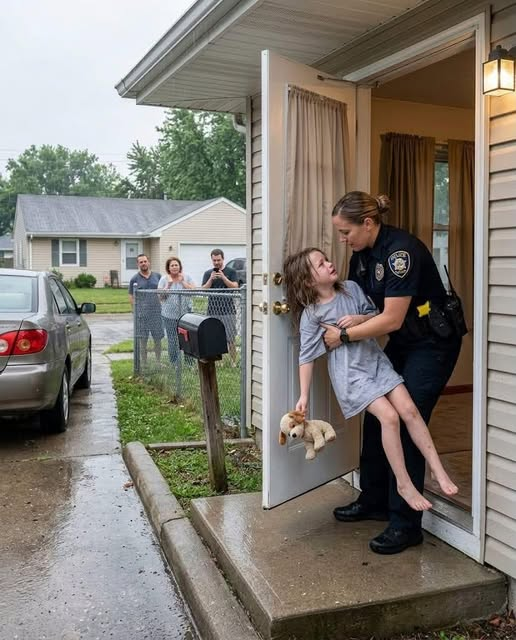
Officer Natalie stayed beside Ashley until the ambulance doors closed.
The girl regained consciousness briefly before they reached the hospital.
Her first question was not about herself.
“Did Daddy come back?”
Natalie hesitated.
“Not yet.”
Ashley tightened her fingers around Buddy.
“He promised.”
Those two words stayed with Natalie.
Andrew had promised thirty minutes.
Not tomorrow.
Not someday.
Thirty minutes.
And everything inside the little rental house suggested he had intended to keep that promise.
The grocery list.
Ashley’s medication.
The Monday appointment.
His wallet was missing, but his passport remained in the bedroom.
His clothes were still hanging in the closet.
His work laptop sat charging beside the couch.
There was no packed suitcase.
No farewell letter.
No evidence of a man preparing to disappear.
Yet four days had passed.
Something had happened.
By midnight, Andrew’s disappearance was officially treated as a missing-person case rather than suspected abandonment.
Then Natalie learned something important.
The rain had started the same evening Andrew left.
Not ordinary rain.
A severe storm had flooded several rural roads outside town.
One of them was the route between Ashley’s house, the pharmacy, and the twenty-four-hour grocery store.
Natalie pulled up traffic-camera records.
At 6:18 p.m., Andrew’s old blue pickup appeared at an intersection.
At 6:24, it passed the pharmacy.
At 6:31, a store camera recorded him buying children’s fever medicine, electrolyte drinks, bread, canned soup, and bananas.
He had been carrying exactly what was written on the note.
The cashier remembered him.
“He seemed nervous,” she told police.
“About what?”
“His daughter. He kept checking the time.”
That mattered.
Andrew had not been running away.
He had been rushing home.
But he never arrived.
The next morning, rescue teams began searching the flooded roads.
News of Ashley’s rescue had already spread.
So had the accusations.
Online posts called Andrew heartless.
Neighbors gave interviews.
One man told a reporter:
“Any father who leaves a seven-year-old alone for four days doesn’t deserve her.”
Natalie watched the clip once.
Then turned it off.
People liked simple villains.
They required less patience than complicated truth.
At 10:42 a.m., a county rescue worker radioed from an old service road near Willow Creek.
“We found tire marks.”
The road had been closed since the storm.
Mud covered most of the shoulder.
A section of guardrail was bent outward.
Below it, floodwater moved through thick trees.
Natalie arrived twenty minutes later.
Search teams were already descending the slope.
Then someone shouted.
“There!”
Part of a blue pickup was visible between branches near the swollen creek.
The truck had left the roadway.
The front end was trapped beneath fallen limbs.
One door stood open.
Andrew was not inside.
But the groceries were.
A crushed loaf of bread.
A torn pharmacy bag.
Ashley’s medication.
All still in the truck.
Natalie stared at them.
The thirty-minute promise had ended here.
The search expanded immediately.
Then a firefighter found footprints farther downstream.
One set.
Adult.
Uneven.
They continued for almost half a mile before disappearing near an abandoned maintenance shed.
Inside, rescuers found Andrew Carter.
Alive.
Barely conscious.
Cold, exhausted, and unable to stand without help.
The first thing he said when they reached him was:
“Ashley.”
A paramedic leaned closer.
“Your daughter is safe.”
Andrew closed his eyes.
Then he cried.
At the hospital, Natalie learned what had happened.
Andrew remembered losing control when another vehicle approached through standing water.
He swerved.
The truck went through the damaged guardrail.
He escaped before the water rose higher, but his phone had been destroyed.
He tried climbing back toward the road.
Then he became disoriented in the storm.
He had suffered an injury that made walking difficult and eventually took shelter in the maintenance shed.
He believed rescuers would find the truck quickly.
They didn’t.
Floodwater hid it from the road.
The storm disrupted cellular service.
And because Andrew and Ashley had only moved into the rental house three weeks earlier, very few people knew their routines.
He had no nearby relatives.
No close neighbors.
No one realized Ashley was alone.
Natalie sat beside his hospital bed.
“Why didn’t you arrange someone to check on her?”
Andrew looked ashamed.
“I thought I would be gone half an hour.”
He swallowed.
“Her babysitter canceled. Ashley had a fever. I needed the medicine.”
His eyes filled again.
“I told her to lock the door and not answer anyone except me.”
Natalie said nothing.
There were still questions authorities would need to review.
Leaving a seven-year-old alone, even briefly, had been a serious decision.
But that was very different from deliberately disappearing for four days.
Andrew turned his head.
“Does she think I left her?”
Natalie remembered Ashley staring through the curtain at every passing vehicle.
“She kept waiting for you.”
Andrew covered his face.
Father and daughter were reunited the next afternoon.
Doctors made sure both were stable first.
Ashley sat in the pediatric ward wearing hospital pajamas with Buddy tucked under one arm.
When Andrew entered in a wheelchair, she stared at him.
She didn’t move.
“Sweetheart.”
His voice broke.
Ashley’s lower lip trembled.
“You said thirty minutes.”
“I know.”
“You took four days.”
“I know.”
“Why?”
Andrew reached toward her, then stopped.
He waited.
“I tried to come home.”
Ashley stared at him.
“The truck went off the road. I couldn’t call you.”
She looked toward Natalie.
“Is that true?”
Natalie nodded.
“They found your medicine in his truck.”
Ashley looked back at her father.
Then she climbed off the bed.
For one terrible second, Andrew seemed afraid she might walk away.
Instead, she ran to him.
He wrapped his arms around her carefully.
“I thought you didn’t want me anymore,” she whispered.
Andrew’s face collapsed.
“Never.”
He held her tighter.
“Never, Ashley.”
Buddy was trapped awkwardly between them.
Neither cared.
The official investigation took several weeks.
Authorities reviewed Andrew’s actions before the accident.
They also examined whether Ashley had adequate support.
The conclusion was uncomfortable but clear.
Andrew had made a poor decision leaving his young daughter alone, even for what he expected to be a short trip.
But he had not abandoned her.
The four-day disappearance had been caused by the crash, the flooding, and his inability to reach help.
The public story changed.
The same people who had called him a monster now called him unlucky.
Some apologized.
Many didn’t.
Natalie noticed that too.
One neighbor who had spoken harshly to reporters came to the hospital carrying flowers.
Andrew accepted them.
But he said:
“Next time you think a child is alone, don’t wait four days to judge the parent.”
The man looked confused.
Andrew continued:
“Knock on the door.”
That sentence spread farther than any accusation had.
Because it revealed another truth.
Ashley had lived surrounded by houses.
People had noticed the curtains stayed closed.
One neighbor heard her television at unusual hours.
Another noticed Andrew’s truck was gone.
Someone even saw Ashley looking through the window twice.
Nobody checked.
They assumed.
They discussed.
They posted online.
But nobody knocked.
Six months later, Ashley and Andrew moved closer to her aunt.
There was a new rule.
Ashley was never left alone.
Not for thirty minutes.
Not for five.
Andrew created a written emergency contact list and placed one copy beside the refrigerator and another inside Ashley’s backpack.
Natalie visited once.
Ashley opened the door carrying Buddy.
“You came!”
“I promised.”
Ashley smiled.
“Promises are serious.”
Natalie laughed.
“I’ve heard.”
Andrew appeared behind her.
He was walking normally again.
The scars from those four days were less visible now.
The guilt was not.
Before Natalie left, Andrew stopped her at the porch.
“Thank you for not deciding what kind of father I was before you knew what happened.”
Natalie looked toward Ashley.
“I didn’t know.”
“That’s exactly why.”
A year after the 911 call, Ashley’s class had an assignment.
Write about someone brave.
Most children chose firefighters.
Athletes.
Superheroes.
Ashley chose her father.
Her teacher expected the story to be about the flood.
It wasn’t.
Ashley wrote:
“My dad was brave because he kept trying to come home.”
Then beneath it, in smaller handwriting:
“I was brave because I called 911.”
Andrew framed the paper.
He placed it beside the grocery list recovered from the truck.
Rice.
Chicken.
Electrolyte drinks.
Medicine.
A few ordinary items written by a father expecting to be home before dinner.
For four days, an entire neighborhood looked at an empty driveway and believed they understood the story.
They didn’t.
Sometimes the person who fails to come home is not the person who chose to leave.
And sometimes, before deciding who deserves blame, the most important thing anyone can do is simply ask what happened.
