For several seconds, nobody moved.
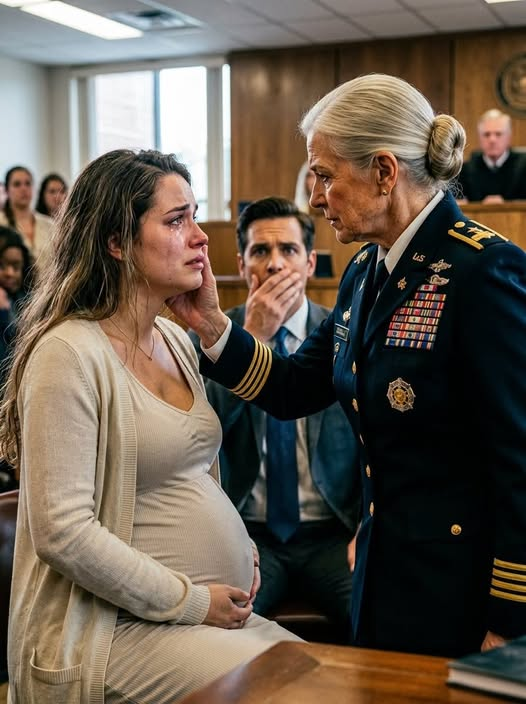
General Eleanor Sterling still had one hand against my cheek.
I stared into her eyes.
My eyes.
“No,” I whispered. “My mother abandoned me.”
Eleanor’s face crumpled.
“I never abandoned you.”
Judge Carter leaned forward.
“General, perhaps we should establish exactly what you’re claiming.”
Eleanor turned.
“I’m claiming that Clara Hayes was taken from me thirty years ago.”
Julian laughed nervously.
“This is insane.”
Eleanor didn’t even look at him.
One of the officers behind her stepped forward carrying a sealed case.
Eleanor opened it.
Inside were photographs.
Hospital documents.
A birth certificate.
And a tiny silver bracelet.
My knees weakened when I saw the engraving.
CLARA E. STERLING.
“I was twenty-four when you were born,” Eleanor said. “Your father and I weren’t married. My family considered the pregnancy a disgrace.”
Her voice hardened.
“My father had influence. Money. Connections.”
Three days after giving birth, Eleanor had been told her newborn daughter had developed complications and died.
There had been a funeral.
A tiny closed coffin.
She had believed it for almost thirty years.
Until six months ago.
“My father died last year,” she continued. “His attorney sent me documents from a private archive.”
Her hands trembled.
“There was no death certificate.”
I stopped breathing.
“There was an adoption transfer.”
The courtroom went silent.
“You were alive.”
I pressed a hand against my mouth.
“My father arranged for you to disappear into a private adoption network. Something went wrong with the placement, and eventually you entered foster care under a different surname.”
Memories flashed through me.
Different houses.
Different bedrooms.
Trash bags filled with my belongings.
Birthdays nobody remembered.
All those nights wondering why my mother had never come.
“She looked for me?” I whispered.
Eleanor’s eyes filled again.
“From the moment I learned you might be alive.”
Julian stood abruptly.
“This has nothing to do with our divorce.”
Eleanor finally turned toward him.
“No?”
His confidence faltered.
“No.”
Eleanor looked at the documents on his table.
Then at me.
“What did he take?”
I shook my head.
“Mom…”
The word escaped before I could stop it.
Eleanor froze.
So did I.
Something changed in her face.
Not triumph.
Something softer.
Almost unbearable.
I swallowed.
“He got the house. The accounts. Everything.”
Julian interrupted.
“Legally.”
My attorney, Rachel Moore, looked exhausted.
“The marital agreement placed most assets under Mr. Hayes’s control.”
Eleanor’s expression changed.
“What marital agreement?”
Julian went pale.
That was the first moment I noticed it.
Fear.
Eleanor noticed too.
“Clara,” she said, “when did you sign it?”
“Three weeks before our wedding.”
“Where?”
“At Julian’s family attorney’s office.”
“And did you have independent counsel?”
I hesitated.
“No.”
Julian immediately said:
“She chose not to.”
I looked at him.
That wasn’t how I remembered it.
He had told me hiring another attorney would be insulting.
Don’t you trust me?
I had been twenty-three.
No family.
No money.
Desperate to finally belong somewhere.
So I signed.
Eleanor looked toward one of the officers.
A civilian investigator stepped forward.
“General, there’s something else.”
He placed another folder before Judge Carter.
Julian’s attorney stood.
“I object to whatever this performance is.”
Judge Carter opened the folder.
His expression changed.
“What am I looking at?”
The investigator answered.
“Financial records associated with the Sterling family trust.”
I stared at him.
“What trust?”
Eleanor turned back to me.
“The one created for you.”
My biological grandmother had never agreed with what happened.
She discovered years later that I had survived.
But by then, the records connecting me to Eleanor had disappeared.
She created a protected trust anyway.
If I was ever located and my identity confirmed, it would become mine.
I felt dizzy.
“How much?”
Eleanor didn’t answer.
The investigator did.
“Current valuation is approximately forty-eight million dollars.”
Julian sat down.
Hard.
I almost laughed.
Not because forty-eight million dollars suddenly fixed my life.
But because Julian had spent years convincing me that without him, I was nothing.
And somewhere, all that time, my name had been sitting on an inheritance he could never touch.
Judge Carter removed his glasses.
“Has maternity been legally established?”
Eleanor nodded.
“Court-approved DNA confirmation was completed this morning using Clara’s archived hospital sample from her current pregnancy screening, pursuant to the identification proceedings already underway.”
The judge studied the papers.
Then looked at me.
“Mrs. Hayes, it appears today’s ruling concerns marital property only. Any separately inherited assets would require independent legal consideration and may not be part of the marital estate.”
Julian shot to his feet.
“She’s my wife!”
I looked at him.
“Not anymore.”
His mouth closed.
But Eleanor wasn’t finished.
She turned toward Julian.
“My investigators reviewed Clara’s finances after we identified her.”
His attorney immediately interrupted.
“General—”
“And we found something interesting.”
She placed three bank statements on the table.
Money had been transferred from accounts containing income I had earned before marriage.
The funds had moved through Julian’s company.
Then into accounts controlled solely by him.
My attorney stared at the pages.
“We requested these records.”
“I know,” Eleanor said.
“Mr. Hayes failed to disclose them.”
Judge Carter’s expression darkened.
Julian began talking quickly.
“They were investments. Clara knew about them.”
I stared at him.
“No, I didn’t.”
“They benefited our household.”
“No.”
For years Julian had handled everything.
Whenever I asked about money, he told me not to worry.
Whenever I wanted access, he accused me of being ungrateful.
Now I understood why.
Judge Carter looked toward the clerk.
“The court will temporarily stay enforcement of the disputed financial portions of today’s order pending review of the newly presented records.”
Julian went completely still.
His victory had lasted less than twenty minutes.
Outside the courthouse, snow covered the steps.
Eleanor removed her military coat and placed it around my shoulders.
“You’ll freeze.”
I looked at her.
Thirty years.
I wanted to hug her.
I wanted to scream at her.
I wanted to ask where she had been every Christmas.
Every graduation.
Every night I had cried myself to sleep in somebody else’s house.
Instead, I asked:
“Why didn’t you find me sooner?”
She didn’t defend herself.
“I wish I had.”
Tears filled her eyes.
“I can give you explanations, Clara. I can show you every document. But I cannot give you those years back.”
That answer mattered.
She wasn’t demanding forgiveness simply because we shared blood.
She held out her hand.
“So I’m not asking you to call me Mom.”
I looked down at her hand.
“I’m asking whether I can know you.”
Slowly, I took it.
“Yes.”
My son, Benjamin, was born five weeks later.
Healthy.
Loud.
Perfect.
Eleanor was outside the delivery room.
She didn’t enter until I asked for her.
When she finally held her grandson, the four-star general who had commanded thousands of people cried so hard a nurse brought her tissues.
“You’re embarrassing the Army,” I teased.
She laughed through her tears.
“Classified information.”
For the first time in my life, I had a mother beside me.
Not a perfect one.
Not one who could erase thirty lost years.
But one who showed up.
The investigation into Julian’s finances lasted months.
The court ultimately revisited significant portions of the original settlement after previously undisclosed assets and transfers were examined.
I recovered property and funds that were legally mine.
The Sterling inheritance remained separate.
Julian tried contacting me repeatedly.
At first he apologized.
Then he blamed his attorneys.
Then his parents.
Then me.
Finally, he asked for another chance.
I met him once.
In public.
He looked exhausted.
“Clara, we have a son.”
“Yes.”
“He deserves his father.”
“He deserves a father who loves him.”
Julian leaned forward.
“I do.”
“Then prove that by being his father.”
Hope appeared in his eyes.
I finished:
“Not by becoming my husband again.”
His expression collapsed.
“You really don’t need me anymore.”
That sentence told me he still hadn’t understood.
“I never needed you to own my life, Julian.”
I stood.
“I needed you to love me.”
He had no answer.
Two years later, Eleanor and I returned to the courthouse.
Not for Julian.
For me.
A judge approved the final corrections to records documenting my identity and history.
Afterward, Eleanor handed me the tiny silver bracelet she had carried into that first courtroom.
CLARA E. STERLING.
“I kept thinking this proved you belonged to me,” she said.
I looked at her.
“And now?”
She smiled.
“Now I understand you belong to yourself.”
I hugged her.
Behind us, Benjamin ran across the courthouse lobby shouting:
“Grandma!”
Eleanor immediately crouched.
The decorated general disappeared.
She became simply his grandmother.
Watching them, I remembered Julian’s whisper:
You were never meant to keep anything.
He had been wrong.
I kept my son.
I reclaimed my future.
And eventually, I found the family that had spent decades believing I was gone.
But the greatest thing I recovered wasn’t forty-eight million dollars.
It wasn’t the house.
It wasn’t my name.
It was the knowledge that being abandoned had never meant I was worthless.
I had walked into that courtroom believing everything had been taken from me.
I walked out carrying something nobody could ever take again:
the truth of who I was.
