Judge Reynolds read the first page twice.
Then a third time.
Her eyes moved from the document to my mother.
“Mrs. Carter,” she said slowly, “do you recognize the name Dr. Samuel Price?”
My mother’s face went blank.
“No.”
Ethan shifted in his chair.
My father answered too quickly.
“Never heard of him.”
The judge looked down again.
“That is interesting.”
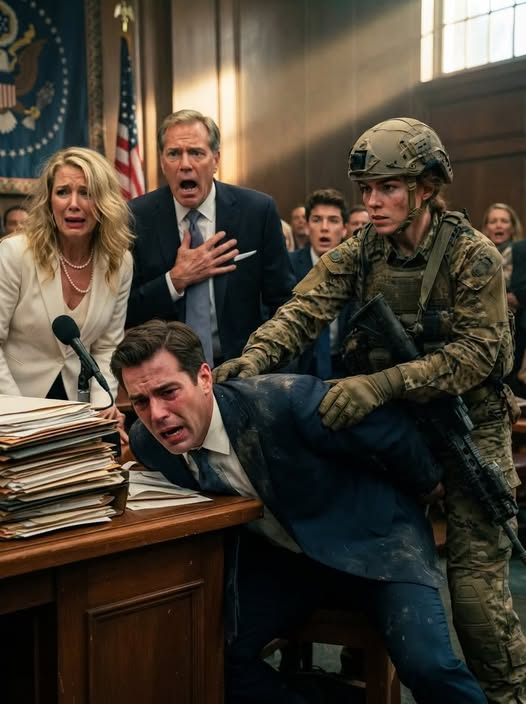
Bradley Collins was still straightening his jacket after our confrontation. His embarrassment had turned into anger.
“Your Honor, whatever Commander Carter brought into this courtroom cannot possibly be admissible without proper authentication.”
“Lieutenant Colonel,” I corrected.
Bradley stopped.
My mother stared at me.
Apparently, she hadn’t known that either.
Judge Reynolds raised a hand.
“Mr. Collins, you’ll have your opportunity.”
Then she turned to me.
“Colonel Carter, where did these documents come from?”
“From an investigation connected to my grandfather’s estate.”
My father laughed.
“You expect us to believe the military investigates family trusts?”
“No.”
I met his eyes.
“The military investigated who was accessing my secured personnel records.”
That ended his laughter.
Ethan looked at me.
“What?”
I continued.
“Someone repeatedly attempted to obtain information about my deployments, mental-health screenings, and security status.”
My mother’s fingers tightened around her purse.
“The requests were traced back to a private investigations company.”
I looked toward Bradley.
“Owned by a subsidiary connected to the Carter family office.”
For the first time, Bradley stopped looking confident.
Judge Reynolds turned another page.
“And Dr. Price?”
“He signed the psychiatric evaluation claiming Ethan suffered from severe emotional instability.”
The judge nodded.
The report was the foundation of my parents’ custody petition.
According to them, Ethan had become unpredictable after our grandfather died.
He supposedly required “structured family supervision.”
Conveniently, that supervision would place control of his trust in my father’s hands until Ethan turned twenty-five.
Judge Reynolds looked toward Ethan.
“Did you ever meet Dr. Price?”
My brother shook his head.
“No, ma’am.”
My mother stood abruptly.
“He was evaluated remotely.”
Ethan looked at her.
“No, I wasn’t.”
“Sit down, Mrs. Carter,” the judge ordered.
Mom obeyed.
But now Ethan was staring at our parents differently.
As if the last pieces of something terrible were finally fitting together.
I hated that look.
He was fourteen.
He should have been worrying about homework.
Not whether his parents had fabricated medical records to control his inheritance.
Judge Reynolds opened the second section.
Bank transfers.
Trust amendments.
Payments.
Bradley whispered something to my father.
My father ignored him.
The judge’s expression hardened.
“Mr. Carter, did you withdraw eight hundred and forty thousand dollars from an account associated with Ethan’s trust?”
Dad leaned forward.
“Those were administrative expenses.”
“Administrative?”
“Yes.”
“For what?”
He hesitated.
Judge Reynolds read aloud.
“Consulting. Property management. Family office services.”
She looked up.
“All companies controlled by you.”
Nobody spoke.
Then she reached the page I had been waiting for.
The one that had made my mother’s face turn to stone.
Judge Reynolds looked at me.
“Colonel Carter…”
Her voice changed.
“This document states that Ethan is not the only beneficiary of the trust.”
My father went white.
Ethan turned toward me.
“What does that mean?”
I took a breath.
Our grandfather had always distrusted my father’s obsession with money.
Before he died, he created a second provision.
If my parents attempted to manipulate Ethan’s custody for financial control, stewardship of the entire trust would automatically transfer.
Not to them.
Not to Ethan.
To an independent guardian.
And Grandpa had named that person fifteen years ago.
Me.
My mother stood again.
“This is impossible!”
The judge looked at her sharply.
“Why?”
“Because Madison renounced the family!”
I felt something cold settle inside me.
There it was.
Not denial.
Recognition.
She had known.
Ethan whispered:
“Mom?”
She realized her mistake.
Too late.
Judge Reynolds leaned forward.
“You knew this clause existed?”
My mother said nothing.
My father closed his eyes.
Bradley whispered:
“Do not answer.”
But Judge Reynolds was already looking at him.
“Mr. Collins, I strongly suggest you stop advising witnesses to remain silent about documents directly relevant to a minor’s welfare.”
Then Ethan spoke.
Quietly.
“I want to live with Madison.”
The courtroom froze.
My mother turned toward him.
“Ethan, you don’t understand.”
“I understand enough.”
Her expression softened instantly.
The same expression she used when she wanted obedience to look like love.
“Honey, your sister lives a dangerous life.”
“That’s what you told everyone.”
Ethan looked at me.
“But she came.”
His voice cracked.
“You didn’t.”
My chest tightened.
He wasn’t talking about court.
Six months earlier, Ethan had called me from school after a panic attack.
Our parents had been attending a charity gala.
They sent a driver.
I had been thousands of miles away.
And still, I had stayed on the phone with him until morning.
Ethan looked at our parents.
“When Grandpa died, you asked about the trust before you asked whether I was okay.”
My father’s face hardened.
“That money is your future.”
“No.”
Ethan shook his head.
“It became yours.”
Judge Reynolds called for a recess.
Twenty minutes later, I found Ethan sitting alone in a consultation room.
My gear had been secured outside the courtroom by then.
Without it, I suddenly felt more exposed.
He looked up.
“Are you really a colonel?”
“Yes.”
“And a sniper?”
I sat beside him.
“I’m military intelligence attached to specialized operations. The rifle was mission equipment, not a courtroom prop.”
He nodded.
“Mom said you washed out of officer training.”
I almost smiled.
“I did not.”
“She said you left because you couldn’t handle pressure.”
“That isn’t true either.”
Ethan looked down.
“What else did they lie about?”
That was the question I couldn’t answer.
Because the truth was still getting worse.
I opened the final sealed envelope.
“There’s something else.”
His face tightened.
“What?”
“Grandpa left a recording.”
Ethan looked at me.
“For us?”
“For whoever opened the trust investigation.”
We returned to the courtroom.
Judge Reynolds allowed the recording to be played.
My grandfather appeared on screen.
Older.
Tired.
But unmistakably himself.
“If this message is being watched,” he said, “then Richard and Diane have attempted to control Ethan’s trust.”
My mother began crying.
Grandpa continued.
“I love my son. But love does not make me blind.”
My father stared at the screen.
“I watched Richard measure every relationship by usefulness. I watched Diane excuse him because confrontation was inconvenient.”
Then Grandpa said the sentence that broke Ethan.
“Ethan is not an investment.”
My brother covered his mouth.
I placed a hand on his shoulder.
Grandpa continued.
“If Madison is present, then she came home despite every reason we gave her not to.”
My eyes burned.
“I chose her as successor trustee because she was the only person in this family who walked away from money when staying would have been easier.”
My father suddenly stood.
“This recording proves nothing!”
Judge Reynolds slammed the gavel.
“Sit down!”
Dad ignored her.
He pointed at me.
“She wants the money!”
I stood.
“No.”
His eyes burned.
“You always wanted to punish us.”
“I don’t want Ethan’s money.”
“Then why are you here?”
I looked at my brother.
“Because he called me.”
That was all.
That was the difference between us.
The hearing lasted another four hours.
By sunset, Judge Reynolds issued temporary protective orders.
My parents lost control of Ethan’s trust pending forensic review.
The psychiatric report was referred for investigation.
Bradley withdrew as their attorney after learning several documents provided by my father might have been falsified.
And Ethan was temporarily placed with me.
Not because I wore a uniform.
Not because of my rank.
Because when the court asked Ethan where he felt safe, he said my name.
Three months later, investigators confirmed the financial manipulation.
My parents had redirected more than a million dollars through related companies.
Dr. Price admitted he had signed an assessment based largely on information provided by my mother.
He had never interviewed Ethan properly.
The custody petition collapsed.
The trust’s protective clause activated.
But I did something my father never expected.
I declined personal control of the money.
Instead, I appointed an independent fiduciary approved by the court.
Dad stared at me during the final hearing.
“You’re giving it away?”
“No.”
I looked at Ethan.
“I’m making sure it stays his.”
That was when my father finally understood.
This had never been about beating him at his own game.
I refused to play it.
A year later, Ethan was living with me near my stateside assignment.
He joined the photography club.
Got his first terrible haircut without asking permission.
Failed algebra once and survived.
Normal things.
Beautiful things.
My parents were allowed supervised contact after completing court requirements.
Healing was slow.
Messy.
Incomplete.
One afternoon, Ethan found the old photograph of us as children.
I was seventeen.
He was barely a toddler sitting on my shoulders.
“You look happy,” he said.
“I was.”
“Before you left?”
I nodded.
“Do you regret leaving?”
I thought about it.
“No.”
“Do you regret coming back?”
I looked at him.
“Never.”
He smiled.
Then he asked:
“What was the biggest secret in that file?”
I could have said the trust clause.
The stolen money.
The fake evaluation.
But those weren’t the real secret.
“The biggest secret was that Grandpa knew exactly what kind of family we were becoming.”
Ethan frowned.
“And he couldn’t stop it?”
“No.”
I touched his shoulder.
“But he made sure money couldn’t finish the job.”
My family had laughed when I entered that courtroom because they thought the uniform made me ridiculous.
They thought strength meant intimidation.
Control.
Money.
Fear.
They were wrong.
The rifle never won Ethan’s freedom.
Neither did my rank.
The thing that destroyed their case was much simpler.
Records.
Truth.
And a fourteen-year-old boy finally being allowed to say what he wanted.
My father had spent years believing whoever controlled the money controlled the family.
He learned otherwise.
Because the day Ethan chose me, he didn’t choose the soldier.
He chose the one person who had never asked what his trust was worth before asking whether he was okay.
