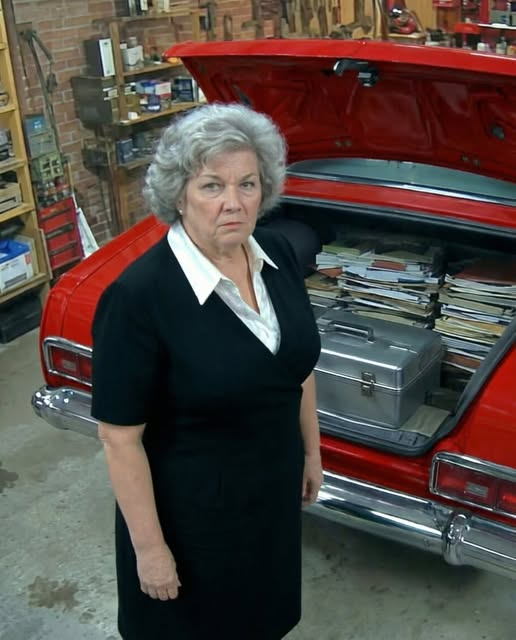
For several seconds, I simply stood there staring into the trunk.
There were no stacks of cash.
No gold bars.
Nothing dramatic.
Instead, Robert had left three metal document cases, a laptop, and a blue folder with my name written across the front.
ELEANOR HALE — OPEN FIRST.
I sat on the dusty concrete floor and opened it.
The first page was a letter.
Ellie,
The $6.2 million is real.
My stomach dropped.
Then I kept reading.
But it is not your debt.
I stopped breathing.
Robert explained everything.
Three years earlier, his logistics company had begun collapsing after one of his largest partners defaulted on a contract. Robert had borrowed heavily trying to keep hundreds of employees working.
The newspapers had been right about the loans.
What nobody knew was that six months before his death, Robert had completed a restructuring.
The struggling operating company carried the debt.
But our home, retirement accounts, investments, and several warehouses had been legally separated years earlier.
And there was more.
Much more.
I opened the first metal case.
Inside were property deeds.
Seven of them.
Industrial buildings in three states.
According to the valuation reports attached, Robert’s personal holding company owned them free and clear.
Estimated value:
$9.8 million.
My hands began trembling.
I opened the second case.
Investment accounts.
Municipal bonds.
Insurance policies.
A retirement trust.
The total exceeded another $4 million.
Then I found a document that made me cover my mouth.
Robert had sold forty percent of a software subsidiary two months before his stroke.
The sale had not yet been publicly announced.
My share, as surviving spouse and trust beneficiary, was worth approximately:
$7.4 million.
Robert had died surrounded by rumors that he was ruined.
But after liabilities tied to the failing company were settled, his estate was still worth more than twenty million dollars.
I started crying.
Not from relief.
From anger.
“Why didn’t you tell me?” I whispered into the empty storage unit.
Then I opened the final case.
That answered everything.
Inside were letters from Mark and Lucas.
Emails.
Text-message printouts.
Copies of documents.
At first I didn’t understand.
Then I recognized a message Mark had sent his father eight months earlier.
If the company is really failing, transfer the lake property to us before creditors take it. Mom doesn’t need to know.
Lucas had replied:
Dad, protect the assets that matter. Mark and I can hold them temporarily.
Another message.
Robert:
What about your mother?
Mark:
She’ll be fine. She doesn’t understand business anyway.
My stomach turned.
There were dozens.
Our sons had known their father was struggling.
They hadn’t offered help.
They had offered to hide assets—for themselves.
Robert had refused.
That was when their relationship changed.
And suddenly I understood why they had stopped visiting during the final year.
I opened the laptop.
A video file sat on the desktop.
FOR ELLIE.
Robert appeared on screen.
Older.
Tired.
But smiling.
“Hello, sweetheart.”
I broke immediately.
For twenty-seven years, he had called me that whenever he knew I was angry with him.
“If you’re watching this, I didn’t get enough time to explain.”
He coughed.
“The boys think I’m broke.”
His expression changed.
“I let them think it.”
I stared at the screen.
Robert continued.
“I needed to know whether they loved us or the life we provided.”
My eyes closed.
“Mark asked me to transfer the properties. Lucas asked about my life insurance three times.”
Robert looked down.
“I kept hoping I was misunderstanding them.”
Then he looked directly into the camera.
“I wasn’t.”
His next words hurt more.
“If they abandon you when they think there is nothing to inherit, do not reward them when they discover they were wrong.”
I paused the video.
For nearly an hour, I sat beside that ridiculous old Ford and cried for the man I had buried alone.
Then I finished watching.
Robert had rewritten his estate plan.
I was sole beneficiary of nearly everything.
Our sons had each been left one thing.
An envelope.
Nothing more.
They came back eleven days later.
Not because they missed me.
Because the business press announced the software sale.
My phone started ringing at 6:14 that morning.
Mark.
Then Lucas.
Then Mark again.
I let all three calls go unanswered.
At nine, someone pounded on my door.
I opened it.
Both of them stood outside.
For the first time since Robert died, my sons were home.
Mark forced a smile.
“Mom.”
Lucas tried to hug me.
I stepped back.
That surprised him.
“We heard there’s been some confusion about Dad’s estate,” Mark said.
“Confusion?”
“The newspapers are saying one of his companies was sold.”
“Yes.”
“And apparently there are properties.”
“Yes.”
They exchanged glances.
Lucas lowered his voice.
“Why didn’t you tell us?”
I almost laughed.
“You didn’t come to his funeral.”
Mark’s expression hardened.
“We were upset.”
“You said attending a poor man’s funeral was a waste of time.”
“Mom, people say stupid things when they’re grieving.”
“You weren’t grieving.”
Silence.
Then Mark changed tactics.
“We’re still his sons.”
“Yes.”
“So legally—”
“There it is.”
He stopped.
I smiled sadly.
“Four minutes.”
“What?”
“You’ve been inside this house four minutes and we’ve already reached the word legally.”
Lucas looked ashamed.
Mark didn’t.
“Dad wouldn’t cut us out.”
I walked into Robert’s study.
They followed.
Two envelopes waited on the desk.
One marked MARK.
One marked LUCAS.
Their faces changed.
“Your father left these.”
They tore them open.
Mark’s contained a single photograph.
The four of us at the lake house when the boys were teenagers.
On the back, Robert had written:
This was the last summer before you started asking what everything cost.
Lucas’s letter was longer.
He read silently.
Then sat down.
“What did he say?” Mark demanded.
Lucas didn’t answer.
So I did.
“He wrote that he loved you.”
Mark stared at me.
“And?”
“And he hoped someday that would matter to you more than his money.”
Mark threw the photograph onto the desk.
“This is insane. We’re his children. We can contest this.”
“You can.”
His eyes narrowed.
“You’re not worried?”
“No.”
That was when I showed them the final document from the blue Ford.
A signed memorandum from Robert’s attorney.
Attached were copies of Mark and Lucas’s messages asking Robert to transfer assets away from me.
And beneath them was a clause in the family trust.
Anyone who challenged the estate unsuccessfully would lose even the modest educational trusts Robert had created for the grandchildren.
Mark went pale.
“You’d take money from your own grandchildren?”
“No.”
I pushed the paper toward him.
“Your father protected their accounts separately. You just assumed their money belonged to you.”
Lucas covered his face.
Mark began pacing.
“This is revenge.”
“No.”
I looked at my sons.
“This is consequence.”
For the first time, Lucas began crying.
Not loudly.
He simply sat there staring at his father’s handwriting.
“I should’ve gone to the funeral.”
“Yes.”
“I thought he’d destroyed everything.”
“I know.”
He looked at me.
“I’m sorry.”
I wanted to forgive him immediately.
A mother’s heart is inconvenient that way.
But apologies made after discovering twenty million dollars require time.
Mark still wasn’t finished.
“So what happens now?”
I looked around the study.
Robert’s chair.
His books.
The photograph of our wedding.
“What happens now is that I live.”
“With all of it?”
“With what my husband left me.”
Mark laughed bitterly.
“You don’t even know how to manage that kind of money.”
I smiled.
There he was.
Exactly the son Robert had feared he had raised.
“You’re right.”
Mark blinked.
“I hired professionals.”
His smile disappeared.
“And yesterday I signed the first documents.”
“What documents?”
“The warehouses are being moved into a long-term trust.”
“For who?”
“Some will provide retirement benefits for employees who stayed with your father during the restructuring.”
Mark stared.
“And the rest?”
I looked at Lucas.
“For your children. And Mark’s.”
Their faces changed.
They would receive nothing directly.
But their children would be protected.
Robert’s employees would be protected.
And I would be protected.
Exactly the people my husband had worried about until the end.
Mark walked toward the door.
“This family is finished.”
I didn’t stop him.
Lucas remained.
At the doorway, Mark looked back.
“One day you’ll regret choosing money over your sons.”
I shook my head.
“You still don’t understand.”
I walked to the desk and picked up the photograph he had thrown down.
“You were the ones who chose money first.”
He left.
Lucas stayed until sunset.
We talked about his father.
Not the estate.
Not the company.
Robert.
For the first time in years, Lucas asked what his father had been afraid of before he died.
What music he listened to when he couldn’t sleep.
Whether he knew his grandchildren loved him.
It didn’t erase what Lucas had done.
But it was a beginning.
Mark took much longer.
Almost two years.
The first time he returned without mentioning lawyers, trusts, or inheritance, he brought flowers to his father’s grave.
I stood several steps away.
He placed them carefully beside the stone.
Then he said:
“I thought Dad leaving me nothing was the punishment.”
I waited.
Mark looked at the name carved into the granite.
“I was wrong.”
His voice broke.
“The punishment was realizing why he did it.”
I put my hand on my son’s shoulder.
Not everything damaged can be restored exactly as it was.
Sometimes it shouldn’t be.
But people can still choose what they become after the damage.
The old blue Ford remains in storage.
I could sell it.
It isn’t worth much.
But every year on Robert’s birthday, I drive it around the block.
The engine complains.
The air-conditioning barely works.
And the paint has faded almost completely.
Yet I keep it.
Because my husband spent his final months surrounded by people measuring his worth in dollars.
That car held the one truth they had all missed.
Robert Hale did not die poor.
But the fortune wasn’t what made him rich.
His final gift to me was knowing exactly who would remain beside me when everyone believed there was nothing left to take.
And that was worth more than the millions hidden in the trunk.
