Daniel said nothing.
I could hear only his breathing through the phone.
Then:
“What camera?”
That question told me everything.
Not:
What happened?
Not:
Are you sure?
Just:
What camera?
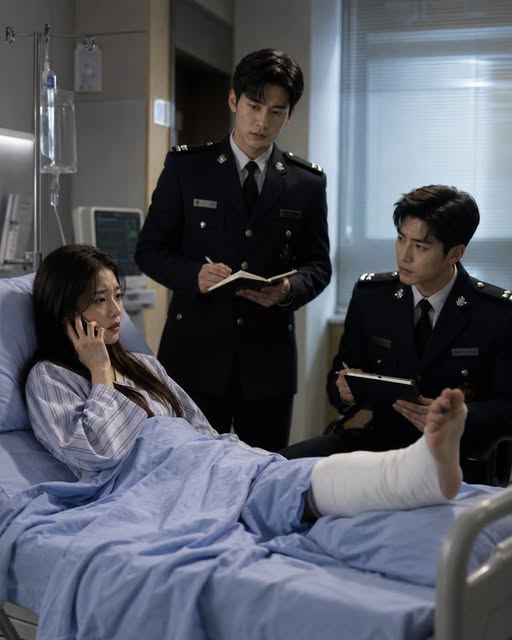
I looked at the police officer beside my bed.
“The hallway camera you forgot I installed after your mother claimed someone kept moving her things.”
Daniel’s voice became quieter.
“Sofía, don’t do anything stupid.”
I almost laughed.
“For seven years, that sentence worked on me.”
I ended the call.
Then I opened the security application.
The recording had already been backed up automatically.
There was no dramatic confrontation.
No mystery.
At 8:07 that morning, Daniel’s mother, Margaret, came out of the kitchen carrying a bottle.
She looked toward the hallway.
Then toward the stairs.
A few minutes later, the surface of several steps had been made dangerously slick.
At 8:31, I came down carrying laundry.
The recording showed the fall.
I didn’t watch that part twice.
I didn’t need to.
The older officer took my statement.
Then he asked:
“Did your mother-in-law know you would use those stairs?”
“She knew I did every morning.”
“Had you argued recently?”
I nodded.
The night before, Margaret had complained that I refused to prepare a separate midnight meal because I had worked a twelve-hour shift.
She told Daniel I was disrespectful.
Daniel told me:
“If Mom asks, you do it. She’s elderly.”
Margaret was sixty-one.
She attended dance classes three times a week.
But whenever chores appeared, she suddenly became ancient.
The officers went to the house that evening.
Margaret denied everything.
Then they showed her the footage.
According to the report, her story changed three times in twenty minutes.
First, she said she had spilled something accidentally.
Then she claimed she was cleaning.
Finally, she insisted she only wanted to “teach me to be more careful.”
Daniel called me afterward.
“You’ve gone too far.”
I stared at the hospital ceiling.
“Your mother caused me to fall.”
“She didn’t mean for you to get seriously hurt.”
“That’s your defense?”
“She’s my mother.”
“And I was your wife.”
He became silent.
I continued:
“You called the police because your mother missed lunch.”
“You didn’t call an ambulance when I told you I had a broken leg.”
“You told officers to bring me home to cook.”
“And now you’re worried about consequences for the person who put me in the hospital.”
There was nothing left to discuss.
The next morning, my attorney arrived.
Her name was Rachel Kim.
I had first contacted her three weeks earlier.
Not because of the stairs.
Because of the bank statements.
Daniel had told me for years that nearly half his salary went toward Margaret’s medical expenses.
It didn’t.
Large cash withdrawals appeared every month.
Transfers to betting platforms.
Private loans.
Credit card advances.
When he lost money, he moved funds from our joint savings account and labeled the withdrawals “family medical.”
Meanwhile, I worked overtime believing we were barely surviving.
Rachel placed a folder beside my bed.
“We’ve traced enough to begin.”
“How bad?”
She hesitated.
“Worse than you thought.”
Daniel had used money from the account we created for a future home.
He had also borrowed against a small investment account my father left me.
My signature appeared on one document.
I had never signed it.
I stared at the page.
“He forged this?”
“We’ll have it examined.”
For the first time since the accident, my leg stopped being the biggest problem.
Daniel arrived at the hospital that afternoon.
He carried flowers.
Cheap ones from the lobby gift shop.
He placed them beside my bed and sighed as though I had inconvenienced him.
“Can we stop this?”
“Stop what?”
“This war.”
I looked at him.
“You started calling it a war when I stopped obeying.”
His face tightened.
“Mom is terrified.”
“Good.”
“Sofía.”
I pointed toward the chair.
“Sit.”
For once, he did.
I placed copies of the bank records in front of him.
His face changed before he reached the second page.
“How did you get these?”
“They’re our accounts.”
“You went through my transactions?”
“Yes.”
“That’s private.”
I almost laughed.
“Our money is private from me?”
He tried another approach.
“I can explain.”
“Start with the gambling.”
His mouth closed.
Then:
“It wasn’t that much.”
I turned to another page.
“Then explain this.”
Silence.
“And this.”
His shoulders dropped.
Finally:
“I was trying to win it back.”
That sentence was almost pathetic enough to make me feel sorry for him.
Almost.
“You told me we couldn’t afford physical therapy for my back last year.”
“I was under pressure.”
“You told me your mother’s prescriptions cost too much.”
“They do.”
“You took money from my father’s account.”
His eyes snapped up.
“That was for the family.”
“No.”
I looked directly at him.
“It was for you.”
Then I showed him the disputed loan document.
Daniel went pale.
“Sofía…”
“Did you sign my name?”
He stood.
“I was going to repay it.”
“Did you sign my name?”
He looked away.
That was the answer.
I pressed the call button for the nurse.
“You need to leave.”
Daniel stared at me.
“You’re destroying everything over money?”
“No.”
I shook my head.
“The money can be earned again.”
“You destroyed this marriage every time you decided I existed to serve you.”
He whispered:
“What am I supposed to do now?”
For seven years, I had cooked.
Cleaned.
Managed appointments.
Paid bills.
Worked.
Cared for his mother.
Covered his debts without knowing they were debts.
And somehow, Daniel still thought the terrifying question was what would happen to him without me.
I answered:
“Learn.”
Margaret was no longer allowed inside my home while the incident was being investigated.
Daniel moved in with her.
For the first time, he had to experience the woman he had always demanded I serve.
Within two weeks, he called complaining.
“She expects breakfast at seven.”
I said nothing.
“She wants different food every day.”
Silence.
“She calls me at work because she gets lonely.”
Still nothing.
Finally:
“I didn’t realize how much you were doing.”
I closed my eyes.
“That’s because you didn’t want to.”
Then I hung up.
The divorce lasted nine months.
The financial review confirmed that Daniel had hidden substantial gambling losses and improperly used money belonging to me.
The forged document became part of a separate legal dispute.
Margaret faced consequences for what happened on the stairs, and the camera footage prevented the family from rewriting the incident as an accident.
I did not spend those months plotting revenge.
I spent them learning how to walk normally again.
Learning how to live alone.
Learning how strange it felt to cook one meal because I wanted it, not three because someone demanded them.
Daniel eventually agreed to repay the money he had taken.
The settlement wasn’t perfect.
Real life rarely is.
But I left with my financial independence, my father’s remaining assets protected, and no obligation to care for Margaret ever again.
That was enough.
A year later, I saw Daniel outside a grocery store.
He looked older.
He was carrying two bags and talking on the phone.
“Yes, Mom.”
Pause.
“No, I bought the low-sodium one.”
Another pause.
“I’ll cook when I get home.”
He saw me.
We both froze.
Then I smiled.
Not cruelly.
Just because sometimes life writes its own ending.
Daniel ended the call.
“How’s your leg?”
“Good.”
“I heard you got promoted.”
“I did.”
He nodded.
Then:
“Mom still says you ruined the family.”
I looked at him.
“No, Daniel.”
“She tried to make me fall because she wanted to punish me.”
“You called the police because I wouldn’t cook with a broken leg.”
“You gambled away money and hid it behind your mother’s medical bills.”
I smiled faintly.
“I didn’t ruin your family.”
“I stopped carrying it.”
He lowered his eyes.
For once, he didn’t argue.
When I got home that evening, I made dinner.
One plate.
Exactly what I wanted.
I ate by the window with my leg resting comfortably on another chair.
No one shouted from another room.
No one demanded tea.
No one asked whether I had finished cleaning.
For years, I thought marriage meant endurance.
I thought a good wife was measured by how much inconvenience she could absorb without complaining.
Then I broke my leg.
And somehow, that fracture healed something else.
The police had been called to force me back into my role.
Instead, they became witnesses to the moment I finally stepped out of it.
Daniel believed my broken leg made me helpless.
Margaret believed fear would keep me obedient.
They were both wrong.
The cast came off after a few months.
The marriage was the thing I never put back on.
