Connor stopped walking.
My mother turned first.
My father followed.
For several seconds, nobody moved.
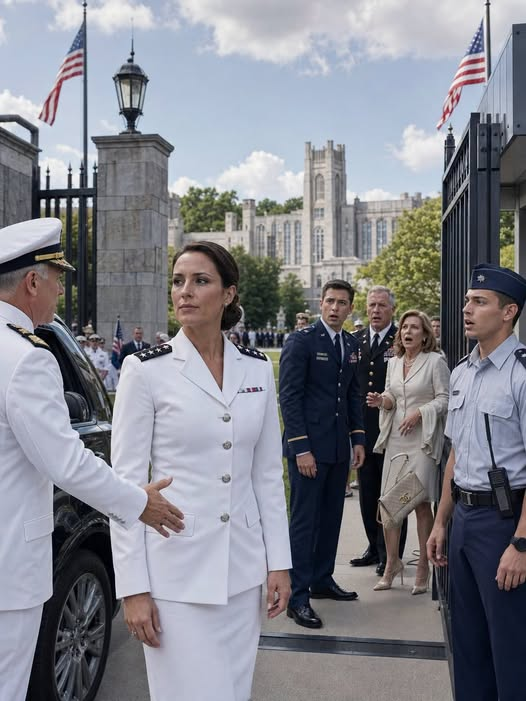
Admiral Vance approached me.
“Apologies for the delay, Alicia.”
Petty Officer Thorne looked as if he wanted the pavement to swallow him.
“Ma’am, I—”
“You followed the list you were given,” I said. “You did nothing wrong.”
Vance glanced at the clipboard.
“Her name was removed?”
Thorne hesitated.
“Yes, sir.”
Twenty yards away, Connor had gone pale.
Admiral Vance understood immediately.
But instead of humiliating him, he simply said:
“Then we’ll correct the oversight.”
I opened my coat.
The uniform beneath it became visible.
So did the three stars.
My father’s face changed completely.
He knew exactly what they meant.
“Vice Admiral?” he whispered.
For thirty years, Dad had been able to identify rank from across a parade field.
Apparently he just never imagined seeing those stars on his daughter.
Connor slowly approached.
“Alicia…”
I looked at him.
He glanced at my shoulder boards.
Then at Admiral Vance.
“How long?”
“Long enough.”
“You never told us.”
Dad finally found his voice.
“Why would you hide something like this from your family?”
That question almost made me laugh.
“I didn’t hide my career.”
I looked at him.
“You stopped asking about it.”
Silence.
Inside the auditorium, Connor’s name appeared across a large screen.
The ceremony honored several aviation officers for operational excellence.
I took a seat in the front row beside Admiral Vance.
My parents sat three rows behind us.
Nobody spoke to me.
Halfway through the program, Vance walked to the podium.
“Before today’s aviation recognition, there is another presentation.”
Connor looked confused.
Vance continued.
“Four days ago, American personnel overseas faced a rapidly deteriorating situation. The safe recovery of those personnel depended on coordination across multiple commands.”
He did not reveal classified details.
Neither would I.
But he said enough.
“A strategic cyber and intelligence task force provided critical support to the aviation crews involved.”
Connor’s posture changed.
He knew the operation.
Of course he did.
Two of his closest friends had been in that aviation unit.
Vance looked toward me.
“That task force was commanded by Vice Admiral Alicia Fisher.”
The room erupted in applause.
Connor did not clap at first.
He simply stared at me.
Then one of the pilots being honored stood.
Commander Evan Rhodes.
Connor’s former squadron mate.
He turned toward me and saluted.
Others followed.
One after another.
Only then did Connor slowly rise.
His hand came up.
For the first time in my life, my brother saluted me.
I returned it.
Nothing more.
After the ceremony, my parents found me near the reception hall.
Dad looked shaken.
“Why didn’t you tell me you made admiral?”
“I called you after my promotion.”
His brow furrowed.
“When?”
“March seventeenth.”
Mom’s eyes widened.
“That was Connor’s flight demonstration weekend.”
“Yes.”
Dad remembered.
I could see it happen.
“You said you had news.”
“And you told me you were busy.”
He lowered his eyes.
I continued.
“I called again the following week.”
Mom whispered:
“I remember.”
I looked at her.
“You said Dad was tired and I should tell you another time.”
Neither spoke.
That was the problem with neglect.
Eventually, the people doing it forget the moments entirely.
The person receiving it remembers every one.
Dad looked at my stars again.
“I thought you were doing technical support.”
“I command more than technical support.”
“I didn’t know.”
“No.”
I nodded.
“You didn’t.”
Connor arrived last.
His wife stayed several steps behind him.
He looked nothing like the man who had laughed at the gate.
“Alicia, can we talk?”
“We’re talking.”
His jaw tightened.
“I didn’t know you were invited by Admiral Vance.”
“That shouldn’t matter.”
He looked confused.
“What?”
“You shouldn’t need to know your sister outranks half the building before deciding she deserves a seat at your ceremony.”
He flinched.
“I was joking.”
“You removed my name.”
Silence.
“That required effort, Connor.”
He looked away.
Finally:
“I didn’t want people asking what you did.”
I almost smiled.
“Why?”
“Because I didn’t know.”
There it was.
The truth beneath years of jokes.
My brother had mocked my career because admitting he knew nothing about it would have forced him to admit he had never cared enough to learn.
Then Connor said:
“Evan told me something.”
I waited.
“He said your people were part of the reason his crew got home.”
“I can’t discuss the operation.”
“I know.”
His voice cracked slightly.
“He said I spent years calling you a keyboard pusher while people I respect knew your name.”
I shook my head.
“You’re still missing the point.”
He looked at me.
“You shouldn’t respect me because they do.”
That silenced him.
At the reception, Commander Rhodes approached with another officer.
He smiled.
“Ma’am.”
“Commander.”
Then he looked at Connor.
“Your sister is the reason some of us sleep better.”
Connor gave an uncomfortable laugh.
“You apparently know her better than I do.”
Rhodes didn’t laugh.
“No, Major.”
He glanced at me.
“I know her work.”
Then he walked away.
That distinction landed harder than an insult.
Because my family had known me my entire life.
And somehow strangers had bothered to understand more.
Dad found me alone on the terrace later.
For a while, we watched boats moving across the water.
Then he said:
“I failed you.”
I looked at him.
He was not a man who apologized easily.
“When Connor wanted to fly, I understood it.”
He continued.
“I knew the language. The training. The risks.”
He rubbed his hands together.
“When you went into cyber and intelligence, I didn’t understand it.”
“So you decided it didn’t matter.”
“Yes.”
The honesty surprised me.
“I made the mistake of believing service only counted when it looked like mine.”
I said nothing.
Then he asked:
“Can I ask what you actually do?”
I almost answered automatically.
The simplified version.
The one designed to end conversations quickly.
Instead, I said:
“Yes.”
So we sat there for twenty minutes.
I told him what I could.
Not classified operations.
Not locations.
Not capabilities.
Just enough for my father to finally understand that warfare had changed while his definition of courage had remained frozen in time.
When I finished, he looked toward the water.
“I should have asked twenty years ago.”
“Yes.”
Connor apologized weeks later.
Not publicly.
Not because an admiral was standing nearby.
He called me.
“I removed your name because Chloe said it would be awkward explaining what you did.”
I waited.
“And I agreed because making you small was easier than admitting I didn’t understand you.”
That was the first apology from him I believed.
“I’m sorry.”
I accepted the apology.
I did not erase the history.
Those are different things.
Months later, our parents hosted Thanksgiving.
For the first time in years, Dad’s wall had a new photograph.
Connor in flight gear remained there.
So did Dad in his Marine uniform.
Beside them was a photograph I had never seen before.
Me.
In dress uniform.
Three stars visible.
I stared at it.
Dad came up behind me.
“Too much?”
“No.”
He smiled awkwardly.
“I thought the wall should tell the whole story.”
Connor walked past carrying a bowl.
“Careful,” he said. “Apparently the basement IT department gets offended easily.”
I looked at him.
He froze.
Then I smiled.
“You’re improving.”
He laughed.
This time, I did too.
My family had spent years believing Connor was the Fisher who served where it mattered.
The pilot.
The visible warrior.
The son whose career produced stories they understood.
I was the daughter behind a computer.
The one in the basement.
The one Connor thought he could erase from a guest list without consequence.
But the greatest lesson that day had nothing to do with rank.
Not the stars.
Not the admiral.
Not even the officers who stood when my name was announced.
It was something much simpler.
You should never need to discover someone’s importance before deciding to treat them with respect.
Connor thought removing my name from his ceremony would put me back in my place.
Instead, a four-star admiral walked outside and called me by the title my own family had never bothered to learn.
And in that moment, they finally understood:
I had never been standing in Connor’s shadow.
They had simply never looked far enough to see where I was standing.
