I gave birth eight days later.
Not in the house Julian had taken from me.
Not with his mother waiting outside the delivery room.
Not with my husband holding my hand.
My son was born in a small coastal hospital while my mother sat beside me.
I named him Mateo.
When the nurse placed him in my arms, I stared at his tiny face and understood something immediately.
Julian had been wrong.
I had not left with nothing.
I had left with everything that mattered.
Three weeks later, I learned the real reason for the divorce.
Her name was Vanessa Cole.
She worked with Julian.
And she had been three months pregnant when he forced me to sign the papers.
A mutual friend sent me a photograph.
Julian and Vanessa were standing inside my former home.
My curtains behind them.
My dining table beneath their champagne glasses.
And Julian’s mother had one hand resting proudly on Vanessa’s belly.
The caption read:
A new beginning for our family.
I stared at the photograph for a long time.
Then deleted it.
My mother was furious.
“You should expose them.”
“No.”
“Camila!”
I looked down at Mateo sleeping against my chest.
“I have a newborn.”
“I don’t have time to fight for an audience.”
That did not mean I did nothing.
I hired a lawyer.
The agreement Julian had forced me to sign was not as untouchable as he believed.
My lawyer reviewed the property records.
The down payment had not come entirely from his mother.
A large portion had come from savings I had contributed before leaving work during pregnancy.
Mortgage payments had also been made from our joint marital funds.
The savings Julian claimed were “his” were not solely his either.
I did not receive everything.
I did not ask for everything.
But I refused to disappear simply because Julian had prepared paperwork designed to make me believe I had no rights.
After months of negotiation, I received a fair settlement.
Enough for a small apartment.
Enough to care for Mateo.
Enough to begin again.
Julian hated it.
His mother hated it more.
But the documents did not care about their opinions.
Julian asked about Mateo exactly twice during the first year.
The first message arrived three days after his birth.
Is he healthy?
I answered:
Yes.
The second came six months later.
Send me a picture.
I did.
He replied with a thumbs-up.
That was all.
No call.
No visit.
No birthday gift.
Nothing.
Vanessa’s daughter had been born two months after Mateo.
And from the photographs people kept sending me, Julian had fully embraced his new family.
So I stopped waiting.
I went back to work when Mateo was ten months old.
Before marriage, I had worked in accounting.
I started part-time.
Then full-time.
My mother watched Mateo while I rebuilt the career I had abandoned when Julian said a good wife should focus on home.
Three years later, I became financial controller for a regional logistics company.
I bought a modest two-bedroom house near the sea.
Mateo had a blue room with stars painted on the ceiling.
He grew into a loud, curious child who asked twenty questions before breakfast.
He knew he had a father named Julian.
I never lied.
But I never invented a better version of Julian either.
When Mateo once asked:
“Why doesn’t Dad live with us?”
I answered:
“Because adults sometimes make choices that change families.”
“Did I do something?”
I pulled him onto my lap.
“No.”
“Never.”
That was the only part I needed him to understand.
Five years after the divorce, someone knocked on my door.
It was raining.
Mateo was building a tower on the living-room floor.
I opened the door.
And froze.
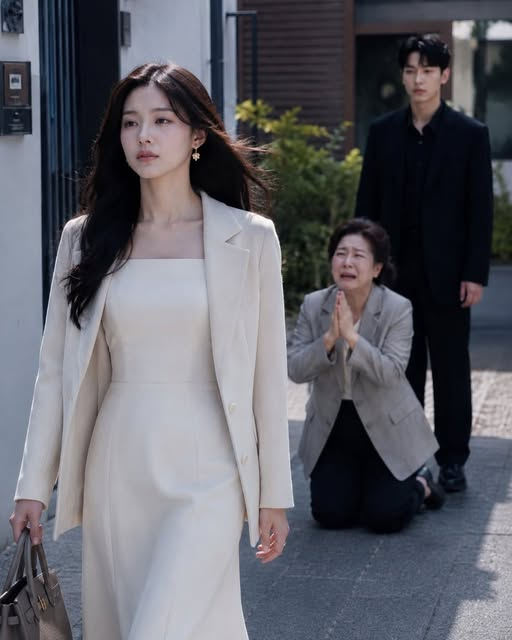
Julian’s mother stood outside.
Margaret looked ten years older.
Behind her was Julian.
He was thinner.
Much thinner.
One hand rested against the wall as though standing required effort.
For a moment, nobody spoke.
Then Margaret started crying.
“Camila.”
I did not move.
“What are you doing here?”
She looked toward Julian.
He seemed unable to meet my eyes.
“We need to talk.”
“No.”
Margaret’s face crumpled.
“Please.”
That word almost made me laugh.
Five years earlier, she had come to inspect the house after I left.
Now she was standing outside mine asking permission to enter.
I stepped onto the porch and closed the door behind me.
“Mateo is inside.”
Margaret immediately looked toward the window.
“My grandson…”
“You don’t get to call him that yet.”
She lowered her head.
For once, she did not argue.
Then Julian spoke.
“I’m sick.”
I stared at him.
“I can see that.”
He swallowed.
“It’s serious.”
I said nothing.
“I’ve been undergoing treatment for months.”
Still nothing.
He looked toward the door.
“I wanted to see Mateo.”
“For what?”
His eyes filled.
“Because he’s my son.”
I almost couldn’t believe him.
“Five years ago he was also your son.”
Julian closed his eyes.
“I know.”
“No.”
“You knew he existed.”
“That’s different.”
Margaret started crying harder.
“We made terrible mistakes.”
I looked at her.
“You inspected my home the afternoon after your son threw me out ten days before I gave birth.”
She flinched.
“You told relatives I was greedy because I challenged the property agreement.”
“I know.”
“And now you’re here because Julian is sick?”
She whispered:
“Yes.”
At least she was honest.
Then I learned what had happened.
Vanessa had left two years earlier.
The daughter Julian had proudly raised was not biologically his.
A paternity test during a medical issue revealed the truth.
Vanessa admitted she had known there was another possibility.
Julian’s marriage to her collapsed.
Then his business struggled.
Then came the illness.
One loss after another.
Margaret apparently began talking about Mateo.
The grandson she had ignored.
The child Julian had never held.
And somehow, after five years, they convinced themselves they could simply come to my door.
I looked at Julian.
“Are you here because you love Mateo?”
He was silent too long.
“That’s what I thought.”
“No.”
His voice cracked.
“I’m here because I finally understand what I did.”
“That isn’t the same thing.”
“I know.”
For the first time in our entire relationship, Julian did not defend himself.
He said:
“I thought Vanessa was giving me the life I deserved.”
“I thought you would struggle without me.”
“I thought eventually you’d call.”
I stared at him.
“I didn’t.”
“No.”
A sad smile appeared.
“You didn’t.”
He continued:
“Every year I told myself it was too late to contact you.”
“Then another year passed.”
“And another.”
“That was convenient.”
“Yes.”
He looked at the ground.
“I was a coward.”
That, at least, was true.
I did not let them meet Mateo that day.
Julian looked devastated.
Margaret tried to argue.
I stopped her.
“You will not walk into his life because guilt finally became uncomfortable.”
“If Julian wants a relationship with Mateo, it will happen slowly.”
“With professional guidance.”
“On Mateo’s terms.”
“And only if he remains consistent.”
Julian nodded immediately.
Margaret opened her mouth.
He stopped her.
“Mom.”
Then he looked at me.
“She’s right.”
That was the first time in seven years I heard Julian choose my boundary over his mother’s wishes.
Five years too late.
But I noticed.
Julian began with letters.
Short ones.
Then supervised video calls.
Then visits.
He never told Mateo he was dying.
Because he wasn’t.
His condition was serious, but treatment was helping.
There were no guarantees.
So for once, Julian stopped making promises he could not control.
He simply showed up.
Mateo was suspicious at first.
Then curious.
Then comfortable.
One afternoon, after Julian left, Mateo asked:
“Is he my dad now?”
I smiled sadly.
“He has always been your biological father.”
“But being your dad is something he has to keep doing.”
Mateo nodded as though that made perfect sense.
Children often understand consistency better than adults.
Margaret changed more slowly.
She apologized.
Then ruined the apology by explaining herself.
Then apologized again.
Eventually she learned to stop defending the past.
I never called her Mom again.
Mateo eventually called her Grandma.
That was his choice.
Not mine.
Julian’s health improved.
Not magically.
Slowly.
He returned to work.
He became more involved with Mateo.
He attended school events.
Learned his favorite food.
Learned that Mateo hated losing at chess.
Learned that five years of fatherhood could not be recovered in one emotional conversation.
One evening, Julian stood outside my house after dropping Mateo off.
“Camila.”
“Yes?”
“If things had been different…”
“No.”
He stopped.
I knew what he wanted to ask.
He smiled sadly.
“You knew?”
“Yes.”
“Would you ever consider…”
“No.”
He nodded.
“I deserved that.”
“This isn’t punishment.”
I looked at him.
“You becoming a better father does not make you my husband again.”
His eyes lowered.
“I understand.”
And I believed him.
Julian eventually became a good father.
That was his redemption.
Not getting me back.
Not rebuilding the marriage.
Not being forgiven so completely that the past disappeared.
He learned to show up for the child he had once treated like an asset he could claim after birth.
And I learned something too.
Forgiveness does not mean returning.
Sometimes forgiveness means you stop carrying anger while keeping the door to your old life permanently closed.
Five years earlier, Julian forced divorce papers across a table while I was ten days from giving birth.
He believed the house belonged to him.
The money belonged to him.
And eventually the baby would belong to him too.
He was wrong about all three.
The house became part of a legal settlement.
The money could be rebuilt.
And Mateo was never property for either of us to own.
He was a child who deserved adults willing to choose him every day.
Julian finally learned that.
It just took him five years, a broken second marriage, a frightening diagnosis, and one rainy afternoon outside my door.
As for me?
I never returned to the woman who signed those papers with trembling hands.
That woman thought being abandoned meant she had lost everything.
She had no idea.
The morning I left Julian’s house carrying my unborn son was not the day my family ended.
It was the day Mateo and I finally began building one of our own.
