I called Robert before I called my son.
He answered on the second ring.
“Henry?”
“I found the account.”
Silence.
Then his voice changed.
“Don’t touch anything yet.”
An hour later, Robert was sitting across from me at my kitchen table with the bank statements spread between us.
He adjusted his glasses and pointed at the deposits.
“These amounts aren’t coming from your regular accounts.”
“I know.”
“Look at the descriptions.”
I did.
Insurance refund.
Equipment sale.
Investment distribution.
Three years of money that somehow carried my name without ever passing through my hands.
Robert turned to the withdrawal column.
Mortgage payment.
Credit card.
Private school tuition.
Luxury auto lease.
All linked to accounts I did not recognize.
Except one address.
Birwood Lane.
David’s house.
My chest went cold.
“Could someone have opened this without me?”
Robert looked at me carefully.
“That’s what we need the bank to explain.”
We went there that afternoon.
The branch manager, a woman named Mrs. Ellis, became visibly nervous when I placed the statement on her desk.
“I need the complete opening file for this account.”
She hesitated.
“Mr. Carter, there are privacy procedures—”
“It is in my name.”
That ended the discussion.
Twenty minutes later, she returned with copies.
The account had been opened three years earlier.
The identification attached to the application was mine.
The signature looked like mine.
Almost.
But I had signed contracts for nearly four decades.
I knew my own handwriting.
That was not my signature.
Then Robert found the beneficiary designation.
David Carter.
My son.
And listed as an authorized contact—
Emily Carter.
I sat back.
Mrs. Ellis whispered:
“Oh, my God.”
The bank escalated the matter immediately.
I was advised not to confront anyone while the records were being reviewed.
So I went home.
That evening, David called.
“Dad, we’re having brunch Sunday. Emily’s parents are coming. You should come too.”
I looked at the bank folder.
“Will there be bread?”
He laughed.
For several seconds.
He genuinely thought I was joking with him.
“Dad, come on. Emily didn’t mean anything by that.”
“You agreed with her.”
The laughter stopped.
“You know how she gets.”
“Yes.”
“I’m starting to.”
He sighed.
“Are you still upset?”
“No.”
That was true.
I had moved far beyond upset.
“I’ll see you Sunday.”
By Sunday, the bank had confirmed enough to make my attorney very interested.
The account had been opened using documents submitted electronically.
A copy of my driver’s license.
An old tax form.
And a signature authorization.
All documents David could have accessed years earlier while helping me organize paperwork after Margaret died.
But the biggest discovery was the source of the deposits.
The account had been receiving payments tied to a small parcel of commercial property I owned through Carter Construction before the sale.
I had retained a minority income interest.
David knew about it.
Apparently, three years earlier, someone had redirected the distributions.
Not millions.
But enough.
More than $170,000 had passed through that account.
Most of it was gone.
I arrived at brunch carrying one envelope.
Emily opened the door.
“Oh, Henry.”
Her eyes dropped toward my clothes.
An old work jacket again.
She smiled.
“We made eggs. Something light for you.”
I smiled back.
“How thoughtful.”
David was in the dining room.
So were Emily’s parents.
Michael came running toward me.
“Grandpa!”
He hugged me.
That was the only moment that morning that felt real.
We sat down.
I ate quietly.
Then, when the adults began talking about vacations and a possible kitchen renovation, I placed the envelope beside David’s plate.
“What’s this?”
“Open it.”
He did.
The color left his face before he reached the second page.
Emily noticed.
“What is it?”
David folded the paper too quickly.
“Nothing.”
I looked at him.
“Then show your wife.”
He stared at me.
Emily grabbed the pages.
Her expression changed too.
Sandra and Richard suddenly became fascinated by their coffee.
I asked:
“Which one of you wants to explain?”
Nobody answered.
So I waited.
Thirty-eight years in construction taught me something.
Silence becomes very uncomfortable when the truth is already sitting on the table.
Finally, Emily spoke.
“It wasn’t stealing.”
Michael was within hearing distance.
I stood.
“Buddy, why don’t you go finish your game upstairs?”
He looked confused.
But obeyed.
When he was gone, I sat again.
Emily continued.
“You weren’t using that money.”
I stared at her.
“That is your explanation?”
“You have more than you could ever spend.”
David finally spoke.
“Dad, listen.”
“No.”
For once, he stopped.
I asked:
“Did you open the account?”
His jaw tightened.
“I handled it.”
“That wasn’t my question.”
“Yes.”
Emily quickly added:
“We were going to tell you.”
“When?”
No answer.
“After three years?”
David leaned forward.
“You helped me before.”
There it was.
The entitlement beneath everything.
“The tuition.”
“The house.”
“The business loan.”
“You always said what you had was eventually mine anyway.”
“I said no such thing.”
“But I’m your only son.”
I looked at him for a long time.
Then said:
“And somehow you turned that into permission.”
Emily’s mother finally whispered:
“Henry, perhaps this can be resolved privately.”
I looked at her.
“Was dinner private?”
She went quiet.
I continued:
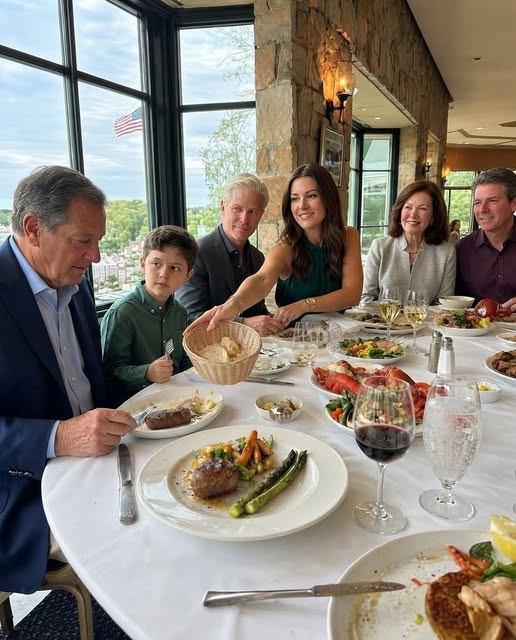
“You were comfortable eating lobster while your daughter told me bread was enough for someone my age.”
“No one stopped her.”
“No one corrected my son.”
“And now that money is involved, everyone suddenly wants dignity.”
Emily’s face hardened.
“So that’s what this is about.”
“The restaurant.”
I almost smiled.
“No.”
“The restaurant only taught me to look.”
David stood.
“You’re going to report your own son?”
“The bank already opened an investigation.”
His face changed.
“You did what?”
“I told the truth.”
“You could ruin me.”
I looked at him.
“No.”
“You made decisions that may ruin things you care about.”
“That is not the same thing.”
He began pacing.
“What about Michael?”
That hurt.
Because I loved my grandson.
And David knew it.
I answered carefully.
“Michael will never pay for what you did.”
“But I will not let you use him to make me ignore it.”
I left twenty minutes later.
David followed me outside.
For the first time since he was a teenager, he looked frightened.
“Dad.”
I stopped beside my truck.
“I’m sorry.”
I waited.
Then he added:
“We were under pressure.”
I closed my eyes.
There was always pressure.
Mortgage.
School.
Business.
Lifestyle.
But somehow the solution had been to take from the seventy-two-year-old man they considered too old for lobster.
“David.”
He looked at me.
“Do you know what hurt most?”
“The money?”
“No.”
“Realizing you had started thinking of me as an inheritance that was taking too long to arrive.”
He began crying.
I had not expected that.
Neither had he.
But I still got into my truck.
An apology is not a key that automatically opens the door you broke.
The bank reversed what it could and froze the disputed account while the matter was reviewed.
My attorney handled the rest.
There were formal consequences.
Financial restitution.
Investigations.
Difficult conversations.
I did not ask anyone to punish David beyond what the evidence justified.
I also stopped rescuing him.
That was harder than reporting the account.
For years, every time he struggled, I stepped in.
I had called it love.
Maybe sometimes it was.
Maybe sometimes it prevented him from learning that choices have costs.
I changed my estate plan too.
Not to disinherit David out of revenge.
Most of my assets went into a trust designed to support Michael’s education and future without giving either parent direct control over the money.
I also created a foundation in Margaret’s name for trade-school scholarships.
She would have liked that.
David received something as well.
But not control.
Not automatic access.
And not the fortune he had apparently begun spending in his imagination.
Months later, Michael visited me alone.
We made grilled cheese sandwiches.
He looked at his plate and suddenly asked:
“Grandpa, do you like lobster?”
I laughed.
“Yes.”
“Then why didn’t you get any at Dad’s birthday?”
Children notice more than adults think.
I said:
“Sometimes grown-ups make unkind choices.”
He frowned.
“Was Dad unkind?”
“Yes.”
I would not lie to him.
“But your dad’s mistakes are not yours.”
Michael nodded.
Then pushed half his sandwich toward me.
“Want some?”
I smiled.
“Absolutely.”
And that simple sandwich meant more to me than the entire dinner at Harrington’s.
Because it was offered with love.
David and I did not become close again quickly.
Trust does not grow back because someone shares your last name.
But over time, he stopped making excuses.
He entered financial counseling.
Sold things he could no longer afford.
Apologized without mentioning pressure, Emily, or the money I had given him before.
One afternoon, almost two years later, he sat on my porch and said:
“I think I spent so long telling people I built everything myself that eventually I started believing your help belonged to me.”
I looked at him.
“That’s the first thing you’ve said that sounds true.”
He nodded.
“I know.”
It wasn’t reconciliation.
But it was a beginning.
People would probably say the bank envelope changed everything.
It didn’t.
The bread did.
The bread showed me the way my family had begun measuring my value.
Old.
Quiet.
Useful only when I was paying for something.
The account simply proved how far that thinking had gone.
My late wife once asked me:
“When they can no longer see the money, will they still remember how to love you?”
For years, I was afraid to learn the answer.
Now I understood something better.
I did not need to hide my money to test people.
I only needed to stop using it to purchase peace.
David had treated my generosity like an entitlement.
Emily had treated my age like a reason I deserved less.
But Michael, at nine years old, had looked at his grandfather’s empty plate and immediately offered half of his own.
That was the person I chose to remember from that table.
Not the lobster.
Not the humiliation.
Not even the stolen money.
Just a little boy who understood something the adults had forgotten:
If someone you love has nothing in front of them, you do not explain why they deserve less.
You make room at the table.
