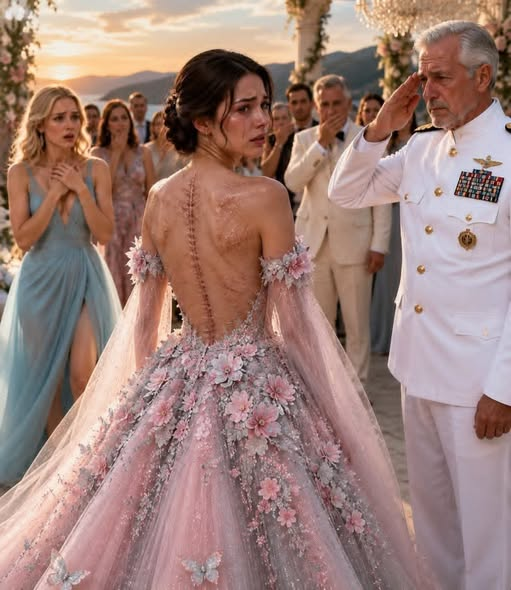
“Captain Vance,” Admiral Thorne said, his hand still raised in salute, “welcome home.”
For several seconds, nobody moved.
Then I returned the salute.
The ballroom seemed to inhale all at once.
My father’s glass slipped from his hand.
It shattered across the marble.
Audrey stopped smiling.
“Captain?” she whispered.
I turned toward her.
“Yes.”
My father stepped down from the stage.
“What is this?”
Admiral Thorne looked at him.
“Your daughter has served in the United States Navy for the past five years.”
Arthur stared at me.
“That’s impossible.”
“No,” I said quietly.
“You just never bothered to find out.”
Five years earlier, I had not “disappeared.”
I had left.
There was a difference.
My father wanted me inside Vance Maritime.
He had already chosen my position, my career path, even the man he thought I should eventually marry.
When I told him I had applied for military service, he laughed.
“You won’t last six months.”
Audrey laughed too.
My mother cried.
My father gave me one final choice.
“Stay and remain a Vance.”
“Or leave and don’t come crawling back when the real world teaches you what you’re worth.”
So I left.
And for five years, I never crawled anywhere.
I trained.
Worked.
Failed.
Improved.
Earned responsibility.
Eventually, I was assigned to a naval logistics and emergency-response unit operating in high-risk environments.
The scars on my back came from an accident during an emergency aboard a damaged vessel.
There was fire.
Structural failure.
Chaos.
I did what the people beside me were doing.
Our jobs.
Some sailors were trapped.
Several of us helped get people out.
I was injured.
That was all I was willing to say about it.
I had never considered my scars a trophy.
They were simply evidence that one terrible night had happened—
and that I survived it.
Audrey stared at my back again.
This time she did not laugh.
“You never told us.”
I looked at her.
“You never asked.”
Father’s face hardened.
“You intentionally hid this to humiliate me tonight.”
Admiral Thorne’s expression turned cold.
“Mr. Vance.”
My father stopped.
The admiral continued:
“Captain Vance did not arrange this.”
“I invited her.”
That silenced everyone.
My father looked around the ballroom.
Apparently, the Navy representatives attending his retirement gala had not come only for him.
Admiral Thorne explained that Vance Maritime was being considered for a major new defense logistics contract.
My father’s company had assumed his decades of industry connections would make the agreement almost automatic.
It wasn’t.
There would be independent review.
Oversight.
Performance requirements.
And one of the officers consulted during the technical evaluation happened to be me.
My father’s face went pale.
“You’re reviewing my company?”
“No.”
I shook my head.
“I disclosed the family relationship immediately and removed myself from decisions involving Vance Maritime.”
Admiral Thorne nodded.
“Exactly as she should have.”
That mattered.
I had not returned to destroy my father’s company.
I had no interest in revenge.
What I wanted was much simpler.
For once, I would not let the Vance name decide who I was.
My mother finally approached.
“Clarissa.”
Her hands trembled.
“Were you hurt badly?”
I almost laughed at the question.
Not because it was funny.
Because five years had passed before anyone in my family had thought to ask.
“I recovered.”
Tears filled her eyes.
“Why didn’t you call?”
“I did.”
She froze.
“Twice.”
The first time, one month after I left.
My father answered.
He told me I had made my choice.
The second time was after the accident.
Audrey answered.
She told me my parents were busy hosting investors and that if I needed money, I should “stop pretending to be independent.”
Audrey’s face drained of color.
“I didn’t know you were injured.”
“You didn’t ask why I was calling.”
She looked down.
My father stepped forward.
“Enough.”
That word.
The same one he had used throughout my childhood whenever reality became inconvenient.
He looked at the admiral.
“This is my retirement gala.”
Then at me.
“And she came here dressed like this to create a spectacle.”
I glanced at my torn blouse.
“No.”
“I came wearing a perfectly normal blouse.”
“Audrey created the spectacle.”
Dozens of guests turned toward my sister.
Her eyes widened.
For the first time, she understood that tearing my clothes in public had not made me look small.
It had only exposed her.
Admiral Thorne removed his jacket and held it out to me.
I shook my head.
“Thank you, sir.”
“But I’m fine.”
Then I looked at Audrey.
“If I cover them now, you’ll think you succeeded in making me ashamed.”
Her lips trembled.
“I was joking.”
“No.”
“You were humiliating someone because you thought nobody important would defend her.”
Audrey started crying.
I did not enjoy it.
There was no satisfaction.
Only exhaustion.
“I’m not going to destroy you over this.”
I paused.
“But we are not sisters in any meaningful sense after tonight.”
Her tears fell harder.
That consequence seemed to hurt her more than shouting would have.
My father followed me into the hallway when I finally left the ballroom.
“Clarissa.”
I stopped.
“You embarrassed me in front of everyone.”
I turned slowly.
“Still about you.”
His expression changed.
“You disappeared for five years.”
“I built a life for five years.”
“You rejected everything I created for you.”
“No.”
“I rejected the requirement that accepting your love meant obeying you.”
Silence.
Then he looked at the scars.
His face softened slightly.
“I didn’t know.”
“I know.”
For the first time, I let myself say what had been sitting inside me for years.
“That was the problem.”
“You didn’t know because you decided who I was before I had the chance to become anyone else.”
He sat down on a bench.
Suddenly he looked less like Arthur Vance, billionaire founder.
More like an aging father at the end of his career.
“Did you really think I wouldn’t be proud?”
I considered lying.
I didn’t.
“Yes.”
His eyes lowered.
“You told me I would fail.”
“I thought pressure would make you stronger.”
“It made me leave.”
That hurt him.
Good.
Not because I wanted him hurt.
Because perhaps pain was finally making the truth impossible to ignore.
I returned to duty two days later.
There was no dramatic takeover of Vance Maritime.
No canceled contracts because my feelings were hurt.
The company was evaluated according to the same standards as everyone else.
My father eventually retired as planned.
Audrey sent three apologies.
I answered the third.
Not with forgiveness.
With boundaries.
My mother began calling once a week.
At first, our conversations lasted four minutes.
Then ten.
Then twenty.
Some relationships can be rebuilt.
But only when the people who broke them stop demanding that rebuilding happen on their timetable.
Nearly a year later, my father came to see me.
No assistants.
No driver.
No gala.
He waited outside my office carrying a small box.
Inside was the piece of torn blouse Audrey had ripped from my back.
“I found it in the ballroom after everyone left.”
I looked at him.
“Why keep it?”
His eyes filled.
“Because it was the moment I realized I had spent five years telling everyone my daughter had disappeared.”
He swallowed.
“When really, I had simply stopped looking.”
I said nothing.
Then he asked:
“Can we start again?”
I thought about the father who had ordered me out of a ballroom.
Then about the man standing before me now.
“We can start differently.”
Not again.
Differently.
He nodded.
That was enough.
For the first time, he understood that being my father did not automatically give him access to the woman I had become.
He would have to know her.
People still tell the story of that retirement gala.
They remember the torn blouse.
The scars.
The shattered whiskey glass.
The admiral crossing the ballroom.
But they usually misunderstand the salute.
Admiral Thorne was not declaring me more valuable because I wore a uniform.
He was recognizing something my family had refused to see.
I had built a life without their approval.
The scars Audrey exposed were never proof that I had failed during those missing years.
They were proof there had been years my family knew absolutely nothing about.
Father thought I had returned as the disgraced daughter.
Audrey thought she was revealing my shame.
Instead, she uncovered the one truth the Vance family had spent five years avoiding:
I had never disappeared.
I had simply become someone they no longer had the right to define.
