Gunnery Sergeant Miller arrived eighteen minutes later.
He was not alone.
Two black government vehicles pulled into the parking lot.
Then a third.
Ryan Parker came out of the gun shop with his arms crossed.
“What is this?”
Nobody answered him.
Miller walked straight past him.
Straight toward Gordon Hayes.
The old Marine slowly stood.
Miller stopped three feet away.
Then snapped to attention.
“Sergeant Hayes.”
Gordon’s expression changed.
Not much.
Just enough for me to notice.
“You have the wrong man,” he said quietly.
Miller shook his head.
“No, sir.”
“We’ve been looking for exactly the right one.”
Then he saluted.
For several seconds, Gordon did not move.
Finally, he returned it.
Ryan laughed nervously behind us.
“What’s all this about?”
A colonel stepped out of the second vehicle.
He looked to be in his sixties.
The moment Gordon saw him, his face went still.
The colonel approached slowly.
“My name is Colonel Andrew Mercer.”
Gordon nodded.
“I know the name.”
Mercer swallowed.
“My grandfather knew yours.”
That was when Gordon looked away.
The story had begun seventy-three years earlier.
During the Korean War, Gordon had been a nineteen-year-old Marine.
His unit became trapped during a brutal winter engagement.
Communications failed.
Several men were wounded.
According to the official account, Gordon repeatedly exposed himself to danger to help move injured Marines to safety and keep his unit together until support reached them.
He received the Silver Star.
Then history moved on.
Gordon returned home.
Married.
Worked thirty-nine years repairing agricultural equipment.
Raised three children.
Buried his wife.
And almost never spoke about the war.
But there was another part of the story.
One that had disappeared inside an incomplete military file.
During that same battle, Gordon had helped save a young lieutenant named Thomas Mercer.
Colonel Andrew Mercer’s grandfather.
Thomas later became a senior Marine officer.
Before his death, he spent years trying to locate Gordon.
He never succeeded.
Records had been lost.
Addresses changed.
Names were entered incorrectly into old databases.
And Gordon Hayes quietly disappeared into civilian life.
Until that morning.
Colonel Mercer held out an old photograph.
Six Marines stood in snow.
One of them was Gordon.
Gordon stared at it for a long time.
“I haven’t seen this in seventy years.”
Mercer’s voice became rough.
“My grandfather kept a copy on his desk until the day he died.”
Gordon looked up.
“Why?”
“Because he said he would not have had a family without you.”
Nobody spoke.
Even Ryan stopped smiling.
Miller explained why Gordon’s name mattered now.
The Marine Corps historical office had been preparing an anniversary exhibit about the unit.
They had located surviving family members.
Letters.
After-action reports.
Photographs.
But Gordon remained missing.
He was believed to have died years earlier.
Then I called Miller.
And suddenly the name became real again.
Not a line inside an archive.
A man sitting outside a store with dust on his boots.
Ryan finally stepped forward.
“All right, this is very touching, but what does any of it have to do with my business?”
Colonel Mercer turned toward him.
“Were you the man who pushed Sergeant Hayes?”
Ryan’s confidence faltered.
“He was causing trouble.”
I stared at him.
“He asked for a part.”
Ryan pointed at me.
“Stay out of this.”
Gordon finally spoke.
“Son.”
Ryan looked at him.
“I didn’t ask anyone to come here.”
His voice was calm.
“I didn’t call the Marines.”
“I didn’t ask for you to lose your business.”
“And I’m not interested in revenge.”
Ryan relaxed slightly.
Too soon.
Gordon continued.
“But if you treat an old man badly because you believe he has nobody behind him, then the problem isn’t who that old man turns out to be.”
“It’s who you chose to be when you thought he was nobody.”
Ryan stopped talking.
There were security cameras inside Tactical Edge Armory.
The entire incident had been recorded.
The insult.
The shove.
Everything.
Local authorities reviewed what happened.
So did the shopping center that leased Ryan’s storefront.
Several customers who had witnessed the confrontation gave statements.
There was no dramatic military takeover.
No general closed the shop.
No convoy threatened anyone.
That was not how consequences worked.
Ryan simply had to answer for his own conduct.
And for the first time that day, being loud did not help him.
Gordon wanted to leave.
Colonel Mercer stopped him.
“There’s something else.”
He handed Gordon an envelope.
Inside was an invitation.
The Marine Corps planned to honor the surviving members and families from Gordon’s old unit at a ceremony later that month.
Gordon stared at the paper.
“I don’t do ceremonies.”
Mercer smiled.
“My grandfather warned us you’d say that.”
For the first time, Gordon laughed.
“What else did he say?”
“That if we ever found you, we weren’t supposed to let you escape.”
Gordon shook his head.
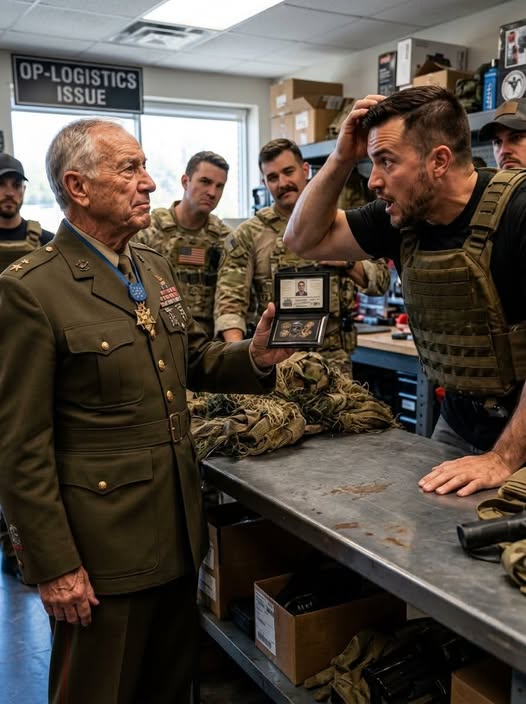
“Sounds like him.”
Then Mercer said quietly:
“He also left something for you.”
At the ceremony three weeks later, Gordon sat in the front row.
No spotlight.
No dramatic entrance.
Just an old Marine in a dark suit with his Silver Star pinned neatly to his chest.
Colonel Mercer read part of his grandfather’s final letter.
He did not read all of it.
Some things belonged to Gordon alone.
But one sentence was shared:
Tell Gordon Hayes that every birthday my children ever celebrated existed partly because he brought me home.
Gordon lowered his head.
I was sitting several rows behind him.
I saw him wipe his eyes once.
Only once.
Afterward, young Marines lined up to shake his hand.
Gordon looked uncomfortable with every second of it.
One corporal asked:
“Sergeant Hayes, why didn’t you ever tell people what you did?”
Gordon looked at the medal.
Then said:
“Because the men who didn’t come home don’t get to tell their stories.”
“So I never felt like mine was the most important one.”
Nobody knew what to say after that.
They didn’t need to.
Months later, I saw Gordon again.
He was sitting in a diner drinking coffee.
I joined him.
“You famous yet?”
He groaned.
“My daughter put that newspaper article on her refrigerator.”
“Terrible.”
“Absolutely humiliating.”
I laughed.
Then noticed the Silver Star was not on his jacket.
“Where is it?”
“At home.”
“You don’t wear it?”
“Only when somebody makes me.”
I smiled.
Then he looked at me.
“You know, son, you made one mistake that day.”
“What?”
“You thought you were helping me.”
“I was.”
“No.”
He shook his head.
“You made one phone call.”
“After that, a lot of people who should have remembered did the helping.”
Ryan Parker eventually issued a public apology.
Gordon never responded publicly.
He did not need to.
The story had stopped being about Ryan long before that.
It became about a man whose country had once written his name into a file and then accidentally allowed seventy years to pass without remembering there was still a person attached to it.
Gordon did not want money.
He did not want revenge.
He did not even want recognition.
What mattered was that somewhere, an old promise was finally completed.
Thomas Mercer had spent the rest of his life trying to find the Marine who helped bring him home.
His grandson finished the search.
And it happened because one stranger refused to watch an eighty-six-year-old man walk away believing nobody had noticed what happened to him.
I thought that phone call summoned powerful people.
I was wrong.
It did something simpler.
It reminded them that Gordon Hayes was still here.
And sometimes the greatest honor you can give someone who has been forgotten—
is to remember their name while they are still alive to hear it.
