Vanessa turned toward Daniel.
“Mr. Hayes.”
Her voice changed instantly.
Less offended.
More careful.
Daniel looked from her to me.
Then at the boarding pass resting beside my glass.
1A — GRACE BENNETT.
His expression sharpened.
“Miss Bennett and I have a meeting after landing.”
Vanessa froze.
I watched the realization spread across her face.
“You know each other?”
Daniel answered calmly.
“Professionally.”
Then he looked at me.
“Ms. Bennett represents the Bennett Strategic Fund.”
Vanessa’s face went completely pale.
That was the fund currently considering a major investment in Moore Capital’s new infrastructure division.
The same division Vanessa had spent eighteen months building.
And according to the briefing documents I had received—
the division she expected to lead if the investment closed.
Suddenly, seat 21A was no longer “just a seat.”
Vanessa recovered quickly.
“Grace, I had no idea.”
That sentence almost made me laugh.
“If you had known who I was, would your mother have given me my seat back?”
Silence.
Daniel looked at her.
“Her mother took your assigned seat?”
I nodded.
“And the cabin crew moved me to economy instead.”
Vanessa hurried to speak.
“My mother was feeling unwell.”
I looked toward business class.
Through the curtain, I could still see her leaning toward the window, taking photographs.
“Then she seems to have recovered remarkably quickly.”
Vanessa’s lips tightened.
Daniel said:
“If she was medically unwell, the crew should have handled it as a medical issue.”
“She should not have needed another passenger’s paid seat.”
Vanessa looked embarrassed.
“I was going to reimburse Grace.”
I held out my hand.
“Excellent.”
She blinked.
I smiled.
“Three thousand five hundred yuan.”
For several seconds, she did nothing.
Then she took out her phone.
The transfer arrived less than a minute later.
I checked it.
“Thank you.”
Vanessa probably expected the matter to end there.
It didn’t.
Daniel sat across the aisle from me after Vanessa returned to business class.
He waited until the cabin was quiet.
“Do you want to postpone the meeting?”
“No.”
“You’ve already had an unpleasant flight.”
“I came here to discuss an investment, not your employee’s mother.”
A faint smile appeared.
“Good.”
Then he became serious.
“But what happened concerns me.”
“Why?”
“Because Vanessa used our executive travel office to arrange this trip.”
I looked at him.
“And?”
“My assistant told me your original reservation was marked as a priority guest.”
He glanced toward the curtain.
“So I would like to know how a priority guest was nearly moved to economy without anyone informing my office.”
That was more interesting.
By the time we landed, Daniel had already requested an internal review.
I didn’t ask for it.
I didn’t threaten the investment.
And I definitely didn’t demand Vanessa lose her job.
That would have made the entire thing look like revenge over a seat.
Instead, I went to the meeting.
At nine thirty the next morning, I entered Moore Capital’s headquarters carrying a twenty-eight-page investment report.
Vanessa was already there.
Perfect suit.
Perfect makeup.
No trace of yesterday’s discomfort.
Daniel sat at the head of the table.
Three board members joined us.
Vanessa began her presentation.
She was good.
Very good.
That mattered.
She knew the numbers.
Understood the market.
And had built a division that could genuinely grow.
For the first hour, I almost forgot the airplane.
Then I reached page nineteen.
“Ms. Moore.”
Vanessa looked at me.
“The projected management expenses increase nineteen percent next year.”
“Yes.”
“What explains it?”
“International expansion.”
“Specifically?”
Her answer became vague.
Consultants.
Travel.
Executive support.
I turned one page.
“And this account?”
Her expression changed.
“Executive hospitality.”
“Your forecast puts nearly two million into it.”
“It includes client relationships.”
Daniel leaned forward.
“Grace, what are you seeing?”
I slid the document toward him.
“Nothing necessarily improper.”
Then I looked at Vanessa.
“But before my fund invests, I want a complete breakdown.”
She smiled stiffly.
“Of course.”
The breakdown arrived three days later.
And that was when seat 21A became relevant again.
Vanessa had been using Moore Capital’s executive travel concierge for personal family arrangements.
Not once.
Repeatedly.
Hotel upgrades for her mother.
Airport transfers.
Lounge access.
Special-service requests.
Most were small.
Some had been reimbursed later.
But several were buried inside business travel accounts.
More importantly, the travel concierge had received a message before our flight.
From Vanessa.
It said:
My mother prefers a window in business. If necessary, move someone flexible. She gets anxious when she cannot see outside.
There was no medical emergency.
No sudden dizziness.
It had been planned.
The crew member apparently believed accommodating the mother of a Moore Capital executive would avoid a complaint.
And I had been selected because I was traveling alone.
A woman.
Someone they assumed would be easier to pressure.
I read the message twice.
Then sent it to Daniel.
No commentary.
Just the document.
Vanessa came into the conference room an hour later.
She looked at me.
“You reported me.”
“No.”
“Your own records did.”
Daniel sat across from her.
“Did you send this?”
She looked at the printed message.
“Yes.”
“My mother hates aisle seats.”
I almost smiled.
“21A wasn’t an aisle seat.”
Vanessa said nothing.
Daniel continued:
“Did you authorize corporate resources for personal travel?”
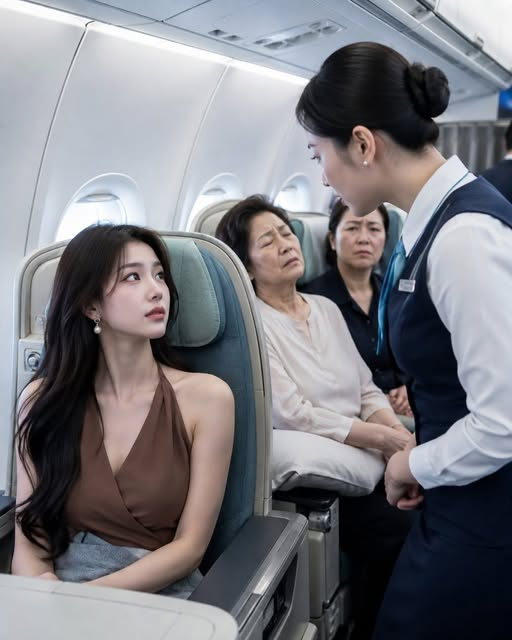
“Everybody does it occasionally.”
“That wasn’t my question.”
Her face hardened.
Then she made the worst possible choice.
She looked at me and said:
“This is all happening because she couldn’t give an older woman one seat.”
I closed my folder.
“No, Vanessa.”
“You still don’t understand.”
“This stopped being about my seat the moment you used company authority to make a stranger give you something you had no right to take.”
The room went silent.
The board did not fire Vanessa that day.
That would have been too easy.
Instead, an independent compliance review began.
The investigation found that the travel issue was part of a broader pattern.
Personal expenses routed through business accounts.
Undisclosed favors for relatives.
Vendor relationships involving family acquaintances.
Nothing large enough to destroy Moore Capital.
But enough to make the board question whether Vanessa should control a division managing billions.
She was removed from consideration for division president.
Later, she left the company.
Not because I demanded it.
Because when given more authority, she had repeatedly treated company systems as if they existed for her convenience.
The seat was simply the smallest example.
Her mother contacted me once.
I don’t know how she got my number.
“You ruined my daughter’s career.”
I answered:
“No.”
“She did.”
“You could have just let an old woman sit by the window.”
“You did sit there.”
Silence.
“And I paid for another seat.”
More silence.
Then I added:
“The problem was never that you wanted 21A.”
“The problem was that both of you believed wanting it was enough reason for somebody else to lose it.”
She hung up.
The investment went forward six months later.
But only after Moore Capital strengthened several internal controls.
Daniel never asked me to overlook what had happened.
That was one reason my board approved the deal.
At the signing ceremony, he shook my hand.
“I owe you an apology.”
“You already gave me one.”
“For the flight?”
He shook his head.
“For assuming our systems were strong because nobody complained.”
I understood.
Systems can look fair when only the people benefiting from them are speaking.
A year later, I boarded another flight.
Business class.
Window seat.
This time, nobody was sitting there.
The flight attendant smiled.
“Welcome aboard, Ms. Bennett.”
I sat down.
Placed my bag beneath the seat.
And looked out the window.
I thought about 21A.
The fake dizziness.
The passengers calling me selfish.
The employee trying to move me to economy because it was easier than asking the person in my seat to leave.
At the time, everyone thought I had lost.
I hadn’t.
I simply refused to spend the entire flight arguing with people who had already decided my purchase mattered less than someone else’s performance.
So I upgraded myself.
That was all.
Everything afterward happened because Vanessa made the mistake of believing entitlement stopped being entitlement when powerful people practiced it politely.
It doesn’t.
The woman in 21A thought pretending to be sick would get her a better seat.
Vanessa thought an apology would erase the method used to get it.
And neither knew the passenger they had chosen to inconvenience was the person evaluating whether Vanessa should be trusted with far greater responsibility.
But even if I had been nobody—
21A would still have been mine.
That was the lesson they understood too late.
Respect is not something you reserve for people after learning their title.
If you only behave properly once you discover who someone is, you were never respectful in the first place.
