The box I sent Kelsey was white.
Heavy.
Wrapped with a silver ribbon.
Exactly the kind of package she expected from me.
That mattered.
Because for months, she had been telling everyone that my husband and I were giving her “something substantial” for the wedding.
She assumed it would be money.
She wasn’t entirely wrong.
Inside the box was a check.
For $25,000.
But there was one problem.
Across the front, in red ink, I had written:
VOID.
Underneath it sat a photograph of my grandmother standing in front of her garden twenty years earlier.
She was smiling beside the roses Kelsey had ripped from the ground.
Then came twelve current photographs.
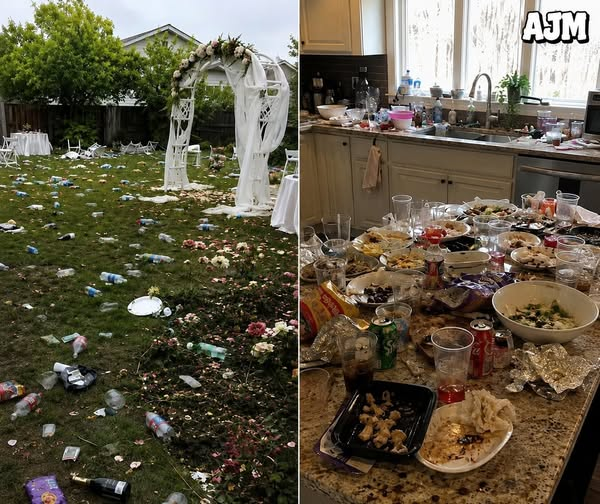
Destroyed flower beds.
Broken irrigation pipes.
Wine stains on the wooden floor.
Trash beside the lake.
A cracked porch railing.
Cigarette burns on one of Grandma’s hand-sewn cushions.
And finally, a photograph of the wedding arch.
My grandmother’s flowers woven through it like trophies.
Below those photographs was a folder.
The first page read:
PROPERTY DAMAGE — ITEMIZED RESTORATION COST
Professional cleaning: $3,800.
Floor repair: $4,600.
Damaged furniture and textiles: $7,250.
Irrigation replacement: $2,900.
Lawn restoration: $5,400.
Garden reconstruction using heritage varieties: $8,700.
Waste removal: $1,150.
Porch repairs: $2,300.
Total preliminary estimate:
$36,100.
And beneath it was a note in my handwriting.
Dear Kelsey,
We originally planned to give you $25,000 for your wedding. Since you decided to help yourself to something more valuable, consider that gift canceled. You now owe the remaining $36,100 for damage to property you were allowed to use—not destroy.
Congratulations.
That was when she called.
“YOU CAN’T DO THIS TO ME!”
I held the phone away from my ear.
“Do what?”
“TAKE BACK MY WEDDING MONEY!”
“It was never your money.”
“You promised!”
“No. Your brother told you we were planning a gift.”
“That’s the same thing!”
“No, Kelsey.”
I looked through the lake-house window at the ruined flower beds.
“It really isn’t.”
Her breathing became furious.
“You’re charging me thirty-six thousand dollars because of some stupid flowers?”
That sentence ended whatever guilt I might have felt.
“Those ‘stupid flowers’ were planted by my grandmother.”
“So replant them!”
“I will.”
“Then what’s the problem?”
“The person paying for it.”
She went silent.
Then laughed.
“You seriously think I’m giving you thirty-six thousand dollars?”
“No.”
I smiled.
“I think your insurance company might.”
Silence.
Complete silence.
Then:
“What insurance company?”
That was when I knew I had her.
When Kelsey asked to use the lake house, I had done one thing she apparently never bothered to think about.
I emailed her a simple temporary-use agreement.
Nothing dramatic.
No rent.
No deposit.
Just basic rules.
No structural changes.
No removal of plants.
No open flames inside.
Maximum guest count.
Professional waste removal required.
And responsibility for damage caused by her vendors or guests.
Kelsey had replied:
Fine. Whatever. I agree.
That email was enough for my attorney and insurer to begin sorting out responsibility.
And there was something else.
The photographer had documented practically the entire wedding.
So had the videographer.
Kelsey had proudly posted clips online.
In one video, she was standing beside my grandmother’s flower bed telling the wedding planner:
“Rip those out. They’re ugly. Use the good ones for the arch.”
The planner hesitated.
“Are you sure the homeowner approved that?”
Kelsey laughed directly into the camera.
“She’s my sister-in-law. She’ll get over it.”
I had downloaded the clip before she deleted it.
When I mentioned it, Kelsey stopped shouting.
“You saved my wedding videos?”
“You posted them publicly.”
“That’s creepy.”
“No.”
I looked toward the empty garden.
“Useful.”
Then she said the sentence I had been waiting for.
“My brother won’t let you do this.”
I closed my eyes.
There it was.
Her real confidence.
Not that she had done nothing wrong.
That my husband would protect her from consequences.
“Then call him.”
And I hung up.
My husband, Daniel, came home forty minutes later.
He looked exhausted.
“Kelsey called me.”
“I assumed she would.”
“She’s hysterical.”
“So was I when I saw the house.”
He put his keys down.
“Thirty-six thousand dollars?”
“Preliminary estimate.”
His eyes widened.
“Preliminary?”
“The landscaper hasn’t finished pricing the mature plants.”
Daniel rubbed his face.
“Look, what Kelsey did was awful.”
I waited.
“But…”
There it was.
The most dangerous word in any family dispute.
“But she just got married.”
“And?”
“She and Adam are starting their life.”
“So?”
“They can’t afford this.”
I stared at him.
“Then they shouldn’t have caused it.”
Daniel’s jaw tightened.
“You know what I mean.”
“Yes.”
My voice became quiet.
“You want me to pay for what your sister destroyed because I can afford it and she can’t.”
“That’s not fair.”
“It’s exactly what you’re asking.”
He stopped.
I continued.
“I told her not to remove anything from the garden.”
“I know.”
“She agreed.”
“I know.”
“She knowingly ignored it.”
He looked away.
I asked:
“If somebody destroyed your late father’s belongings because they didn’t match a party theme, would you tell yourself they were only things?”
That hit him.
His father had died six years earlier.
Daniel still kept his old watch in our bedroom drawer.
He never wore it.
He just couldn’t throw it away.
Finally, he sat down.
“What do you want me to do?”
“Nothing.”
He looked up.
“This is between Kelsey and me now.”
But it wasn’t.
Not entirely.
Because three days later, my mother-in-law called.
She didn’t ask how I was.
She didn’t ask how bad the damage was.
She opened with:
“You’re destroying your relationship with this family over landscaping.”
I laughed.
“Hello to you too, Diane.”
“Kelsey made a mistake.”
“She made about thirty-six thousand dollars’ worth.”
“That number is ridiculous.”
“I have contractor estimates.”
“She says you’re threatening lawyers.”
“I told her to contact my attorney if she disputes the damage.”
“She’s your sister.”
“No.”
I paused.
“She’s my sister-in-law.”
Diane’s voice turned cold.
“I’ve always treated you like a daughter.”
“Then imagine how you’d feel if I ripped up your mother’s garden and told you to clean it yourself.”
Silence.
Then:
“Kelsey said the flowers were already dying.”
I actually stopped breathing.
“My grandmother’s roses?”
“She said they looked old.”
“They were old.”
That was the point.
Several had been propagated from the original bushes my grandmother planted.
They could be replaced with the same varieties.
But they would never be those plants.
Diane sighed.
“Can’t you just let this go for family peace?”
I looked out at the torn earth.
“For whose peace?”
She didn’t answer.
Because in that family, peace had always meant the same thing.
Kelsey behaved however she wanted.
Everyone else adjusted.
I had simply refused to adjust this time.
A week later, something strange happened.
The wedding planner called me.
Her name was Rachel.
“I think you should know something.”
“What?”
“The restaurant wasn’t flooded.”
I went completely still.
“What did you say?”
“The original wedding venue.”
Rachel lowered her voice.
“There was no flood.”
I sat down.
“Kelsey told me forty-eight hours before the wedding that the restaurant flooded.”
“She lied.”
“Why?”
Rachel hesitated.
“Money.”
The original venue required Kelsey to pay the remaining balance two days before the wedding.
Nearly $18,000.
Kelsey’s parents had already given her money for that payment.
But instead of paying the venue, she canceled.
She claimed a family emergency.
Then she told everyone else the restaurant had flooded.
My lake house was free.
Her parents’ $18,000?
Still in her account.
I felt my anger become very, very calm.
“Do you have proof?”
“I have the cancellation emails.”
Rachel paused.
“And something else.”
“What?”
“Kelsey asked me not to tell you because she said the lake house would eventually belong to Daniel’s family anyway.”
I almost laughed.
“Excuse me?”
“She said you inherited it, but since you’re married to Daniel, it’s basically family property.”
There it was.
The real problem.
Not the flowers.
Not the trash.
Not even the money.
Kelsey believed my ownership was temporary whenever it interfered with what she wanted.
I thanked Rachel.
Then I called Daniel.
“Come to the lake house tonight.”
“Is something wrong?”
“Yes.”
“What?”
“Your sister lied about the flood.”
Silence.
“What?”
“And I think you need to hear the rest in person.”
Daniel arrived at eight.
I showed him everything.
The emails.
The cancellation.
The wedding planner’s statement.
The payment from his parents.
The video of Kelsey ordering Grandma’s garden ripped apart.
He watched it twice.
On the second viewing, his face went gray.
“She said you approved the flowers.”
“I didn’t.”
“She told Mom the florist accidentally damaged them.”
“They didn’t.”
He closed the laptop.
For a long time, he said nothing.
Then:
“I’m sorry.”
I looked at him.
Not a defensive apology.
Not I’m sorry you’re upset.
Just:
“I’m sorry.”
He called his sister from my kitchen.
I did not ask him to.
Kelsey answered cheerfully.
“Did you finally talk some sense into her?”
Daniel’s expression changed.
“Kelsey.”
Silence.
“Why did you lie about the venue flooding?”
She didn’t answer.
“Kelsey.”
“Who told you that?”
“So it’s true.”
“It was complicated.”
“You took Mom and Dad’s venue money?”
“I was going to use it for the honeymoon.”
Daniel closed his eyes.
“And then you used my wife’s home for free.”
“We’re family!”
“You destroyed her grandmother’s garden.”
“It was ugly!”
I watched my husband’s face.
Something in him finally broke.
“Kelsey, do you hear yourself?”
She went silent.
He continued.
“You lied to all of us. You pocketed eighteen thousand dollars. You used Emily’s house without paying for a venue. Then you destroyed part of it and told her to clean up.”
Kelsey’s voice became sharp.
“So now you’re taking her side?”
Daniel looked at me.
“No.”
Then he said:
“I’m taking the side of the person who didn’t lie.”
And for the first time since the wedding, I felt like I wasn’t standing alone.
Kelsey did not pay willingly.
Of course she didn’t.
First she denied the amount.
Then she blamed the vendors.
Then she said the guests caused the damage.
Then she insisted I should claim everything through my own insurance and “move on.”
Eventually, lawyers became involved.
The matter ended in a settlement.
Kelsey and Adam reimbursed a substantial portion of the restoration costs over time.
Her parents demanded she return what remained of the venue money.
The florist provided records showing Kelsey had personally selected plants from Grandma’s garden for the arch after being told not to.
And every vendor was permanently barred from entering the lake property again without my written permission.
But I did one thing nobody expected.
I kept the wedding arch.
Not the whole structure.
Just one section.
The flowers had dried.
Most were ruined.
But mixed inside them were several branches from Grandma’s climbing rose.
A horticulturist told me we might be able to propagate surviving material.
We tried.
Most failed.
One didn’t.
Months later, a tiny green shoot appeared.
I cried harder over that little leaf than I had over the entire legal fight.
Daniel wrapped his arms around me.
“Grandma’s rose?”
I nodded.
“Grandma’s rose.”
We replanted it beside the porch.
Kelsey didn’t speak to me for almost a year.
That was peaceful.
Then she appeared at the lake house one Saturday afternoon.
Alone.
No husband.
No mother.
No audience.
I remained on the porch.
“What do you want?”
She looked toward the restored garden.
The grass had grown back.
The porch was repaired.
New roses climbed along fresh supports.
“You fixed everything.”
“Almost.”
She walked toward one rosebush.
I immediately said:
“Don’t touch it.”
Her hand dropped.
For once, she listened.
“Is that one Grandma’s?”
“She wasn’t your grandmother.”
Kelsey flinched.
I regretted the sharpness instantly.
But I didn’t take it back.
She nodded.
“Right.”
Then she surprised me.
“I’m sorry.”
I waited.
No excuses came.
She looked at the ground.
“I thought because Daniel was my brother, everything connected to him was somehow mine too.”
I said nothing.
“And everyone always fixed things for me.”
Still nothing.
“Mom. Dad. Daniel.”
Her voice became smaller.
“So when you said no, I didn’t hear no.”
She looked at me.
“I heard temporary.”
That might have been the first honest thing she had ever said to me.
I stepped down from the porch.
“The worst part wasn’t the money.”
“I know.”
“It wasn’t even the mess.”
She nodded.
“It was the garden.”
“No.”
She looked confused.
“The worst part was when I called you afterward and you laughed.”
Her eyes filled.
I continued.
“You knew I loved this place.”
“I did.”
“And for five minutes, your wedding mattered enough that you decided my grief was ridiculous.”
Kelsey wiped her cheek.
“I don’t know how to fix that.”
“You don’t.”
I looked toward the roses.
“You just stop being that person.”
She nodded.
I didn’t hug her.
I didn’t invite her inside that day.
Forgiveness and access are not the same thing.
But it was a beginning.
Two years later, my grandmother’s rose finally bloomed.
One flower.
Small.
Deep pink.
I photographed it and put the picture beside Grandma’s old photograph in the kitchen.
Daniel came up behind me.
“She would have liked that.”
“She would have complained I planted it too close to the porch.”
He laughed.
Probably true.
The lake house remained mine.
Not Daniel’s.
Not Kelsey’s.
Not “the family’s.”
Mine.
But eventually, family gatherings returned there.
Smaller ones.
Respectful ones.
Nobody moved furniture without asking.
Nobody touched the garden.
And Kelsey?
The first time she brought her future child to visit, she stopped beside the roses and said:
“Those belonged to Aunt Emily’s grandmother. We look. We don’t touch.”
I heard her from the kitchen.
I smiled.
That was when I finally knew the lesson had lasted longer than the bill.
Kelsey thought my wedding gift was a box containing $36,100 worth of consequences.
It wasn’t.
The real gift was the first boundary in her life that nobody rushed in to erase for her.
And the gift she accidentally gave me?
She taught me that protecting something you love does not make you selfish.
Sometimes the people calling you selfish are simply angry that your generosity finally has a limit.
Grandma’s garden grew back.
The lawn grew back.
Even one of her roses came back.
But the version of me who allowed people to call disrespect “family” never did.
