Staff Sergeant Warren Cole entered the barracks at 1400 hours.
Every conversation died instantly.
His boots struck the floor in slow, deliberate steps as he moved down the line.
Then he stopped in front of Avery Bennett.
His eyes dropped to the field jacket buttoned to her throat.
“Bennett.”
“Staff Sergeant.”
“What’s the temperature outside?”
“One hundred ten degrees, Staff Sergeant.”
“And yet you’re dressed like it’s January.”
A few recruits suppressed laughs.
Cole didn’t.
“I’ve told you twice that nobody in my platoon gets special treatment because they’re uncomfortable being seen.”
Avery’s expression didn’t change.
“With respect, Staff Sergeant, I’m following the clothing guidance in my medical file.”
That killed the laughter.
Cole frowned.
“What medical file?”
“The one submitted during processing.”
For the first time, uncertainty crossed his face.
But only for a second.
Then his voice hardened.
“You expect me to believe someone cleared you to wear that in this heat?”
“Yes, Staff Sergeant.”
Cole stepped closer.
“Then take it off.”
Avery’s jaw tightened.
“Staff Sergeant—”
“That was an order.”
Nobody moved.
I remember thinking Avery would finally break.
Instead, she said:
“I request that the platoon medic be present.”
Cole stared at her.
For several seconds, the only sound was the ceiling fans.
Then he pointed toward the door.
“Fine.”
Sergeant First Class Ramirez from medical arrived ten minutes later carrying a tablet.
He looked irritated.
“What’s going on?”
Cole gestured at Avery.
“Private Bennett claims she has authorization for this jacket.”
Ramirez searched her file.
His expression changed immediately.
“Yes.”
Cole blinked.
“Yes what?”
“She does.”
The barracks became completely silent.
Ramirez looked at Avery.
“Private Bennett, are you comfortable explaining?”
She hesitated.
Then nodded.
“Only because this has become a platoon issue.”
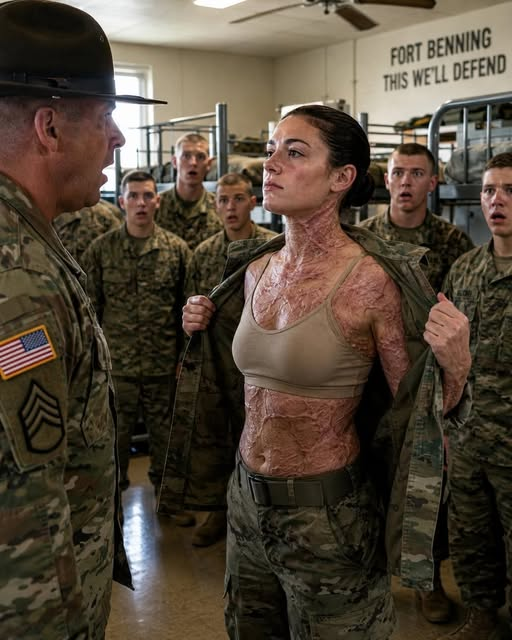
She slowly unbuttoned the jacket.
Nobody laughed.
Underneath, Avery wore a lightweight medical compression garment covering much of her upper body and arms.
And where the material ended, we could see extensive healed scarring.
Not fresh wounds.
Not bruises.
Old injuries.
Years old.
Cole’s face changed.
Avery kept her eyes forward.
“When I was thirteen, our apartment building caught fire.”
No one spoke.
“My younger brother was still inside.”
Her voice remained strangely calm.
“I went back for him.”
One recruit beside me lowered his eyes.
Avery continued.
“We both survived.”
She looked down at the compression garment.
“But I needed multiple surgeries afterward. Heat and direct sun can cause problems with some of the affected areas, and the garment helps protect my skin.”
Cole looked at Ramirez.
“You cleared her for training?”
“With restrictions reviewed by the medical board.”
Ramirez’s tone sharpened.
“She is cleared. The jacket is one of the approved options when conditions require additional coverage. If you had opened her file before turning this into a public spectacle, you would have known that.”
Cole said nothing.
That was the first time I had ever seen Staff Sergeant Warren Cole unable to answer.
But Avery wasn’t finished.
She buttoned the jacket again.
Then looked directly at him.
“I wasn’t hiding because I’m ashamed.”
Her voice was quieter now.
“I was hiding because every time strangers see the scars, they stop seeing me.”
That hit harder than any shouting could have.
“They ask what happened.”
“They stare.”
“They decide I’m fragile.”
“Or brave.”
“Or tragic.”
She swallowed.
“I didn’t come here to be any of those things.”
“I came here to be evaluated like everyone else.”
Cole’s expression tightened.
“And the shooting?”
Avery almost smiled.
“My father taught me before he died.”
A pause.
“He said steady breathing solves more problems than panic.”
Suddenly every perfect shot at the range made sense.
Not secret special forces training.
Not some mysterious military past.
Years of discipline.
Practice.
Control.
Cole dismissed the platoon early.
Nobody celebrated.
Nobody knew what to say.
That evening, Avery sat alone beside her bunk cleaning her boots.
I approached carefully.
“Bennett?”
She looked up.
“What?”
“I’m sorry.”
“For what?”
I felt embarrassed.
“The rumors.”
She nodded.
“You started any?”
“No.”
“But you listened.”
Fair.
“Yes.”
She returned to the boot.
“Then next time don’t.”
That was all.
No inspirational speech.
No instant friendship.
She simply expected better.
The story should have ended there.
It didn’t.
The next morning, Cole called Avery into an office.
Ramirez was there.
So was Captain Ellis, the company commander.
Avery later told me what happened.
Captain Ellis placed a folder on the desk.
“Private Bennett, your medical status was documented correctly.”
“Yes, ma’am.”
“The failure was ours.”
Avery said nothing.
Ellis continued.
“Your information should not have been challenged publicly. We’re reviewing how your accommodation was communicated through the chain of command.”
Cole stood beside the wall.
Then he spoke.
“Bennett.”
She looked at him.
“I was wrong.”
Apparently that surprised her more than the entire meeting.
Cole was not known for apologies.
He continued:
“I thought you were trying to avoid the same standard as everyone else.”
Avery answered:
“I wasn’t.”
“I know that now.”
He paused.
“And I should have known before I opened my mouth.”
No excuses.
No but you could have told me.
No blame.
Just responsibility.
Avery nodded once.
“Understood, Staff Sergeant.”
The command did not fire Cole.
Real life was less dramatic than that.
There was a review.
He received corrective counseling and was required to complete additional training on medical accommodations and privacy.
More importantly, the platoon’s procedures changed.
If a recruit had a documented medical accommodation, instructors received the operational information they needed without forcing the recruit to publicly explain private details.
Nobody wanted another morning like that one.
Something else changed too.
The jokes stopped.
Completely.
At first, people treated Avery too carefully.
That annoyed her even more.
During a training exercise, Private Dawson tried to take part of her equipment.
“I’ve got it.”
Avery grabbed it back.
“So do I.”
Dawson raised both hands.
“Okay.”
Later she told me:
“This is exactly what I meant.”
“What?”
“Yesterday I was the weird coward in a jacket.”
“Today I’m some inspirational survivor everyone wants to protect.”
She shook her head.
“Both are annoying.”
I laughed.
“So what should we do?”
“Treat me normally.”
That turned out to be surprisingly difficult for people.
But eventually we learned.
Avery continued outperforming most of us at the range.
Not every day.
She missed sometimes.
She got exhausted like everyone else.
She struggled with one obstacle course and had to repeat it.
That almost seemed to make her happy.
She didn’t want to be legendary.
She wanted to be ordinary enough that success and failure could belong to her effort rather than her past.
Cole began treating her exactly that way.
If she performed well:
“Good work, Bennett.”
If she messed up:
“Fix it, Bennett.”
No staring at the jacket.
No references to the scars.
No pity.
Oddly enough, that became the apology Avery valued most.
Near the end of training, temperatures climbed again.
One afternoon, we were waiting for transport when Cole walked past Avery.
He stopped.
Everyone noticed.
Months earlier, that moment would have meant trouble.
Instead, he asked:
“You managing the heat?”
“Yes, Staff Sergeant.”
“Need medical?”
“No, Staff Sergeant.”
“Good.”
He walked away.
Avery looked at me.
I grinned.
She rolled her eyes.
“Don’t.”
“I didn’t say anything.”
“You were about to.”
Probably.
Graduation arrived weeks later.
Families crowded the stands.
I noticed Avery scanning the audience.
Then her entire expression changed.
A teenage boy stood near the front beside an older woman.
He raised both arms and shouted:
“AVERY!”
She laughed.
Actually laughed.
It was the first time I had heard it.
“That’s him?” I asked.
She nodded.
“Your brother?”
“Yes.”
The same brother she had gone back for years earlier.
He was taller than she was now.
Perfectly healthy.
Extremely embarrassing.
He shouted again:
“DON’T CRY!”
Avery muttered:
“I’m going to kill him.”
I laughed.
“No, you’re not.”
“Unfortunately.”
After the ceremony, her brother hugged her.
Then noticed Cole standing nearby.
“Are you the instructor?”
Cole nodded.
The boy smiled.
“My sister says you’re terrifying.”
Avery immediately said:
“I never said that.”
“Yes, you did.”
Cole almost smiled.
Then the boy looked at Avery’s jacket.
“Still wearing that thing?”
She shoved his shoulder.
“Still talking too much?”
Somehow that ordinary sibling argument made everything we had imagined about Avery seem ridiculous.
She wasn’t a mystery.
She wasn’t a legend.
She was someone’s sister.
Someone’s daughter.
A recruit who happened to carry visible evidence of one terrible day from years ago.
Nothing more.
Nothing less.
Before leaving, Cole stopped her.
“Bennett.”
She turned.
“Yes, Staff Sergeant?”
He looked at her for a moment.
Then extended his hand.
She shook it.
“You earned your place here.”
Avery’s expression softened slightly.
“Thank you.”
Cole added:
“And for what it’s worth…”
He glanced at the jacket.
“I won’t make assumptions about one of those again.”
Avery smiled.
“Good.”
Then she walked away with her brother.
Months earlier, the entire barracks had obsessed over what Avery Bennett was hiding beneath a jacket in impossible Georgia heat.
We invented stories because the truth belonged to her and she had refused to give it to us.
Cole thought the jacket meant weakness.
Some of us thought it meant shame.
Others wanted something dramatic enough to satisfy our curiosity.
We were all wrong.
The scars beneath it did not explain why Avery was strong.
They did not explain why she could shoot.
They did not explain why she rarely complained.
They were simply part of something that had happened to her.
The real lesson came from what she said after Cole finally saw them:
“Every time people see the scars, they stop seeing me.”
After that day, we learned to do something harder than staring.
We learned to look at Avery Bennett—
and see Avery Bennett.
