The first clip showed my mother entering the apartment the morning after Maya came home from the hospital.
She opened the refrigerator.
Looked directly at the camera.
Then started packing.
Salmon.
Fruit.
Prepared meals.
Liam’s formula.
Even the sealed containers Maya’s doctor had recommended for recovery.
My sister Chloe arrived twenty minutes later carrying shopping bags.
She laughed when she saw the food.
“Perfect. We won’t have to buy anything for the road.”
My hands tightened around the phone.
Then Mark, Chloe’s husband, walked in.
He took two cases of formula from the counter.
“Ethan’s baby can use these.”
Ethan was Chloe’s close friend.
His wife had also recently given birth.
The formula I had paid for specifically because Liam needed it had been carried out of my home like party supplies.
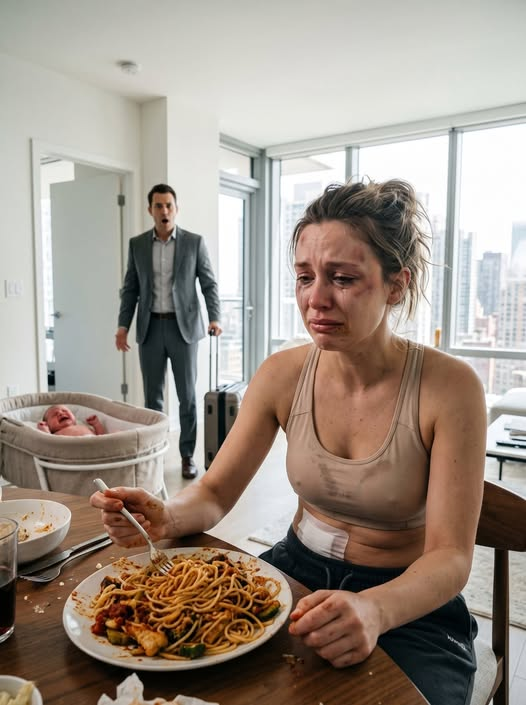
Beside me in the hospital, Maya was asleep with an IV in her arm.
I kept watching.
The next recording was worse.
My mother stood beside Maya’s chair.
“You don’t need David wasting fourteen thousand dollars on you.”
Maya’s voice was weak.
“He sent that for food, a postpartum nurse, and the baby.”
“You have me.”
My mother smiled.
Then she added:
“And since you’re not working, you should learn to be grateful.”
Maya looked down.
Chloe entered wearing a new designer handbag.
The same model that cost nearly four thousand dollars.
My mother admired it.
“Beautiful.”
Chloe laughed.
“David paid for it without knowing.”
Then they both laughed.
I stopped the video.
Fourteen thousand dollars.
I opened the bank records.
The transfer I had made to my mother was supposed to cover:
Groceries.
Maya’s medication.
A temporary home-care nurse.
Heating costs.
Baby supplies.
Emergency expenses.
Instead, within forty-eight hours, large amounts had gone toward hotel deposits, luxury shopping, restaurant reservations, and airfare upgrades.
Then I found something that changed the entire situation.
The home-care agency had actually called.
Twice.
My mother canceled the nurse herself.
In the recording, she told Maya:
“Why should we pay someone hundreds of dollars a day when you can lie down and recover by yourself?”
Maya whispered:
“David already paid for it.”
My mother answered:
“David’s money is family money.”
No.
It wasn’t.
And more importantly—
neither was Maya.
She was not free labor.
Not an inconvenience.
Not a woman who had to earn the right to recover after surgery.
I downloaded every clip.
Then I called the detective assigned after the hospital staff documented Maya’s condition.
“I have recordings.”
He asked:
“What kind?”
“Financial misuse. Abandonment. Removal of medical supplies. And possibly more.”
There was a pause.
“We’ll need copies.”
“You’ll have everything.”
At 2:08 a.m., another clip appeared.
This one was recorded three days earlier.
My mother and Chloe sat at my dining table.
Mark stood behind them.
Spread across the table were papers.
My papers.
I recognized one immediately.
A limited financial authorization I had given my mother before flying to Germany.
It allowed her to pay specific household and medical expenses from a restricted account while I was away.
Nothing more.
But Chloe was holding another document.
“Once David comes back, this expires.”
My mother answered:
“Then we use it now.”
Mark frowned.
“The bank may question the larger transfer.”
My mother waved him off.
“David never checks what I do. He trusts me.”
I felt sick.
Then Chloe asked:
“How much are you moving?”
My mother lowered her voice.
“Thirty-two thousand.”
That was not from the fourteen thousand.
It was from another account tied to my emergency household reserve.
Money they were never authorized to take for themselves.
My mother continued:
“We’ll call it reimbursement for caregiving.”
Chloe laughed.
“What caregiving?”
My mother looked toward the hallway where Maya was apparently resting.
“Exactly.”
The detective watched that clip twice.
Then said:
“This changes things.”
By sunrise, the bank had frozen the disputed transactions pending review.
And Miami police had been contacted.
My family was still celebrating.
They had no idea.
Maya woke shortly after six.
Her fever had begun coming down.
Liam was stable and warm beside her.
I sat near the bed.
She looked at me.
“You didn’t sleep.”
“No.”
“Did you call your mother?”
“No.”
Relief crossed her face.
Then I said:
“I called the police.”
She stared at me.
“David…”
“I saw the recordings.”
Her eyes immediately filled.
“I’m sorry.”
That word nearly destroyed me.
“For what?”
“I should have told you earlier.”
“No.”
I took her hand.
“You were recovering from surgery with a newborn while three adults convinced you that asking for food was selfish.”
She looked away.
“They said you were stressed about work.”
“I was.”
“They said if I complained, I’d ruin your relationship with your family.”
I closed my eyes.
Of course they did.
Maya whispered:
“Your mother said you would eventually get tired of supporting me.”
I looked at her.
“She was wrong.”
Then I corrected myself.
“No. I was wrong.”
Maya frowned.
“I left you dependent on people I should have monitored better.”
“You trusted your mother.”
“Yes.”
“And I trusted that if anything happened, you would tell me.”
I squeezed her hand.
“Neither of those mistakes belongs entirely to you.”
At 8:40 that morning, Chloe posted a photograph from Miami.
A rooftop breakfast.
Ocean behind them.
Champagne on the table.
My mother wearing sunglasses.
Mark holding a plate of lobster.
Caption:
Starting the new year the way we deserve.
Ten minutes later, police arrived at the resort.
I did not watch it happen live.
I did not need to.
Later, the detective told me they were questioned separately.
My mother initially claimed every dollar had been spent caring for Maya.
Then investigators showed her receipts from South Beach.
She changed her story.
Chloe said the trip had been a gift from me.
Then the bank records showed the money came from accounts she was not authorized to use.
Mark claimed he knew nothing.
Then the security footage showed him discussing the transfers.
Their stories collapsed faster than I expected.
Not because I was clever.
Because they had believed trust meant there would never be records.
My mother called me from an attorney’s office later that afternoon.
I answered once.
“David.”
Her voice was shaking with fury.
“You called the police on your own mother?”
“Yes.”
“Over money?”
“No.”
“Then what?”
I looked through the hospital window at Maya holding Liam.
“Over leaving my wife after emergency surgery without adequate food or care.”
“She was fine!”
“No.”
“The doctors disagree.”
Silence.
Then she snapped:
“Maya turned you against us.”
That sentence ended whatever remained.
“Maya defended you.”
My mother went quiet.
“She begged me not to confront you.”
Nothing.
“She was still protecting you while she was in the hospital.”
My voice dropped.
“You were never protecting her.”
Then my mother said:
“I raised you.”
“I know.”
“You owe me.”
I closed my eyes.
“No.”
“What?”
“I owe you respect when you behave with respect.”
I paused.
“I do not owe you permission to hurt my wife.”
She began crying.
For most of my life, that sound would have made me surrender.
That day it did not.
I said:
“From now on, communication goes through the lawyers.”
Then I hung up.
The financial review lasted months.
Not every expense resulted in criminal charges.
But enough of the conduct was serious.
The unauthorized transfers were investigated.
My mother and Chloe were required to repay substantial amounts.
The bank permanently removed their access from every account connected to me.
Mark lost the right to represent himself as an authorized user of any family funds.
The larger alleged misuse became part of a formal case.
I let investigators and attorneys handle it.
I had something more important to do.
Take care of my wife.
And learn how to be a father.
When Maya came home, it was not to the same apartment.
I could not ask her to recover in a place where every room reminded her of being abandoned.
We stayed in a furnished rental for three months while she healed.
I hired a licensed postpartum nurse.
Not because Maya was incapable.
Because she had just undergone surgery and deserved help.
I learned how to prepare Liam’s bottles.
How to change him without somehow getting his clothes crooked.
How to walk around the apartment at three in the morning until he stopped crying.
The first week, Maya woke and found me asleep in a chair with Liam against my chest.
She smiled.
“You’re holding him upside down.”
I woke instantly.
“What?”
She laughed for the first time since I returned.
“You’re not.”
“That isn’t funny.”
“It is from here.”
I laughed too.
That small sound felt like the first normal thing that had happened in weeks.
My mother asked to see Liam.
I said no.
Not forever.
But not yet.
Chloe sent gifts.
I returned them.
Then she wrote:
He’s my nephew too.
I replied:
Being related to a child does not automatically make you safe for that child.
I did not argue further.
Eventually, my mother entered counseling and completed every condition we required before even discussing supervised contact.
Chloe did not.
She continued insisting the entire situation had been exaggerated.
That became her choice.
And choices have consequences.
Maya never had to sit across a holiday table from someone who still believed her suffering was an inconvenience.
The following New Year’s Eve, there was no luxury party.
No rooftop.
No expensive champagne.
Just our small dining table.
Maya made soup.
I cooked badly enough that she took over halfway through.
Liam sat in his high chair banging a spoon against the tray.
At eleven thirty, exactly one year after I had opened the apartment door and found them in the cold, I became quiet.
Maya noticed.
“You’re thinking about last year.”
“Yes.”
She reached across the table.
“David.”
I looked at her.
“You came home.”
“Almost too late.”
“But you came.”
I nodded.
That distinction would probably stay with me forever.
Then Liam threw his spoon onto the floor.
Maya sighed.
“Your son.”
I picked it up.
“Interesting. He becomes mine whenever something hits the floor.”
She smiled.
“That’s marriage.”
The word stopped me.
Marriage.
Not blood.
Not obligation.
Not whoever shouted “family” the loudest.
It was the person beside you when life became inconvenient.
The person you chose to protect when nobody was watching.
The person who should never have to beg to matter.
My mother used to say:
David’s money is family money.
She was wrong.
The money was never the most important thing she took.
She took food from a recovering woman.
Formula from a newborn.
Help that had already been paid for.
Then she took the trust I had placed in her and spent it as casually as everything else.
But the security cameras gave me something back.
The truth.
They showed exactly who emptied the refrigerator.
Who canceled the nurse.
Who moved the money.
Who sat comfortably discussing “reimbursement” while Maya struggled alone in the next room.
My mother and sister believed they had three days before I returned.
They thought New Year’s Eve would erase the evidence beneath hotel lights and champagne.
Instead, before the fireworks were finished, every card was canceled.
Every recording was preserved.
And by breakfast—
the police were standing inside the resort where they thought my money had bought them safety.
One year later, I held my son while Maya laughed across the table.
And I finally understood what had almost cost me everything:
Providing for a family is not the same as protecting one.
I had sent money.
I should have made sure the people I loved were actually safe.
I could not change those eleven days.
But I could change every day after them.
And I did.
