The security guard leaned toward the monitor.
“Manager Tu… look at this.”
He rewound the elevator footage to 12:42 a.m.
A man in a hotel suit stepped out on the eighteenth floor.
Tu Vy’s face changed instantly.
“Deputy Supervisor Tran?”
He was the night-duty supervisor.
The person responsible for master access cards.
But he wasn’t alone.
A middle-aged woman walked out behind him.
The moment her face appeared clearly on the screen, my stomach dropped.
I knew her.
Tham Hao’s mother.
Tu Vy turned toward me.
“You know that woman?”
I could barely answer.
“She’s my boyfriend’s mother.”
No one spoke.
The guard switched cameras.
Mrs. Tham and Deputy Supervisor Tran did not approach Room 1818.
They entered Room 1820.
The room beside mine.
Then the guard checked the floor plan.
His expression changed.
“1818 and 1820 are connecting rooms.”
Cold spread through my entire body.
“There’s a connecting door?”
“Yes.”
“I never opened it.”
Tu Vy immediately said:
“Check the electronic access logs.”
Thirty seconds later, the result appeared.
12:48 a.m.
Master engineering authorization: connecting door opened.
Authorized by Deputy Supervisor Tran.
My hands began shaking.
Someone had unlocked the internal door between my room and the room next door while I was sleeping.
At 1:03, when room service arrived, somebody crossed from 1820 into my room and opened my door from the inside.
Then again at 1:35.
They had been inside Room 1818.
With me.
Sleeping only several meters away.
Tu Vy turned pale.
“Call security. Lock all access records.”
Then she looked at another employee.
“Call the police.”
Deputy Supervisor Tran was stopped before he could leave the hotel.
At first, he claimed it was a misunderstanding.
Then the security department showed him the access log.
His story changed.
Mrs. Tham had supposedly complained that I was “a future family member” and needed someone to “check whether the room was safe.”
Tu Vy stared at him.
“So you unlocked a guest’s connecting door without permission?”
Tran stopped talking.
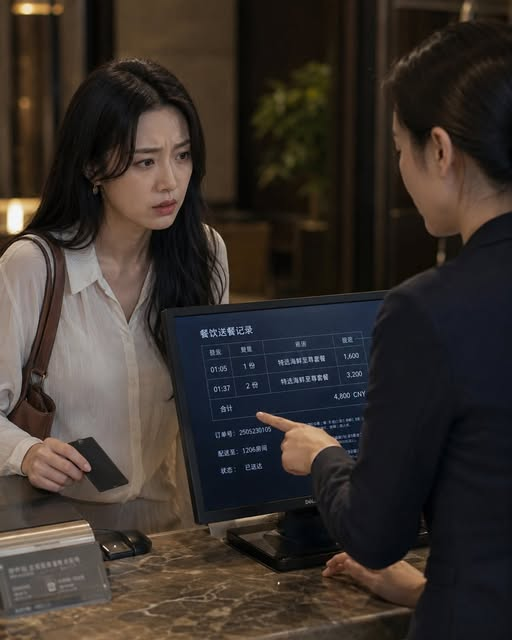
Then came the restaurant records.
The three premium seafood meals had not merely been charged incorrectly.
They had been deliberately signed to Room 1818.
The electronic signature belonged to Deputy Supervisor Tran.
One of the waiters admitted something else.
Tran had specifically instructed him:
“Don’t ask questions. The guest inside is resting.”
I looked at the screen.
“What happened to the food?”
The cameras answered that too.
At 2:11 a.m., Mrs. Tham and Tran emerged from Room 1820 carrying several takeaway containers.
They had eaten the food next door.
I had been given the bill.
Tham Hao arrived forty minutes later.
I had called him only once.
He came rushing into the security room.
“Lam Van!”
His face was filled with worry until he saw his mother sitting in the adjoining office with hotel security.
Then he stopped.
“Mom?”
Mrs. Tham stood immediately.
“Hao, this is being exaggerated.”
My heart sank.
Not because of her.
Because Tham Hao did not ask me whether I was okay.
His first question was:
“What did Mom do?”
Tu Vy explained.
Unauthorized access.
Master key.
Connecting room.
Falsified restaurant charges.
Police notification.
Tham Hao slowly turned toward his mother.
“Why?”
She looked at me.
Her expression contained no shame.
Only irritation.
“I wanted you to see what kind of woman she really was.”
I almost laughed.
“What kind?”
“A woman who pretends to be frugal.”
She pointed toward me.
“She tells you she wants to save for a house, but the moment the company pays for a luxury hotel, she starts enjoying herself.”
“But I didn’t order anything.”
“I know that now.”
That answer stunned even Tham Hao.
“You knew she didn’t order it?” he asked.
His mother frowned.
“That wasn’t the point.”
I finally understood.
She had never been trying to discover whether I was wasteful.
She had been trying to create proof that I was.
The police investigation later found messages between Mrs. Tham and Deputy Supervisor Tran.
She had promised him money for “helping with a family matter.”
One message said:
Put the expenses on her room. Tomorrow I’ll have the invoice.
Another:
Hao thinks she is simple and hardworking. He needs to see that people from poor families become greedy once they touch luxury.
I read that sentence once.
Then stopped.
For years, I had tried to make his mother like me.
I dressed modestly around her.
Never ordered expensive dishes.
Refused gifts from Tham Hao because I did not want her accusing me of using him.
I saved every month for our future apartment.
None of it mattered.
Because she had already decided who I was.
When reality refused to support her opinion—
she manufactured evidence.
Tham Hao followed me into the hotel lobby.
“Lam Van, wait.”
I stopped.
He looked exhausted.
“My mother went too far.”
“Too far?”
“Yes.”
I stared at him.
“Someone entered my room while I was sleeping.”
“I know.”
“She fabricated charges in my name.”
“I know.”
“She wanted to use them to make me look dishonest.”
“I know.”
He rubbed his forehead.
“But calling the police might destroy her reputation.”
There it was.
I became completely calm.
“She committed the act, Tham Hao.”
“She’s still my mother.”
“And I was supposed to become your wife.”
His face changed.
“Don’t make this about us.”
I almost laughed.
“It became about us the moment your first instinct was to protect her from the consequences instead of asking what it felt like for me to discover strangers had entered my hotel room while I slept.”
He went silent.
Then he said something worse.
“Mom told me earlier that she wanted to test you.”
My chest tightened.
“When?”
He hesitated.
“A few days ago.”
“You knew?”
“Not about the room.”
“But you knew she was planning something?”
“She said she wanted to see whether you were really as frugal as you claimed.”
I stared at him.
“And you allowed that?”
“I told her not to go overboard.”
That was enough.
I removed the apartment-savings card from my wallet.
The account we had been contributing to together.
“I’ll transfer your portion back.”
His face went pale.
“Lam Van.”
“We’re done.”
“You’re breaking up with me because of something my mother did?”
“No.”
I looked directly at him.
“I’m breaking up with you because you knew your mother wanted to test my character like I was applying for a position in your family—and you thought that was acceptable.”
He grabbed my wrist.
“Don’t decide while you’re angry.”
I pulled away.
“I’m not angry anymore.”
That frightened him more.
“I’m embarrassed that I spent three years trying to prove I deserved a family that believed it had the right to secretly examine me.”
The hotel did not ask me for 4,800 yuan again.
Obviously.
They issued a formal written apology.
The false charges were removed.
My company received confirmation that I had not violated any hotel policy.
Tu Vy personally apologized for initially insisting that “the system cannot make mistakes.”
“The system didn’t make the mistake,” I told her.
“People did.”
She nodded.
“Then we need a system that makes it harder for people to do this again.”
That response made me respect her.
The hotel changed its master-key procedures after the investigation.
Connecting-room access required dual authorization.
Unauthorized internal entry triggered an automatic security alert.
Night supervisors could no longer modify restaurant charges without a second employee’s approval.
Deputy Supervisor Tran was dismissed and faced investigation over the unauthorized access and falsified charges.
Mrs. Tham also had to answer for her role through the proper legal process.
I did not demand special punishment.
I gave my statement.
Preserved the evidence.
Then returned to work.
Tham Hao contacted me for months.
At first:
My mother wants to apologize.
Then:
She didn’t understand how serious it was.
Then:
I should have stopped her the moment she said she wanted to test you.
That last message was finally true.
I replied once.
Yes. You should have.
Nothing more.
He came to my apartment six months later.
I met him downstairs.
He looked thinner.
“My mother still asks if you’ll withdraw your complaint.”
“That is between her and the authorities now.”
He nodded.
Then said:
“I moved out.”
I looked at him.
“Why are you telling me?”
“I thought maybe you’d see I’ve changed.”
I almost felt sorry for him.
“You needed to move out because you wanted independence.”
“Not because you wanted me back.”
He lowered his head.
Then quietly asked:
“Was there ever a chance?”
I thought about the answer.
“Yes.”
His eyes immediately lifted.
“The moment you saw your mother in that surveillance video, if you had looked at me first and asked whether I was safe…”
I paused.
“Maybe.”
His face crumpled.
“But you asked what she had done wrong.”
That was the difference.
A year later, I bought a small apartment.
Not luxurious.
No river view.
No marble lobby.
But when I signed the mortgage, every yuan in the down payment belonged to me.
I stood in the empty living room with Claire—my coworker, not his family—and she laughed.
“You finally have your house.”
I looked around.
Bare walls.
Cheap windows.
A kitchen barely large enough for two people.
I loved it.
That night, I ordered food.
One meal.
Thirty-eight yuan.
When the deliveryman arrived, I opened the door myself.
For some reason, I started laughing.
Months later, Tu Vy sent me a message.
The hotel had completed its internal review.
She thanked me because the incident had exposed a security weakness that could have hurt someone else in the future.
At the bottom she wrote:
Room 1818 has been permanently removed from the connecting-room inventory unless both guests explicitly request access.
I stared at that sentence for a long time.
Room 1818.
The place where I had gone to sleep believing I was alone.
The place where someone entered silently because they thought my privacy mattered less than proving a point.
The place where a 4,800-yuan bill almost made me doubt my own memory.
People thought the strangest part of the story was that the hotel door opened from the inside while I slept.
It wasn’t.
The strangest part was discovering that the person who arranged everything had spent years telling her son:
“I only want to know whether Lam Van is trustworthy.”
In the end, the cameras answered that question.
Just not about me.
I had told the truth from the beginning.
I had not ordered the food.
I had not opened the door.
I had not lied about my spending.
The surveillance footage revealed something much more expensive than three seafood meals:
It showed me exactly what kind of family I had almost married into.
And the 4,800 yuan I refused to pay?
It became the cheapest escape of my life.
