I called the police without taking my eyes off Mark.
He still had not noticed me.
The paper cup contained a cloudy bath mixture.
The kitchen timer showed forty-three minutes remaining.
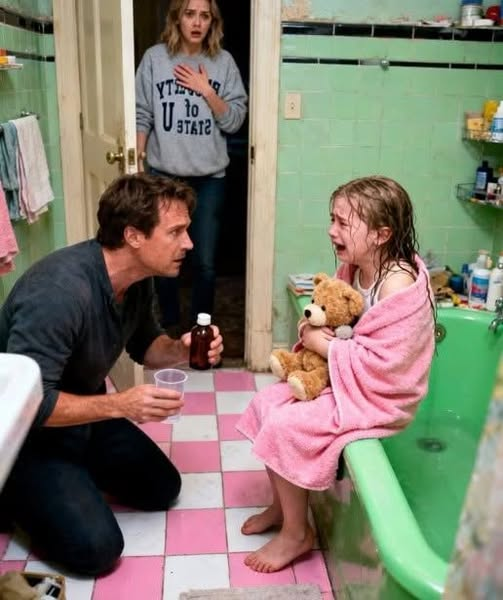
Sophie sat rigidly in the tub, her arms wrapped around herself.
Mark spoke softly.
“Remember. If you get out early, we start the timer again.”
Sophie began crying.
That was enough.
I pushed the door open.
“Get away from her.”
Mark spun around.
His face went white.
“What are you doing?”
I walked straight to Sophie and wrapped her in a towel.
She clung to me.
“Mommy, I’m sorry.”
Those words nearly broke me.
“You have nothing to be sorry for.”
Mark stood.
“You’re misunderstanding this.”
I held Sophie tighter.
“Then explain it to the police.”
His expression changed instantly.
“What police?”
The doorbell rang downstairs.
For the first time since I had known him, Mark looked frightened.
At the hospital, Sophie was examined privately by a pediatric team.
I stayed beside her.
No one forced her to explain more than she could handle.
Eventually, the truth came out in small pieces.
Mark had become obsessed with what he called “behavior training.”
He believed Sophie was too anxious.
Too sensitive.
Too difficult at bedtime.
So he had created long bath routines using an unapproved medicated mixture he claimed would “calm her nervous system.”
If she cried, moved too much, or asked to leave, he restarted the timer.
And he had convinced her it was a game.
A secret game.
Because, as Sophie finally whispered:
“Daddy said you’d stop him if you knew.”
He was right.
The pale marks on the towels came from the mixture.
Doctors found signs of repeated irritation and warned that continuing could have caused much more serious harm.
There was no harmless explanation.
There was only a father using secrecy and fear to control a five-year-old child.
The police photographed the bathroom.
They took the containers Mark had been using.
They preserved my phone recording.
And when officers searched the cabinet beneath the sink, they found handwritten charts.
Dates.
Times.
How long Sophie remained in the bath.
Whether she cried.
Whether she resisted.
Beside several entries Mark had written:
“Still too emotional.”
And:
“Do not tell Mom.”
I stopped reading.
I didn’t need another word.
Mark called me from the station that night.
I did not answer.
The next morning his mother did.
“You’ve destroyed his life.”
I almost laughed.
“My daughter was afraid to take a bath.”
“He was trying to help her.”
“He made a five-year-old believe she would be punished for telling me what happened.”
Silence.
Then she said:
“Families handle these things privately.”
“No.”
I looked through the hospital-room window at Sophie sleeping with her rabbit beneath her arm.
“That is exactly how children remain trapped.”
I hung up.
That afternoon, I filed for emergency custody protections.
Mark was ordered to remain away from Sophie while the investigation continued.
I changed the locks.
Then I removed every timer from the house.
Kitchen timer.
Phone timer.
Even the little hourglass Sophie had used while brushing her teeth.
For weeks, the sound of running bathwater made her nervous.
So we stopped using the bathtub completely.
She showered with the door open whenever she wanted.
Sometimes she asked me to sit outside and talk.
I did.
About school.
Cartoons.
Her stuffed rabbit.
Anything.
The goal was simple.
No secrets.
No fear.
No rules that existed only because an adult said Mommy must never know.
The investigation uncovered something else.
Mark had been warned before.
Months earlier, Sophie’s pediatrician had told him not to use unapproved treatments on her skin.
Mark had never told me.
Instead, he switched doctors and continued privately.
He had even told the new clinic that I supported the routine.
I didn’t.
He had simply counted on me never discovering it.
That became central to the case.
Not one strange evening.
A pattern.
Secrecy.
Deception.
Ignoring medical advice.
Teaching a child that fear was obedience.
Mark eventually admitted he knew I would object.
That admission ended any final doubt I had.
He had not hidden it because he thought it was harmless.
He hid it because he knew it was wrong.
Our divorce was finalized the following year.
The court put Sophie’s safety first.
Any contact Mark was allowed had to follow strict conditions and professional recommendations.
I never taught Sophie to hate her father.
I taught her something more important.
“You never have to keep a secret about something that makes you scared.”
She looked at me seriously.
“Even if a grown-up says I have to?”
“Especially then.”
“And you won’t be mad?”
“Never at you for telling me.”
She nodded.
Then hugged me.
Almost two years later, Sophie asked to take a bath again.
I froze for half a second.
She noticed.
“Mom?”
“I’m okay.”
She filled the tub with bubbles.
No powders.
No timer.
No locked door.
She brought three plastic boats and made up an absurd story about pirates stealing cupcakes.
Ten minutes later, she shouted:
“I’m done!”
I smiled from the hallway.
“Okay.”
She climbed out because she wanted to.
That ordinary moment felt bigger than any courtroom victory.
Mark had called those nights their “special routine.”
For a long time, I hated those words.
But eventually I understood something.
What made the situation dangerous was not the bathtub.
It was the secrecy.
The fear.
The idea that a child’s discomfort mattered less than an adult’s authority.
The night I looked through that partially open door, I thought I was about to discover what kind of man my husband really was.
I did.
But I discovered something else too.
My daughter had been waiting for one adult to believe her fear without demanding that she prove it first.
From that night forward, she never had to wait again.
