Detective Mercer opened the file.
The photograph on the first page was fifteen years old.
The woman was younger.
Longer hair. Thinner face.
But I knew those eyes.
Rebecca’s eyes.
Beneath the photograph was a different name.
Natalie Vaughn.
I stared at Mercer.
“That isn’t my wife.”
He said nothing.
I looked again.
It was her.
Mercer slid the folded note the trooper had given me across the desk.
On it were six words:
ASK MERCER ABOUT NATALIE VAUGHN. DON’T CONFRONT HER.
My mouth went dry.
“Who is she?”
Mercer leaned back.
“Fifteen years ago, Natalie Vaughn was connected to the disappearance of a man named Andrew Keller.”
He opened another photograph.
Andrew was twenty-nine.
He owned a small construction business outside Toledo.
Natalie had been his fiancée.
Three weeks before their wedding, Andrew told his sister that money was disappearing from his business accounts.
Then he vanished.
His car was eventually recovered.
Natalie disappeared days later.
So did her aunt.
Mercer turned another page.
Margaret Vaughn.
I stared at the photograph.
“That’s Margaret Ellis.”
“Yes.”
The woman whose house I had eaten dinner in the previous evening.
The woman Rebecca claimed was practically a mother to her.
Mercer continued.
“About a year later, a woman calling herself Rebecca Ellis appeared in another state.”
He slid over a copy of an old identification application.
Rebecca’s photograph.
Rebecca’s handwriting.
But the birth record attached to it belonged to a relative of Margaret’s who had died years earlier.
I pushed my chair backward.
“No.”
“I’m sorry.”
“We’ve been married thirteen years.”
“I know.”
“I’ve seen her passport.”
“Obtained under the same identity.”
My stomach turned.
“So my marriage…”
“Your attorney will have to determine the civil implications.”
I barely heard him.
There was only one question that mattered.
“Why did the trooper tell me not to go home?”
Mercer became quiet.
Then he asked:
“Has Rebecca recently asked you to sign any financial or estate documents?”
I almost said no.
Then I remembered.
Two months earlier, Rebecca had brought home what she called an updated estate-planning package.
She said everyone our age should have one.
I had signed where she marked.
Then, three weeks ago, she had suggested increasing our insurance coverage.
I told Mercer.
His expression hardened.
“Anything involving the house?”
My pulse quickened.
“She said we should refinance.”
“Did you?”
“I signed preliminary forms.”
Mercer immediately wrote something down.
“Nathan, I don’t know that your wife intended to hurt you.”
He looked directly at me.
“But fifteen years ago, another man discovered serious financial irregularities shortly before he disappeared. Until we understand what’s happening now, I don’t want you confronting her alone.”
For the first time since the traffic stop, I stopped thinking the trooper had overreacted.
I stayed in Ohio.
My attorney handled the first review of our finances.
By evening, he called.
“Nathan, do not go home.”
My hands went cold.
“What did you find?”
A home-equity application had been submitted using our property.
I had never agreed to the final version.
There were also transfers I didn’t recognize.
Small at first.
Then larger.
All moving toward an account connected to Margaret.
Over eighteen months, more than $317,000 had left accounts Rebecca and I shared.
I sat on the edge of the motel bed.
“For thirteen years she handled most of our bills.”
“I know.”
“What else?”
My attorney hesitated.
“There’s an insurance policy.”
“How much?”
“Enough that we’re taking this seriously.”
I closed my eyes.
Then my phone rang.
Rebecca.
I didn’t answer.
A message followed.
Where are you?
Then:
Why did you drive to Ohio?
I stared at those words.
She knew.
Another message arrived.
Nathan, come home. We need to talk before you do something stupid.
For thirteen years, Rebecca had never spoken to me that way.
The mask had slipped.
I forwarded everything to Mercer.
He replied with one sentence:
Stay where you are.
The next morning, police went to Margaret’s house with proper legal authorization.
The “old family photographs” Rebecca claimed she was helping organize were only part of what investigators found.
There were old documents under the Vaughn name.
Financial records connected to Andrew Keller’s business.
Multiple identity papers.
And boxes Rebecca had apparently begun packing.
She and Margaret had not been sorting memories.
They had been preparing to leave.
Rebecca was detained later that day.
The identification issue was confirmed.
My wife’s name was not Rebecca Ellis.
She was Natalie Vaughn.
When Mercer called me, I sat in silence for almost a minute.
Then I asked:
“Did she say anything?”
“Yes.”
“What?”
“She wants to speak with you.”
I almost refused.
But thirteen years deserved one final truth.
So I went.
She looked different without the familiar setting around her.
No kitchen.
No house.
No wedding photographs behind her.
Just a woman sitting across from me whose name I had never known.
I didn’t call her Rebecca.
I said:
“Natalie.”
Her eyes closed.
That told me more than any confession.
“So it’s true.”
“Yes.”
“Thirteen years.”
“I was going to tell you.”
I laughed.
“When?”
She started crying.
“It wasn’t supposed to become this.”
“What wasn’t?”
“My life.”
She told me a story.
Some of it investigators later confirmed.
Some of it I still don’t know if I believe.
Fifteen years earlier, she and Margaret had become involved in financial fraud connected to Andrew’s company.
Natalie claimed Margaret designed most of it.
Andrew discovered the missing money.
He threatened to report them.
Then he disappeared.
Natalie panicked.
Margaret convinced her that police would blame her regardless of what had actually happened to Andrew.
So they left.
New state.
New identity.
New history.
Eventually, she met me.
“I really loved you,” she whispered.
I stared at her.
“Was Nathan real to you?”
“Yes.”
“Then why were you moving our money?”
She looked down.
That was the question she couldn’t romanticize.
“Margaret said the old case was being looked at again.”
“So you were preparing to run.”
She said nothing.
“With my money?”
Tears rolled down her face.
“I was scared.”
“And the insurance?”
Her head snapped up.
“Nathan, no. I never planned anything like that.”
“Then why increase it?”
“Because Margaret told me it would make our finances look normal during refinancing.”
I no longer knew whether that was true.
And I realized something worse.
I would never know.
Every explanation Rebecca had ever given me was now contaminated by the fact that Rebecca had never existed.
I stood.
She panicked.
“Nathan.”
I stopped.
“Did you ever intend to tell me your real name?”
She cried harder.
“One day.”
“Thirteen years gave you 4,745 days.”
She covered her face.
“You had enough.”
Then I walked away.
The cold case changed dramatically several weeks later.
Andrew Keller was found alive.
That was the twist none of us expected.
He had left Ohio voluntarily after discovering the financial scheme.
He had been terrified that he would become responsible for debts and transactions he didn’t understand, so he walked away from his business and eventually rebuilt his life elsewhere.
Years later, he deliberately avoided everyone connected to the Vaughns.
When investigators finally reached him, he agreed to cooperate.
He confirmed Natalie and Margaret had been involved in diverting money from his company.
He also confirmed something important:
Natalie had not caused his disappearance.
But she had allowed everyone to believe he might be dead while she escaped under another identity.
The darkest suspicion disappeared.
The rest did not.
The financial crimes remained.
The false identity remained.
The money taken from our marriage remained.
So did the documents signed in my name.
Margaret and Natalie both faced the consequences of what investigators could actually prove.
I let the lawyers handle it.
I was finished living inside their secrets.
The divorce—or whatever the law ultimately called the end of a marriage entered under a false identity—took months to untangle.
Some of the money was recovered.
Some wasn’t.
I sold the house.
I could not sleep there again.
Not because I believed Natalie would return.
Because every room contained a memory that now came with a question.
Was that birthday real?
That anniversary?
That night she stayed awake when my father was hospitalized?
The way she cried during our wedding vows?
Eventually, my therapist asked me something that helped.
“Does discovering she lied about her identity mean every moment you experienced was imaginary?”
“No.”
“Then you don’t have to solve thirteen years all at once.”
That became my rule.
I stopped trying.
Natalie had lied.
I had loved her.
Both things could be true.
One did not cancel the other.
But love could not repair what trust had become.
Almost a year after the traffic stop, I received a letter.
No return address.
I knew the handwriting.
Nathan,
I don’t expect forgiveness.
Rebecca was a lie when I created her. Somewhere along the way, I started believing I could become her.
The wife you knew was not completely fake.
But I understand why that no longer matters.
You deserved to know who was standing beside you.
I’m sorry I waited until everyone else had to tell you.
At the bottom, she signed:
Natalie Vaughn.
I read the letter once.
Then put it away.
I never answered.
Some truths arrive too late to rebuild anything.
They can only explain the ruins.
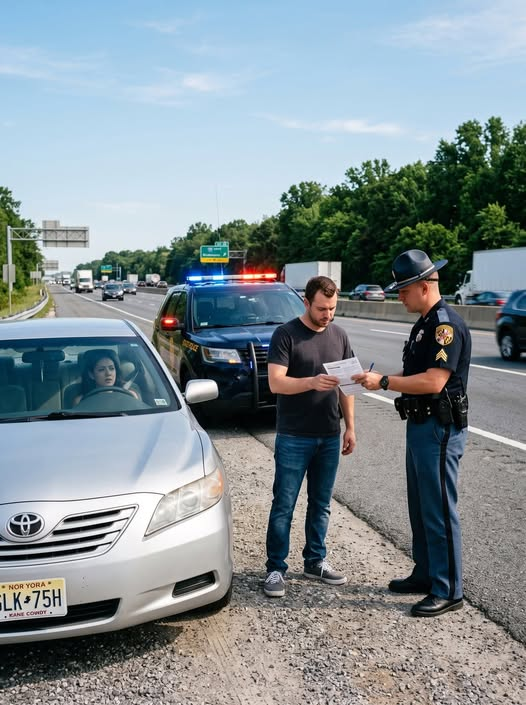
Months later, I was driving along Route 35 when I saw a state trooper finishing another traffic stop.
For a moment, I remembered the flashing lights.
Rebecca’s hands tightening around the steering wheel.
The officer looking at her license twice.
That tiny moment had divided my life into before and after.
I once thought he had saved me from something terrible that might happen that night.
In a way, he had done something larger.
He stopped me from spending the rest of my life inside a story that had never been true.
I had married Rebecca Brooks.
Shared thirteen years with her.
Built a house with her.
Trusted her with everything.
But there had never been a Rebecca Brooks.
There had only been Natalie Vaughn, running from a past she eventually tried to make me finance.
And the most frightening part was not discovering that my wife had another name.
It was realizing how easily a person can live beside a secret for years when love teaches you not to question the person holding it.
