After that Christmas kiss, Tieu Tri and I stopped pretending.
There was never a formal confession.
One day we were a fake couple.
The next, he was waiting outside my lecture hall with cake because I had skipped lunch.
Then he began remembering my exam schedule better than I did.
When I worked part-time at night, he sat in the last booth until closing.
He never said, “I love you.”
Neither did I.
But we stayed together through college.
Then graduation came.
And suddenly love was no longer enough.
Tieu Tri returned to his family business.
I took an ordinary job.
He became busier.
I became increasingly aware of the distance between our worlds.
His family introduced him to daughters of wealthy families.
He always told me:
“Give me time.”
At first, I did.
Then one year became another.
Every time I asked about our future, the answer was still:
“Wait a little longer.”
Five months ago, I finally stopped waiting.
That night, he had missed dinner with me for the third time that month.
I asked:
“Were you with Tham Tri Y?”
He didn’t deny it.
“It was a family dinner.”
“Your family wants you to marry her.”
“I know.”
“And?”
He rubbed his forehead.
“I’m dealing with it.”
That answer broke something in me.
“You’ve been dealing with it for years.”
He looked at me.
“So what do you want?”
“I want to know if there is actually a place for me in your future.”
His silence lasted too long.
Not because he didn’t love me.
I understand that now.
But that night, silence was all I heard.
So I said:
“Let’s break up.”
Tieu Tri’s face turned cold immediately.
“Fine.”
One word.
Seven years ended with one word.
Two weeks later, I discovered I was pregnant.
Three days after that, the newspapers announced Tieu Tri’s engagement to Tham Tri Y.
I deleted his number.
And told myself our child would never become a bargaining chip in a relationship that had already ended.
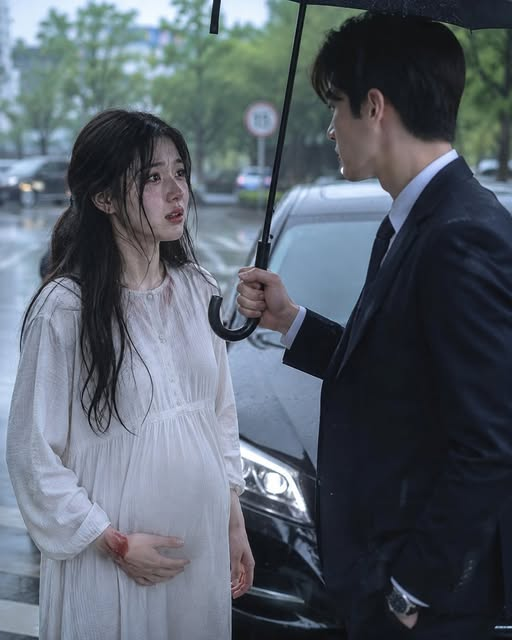
Now, five months later, I was standing beside a road with a scraped wrist, staring at the man I had spent years trying to forget.
My electric scooter had lightly struck the side of his car.
Tieu Tri got out.
His first glance went to the vehicle.
His second went to me.
Then his eyes dropped to my stomach.
His expression changed.
“Where is your husband?”
I blinked.
“What?”
“The man from the hospital.”
His voice became colder.
“Call him. We’ll discuss the damage.”
I finally understood.
He thought the stranger who had brought me to the hospital was my husband.
“He isn’t my husband.”
Tieu Tri froze.
“What?”
“I don’t have a husband.”
His gaze slowly returned to my stomach.
The silence became unbearable.
“How far along are you?”
I looked away.
He stepped closer.
“How far?”
“Almost six months.”
I watched the calculation happen on his face.
Then all the color disappeared.
His voice came out almost inaudibly.
“Is it mine?”
I could have lied.
For one second, I wanted to.
Then I thought about the child.
Whatever had happened between us, she did not deserve to begin life inside another lie.
“Yes.”
Tieu Tri stopped breathing.
Cars passed behind us.
Someone honked.
Neither of us moved.
Finally he asked:
“You knew?”
“Yes.”
“When?”
“Two weeks after we broke up.”
His eyes reddened.
“And you didn’t tell me?”
“You got engaged.”
“That happened afterward.”
“I know.”
“You could have called me.”
I laughed.
“You stood in a hospital hallway today and told your fiancée I was a stranger.”
His jaw tightened.
“Because I thought you had married someone else.”
“And I thought you had chosen someone else.”
That silenced both of us.
My wrist was still aching.
Tieu Tri noticed.
His entire expression changed.
“Get in the car.”
“No.”
“You need that checked.”
“It already was.”
“You’re hurt.”
“So is your car. Send me the repair invoice.”
I picked up the scooter handle.
He took it from me.
“Tieu Tri.”
“Not negotiable.”
I looked at him.
Years ago, I would have followed simply because he told me to.
This time I held out my hand.
“Give it back.”
He stopped.
Then slowly released it.
That small movement mattered.
He finally seemed to understand that pregnancy did not return authority over me to him.
I left.
He didn’t follow.
That evening, Tham Tri Y called me.
I nearly rejected the call.
Then curiosity won.
“Hello?”
Her voice was surprisingly direct.
“Miss Lin, I owe you an explanation.”
“You owe me nothing.”
“Probably true. But I’m giving you one anyway.”
She paused.
“My engagement to Tieu Tri is ending.”
I sat upright.
“What?”
“He came to my house this afternoon.”
My heart began pounding.
“He told both families the engagement was canceled.”
“Because of the baby?”
“No.”
Her answer surprised me.
“He said if he canceled it only because you were pregnant, he would be insulting both of us.”
I said nothing.
Tri Y continued:
“Our engagement was arranged after you two separated. Neither of us particularly wanted it.”
“Then why agree?”
“My family wanted the alliance.”
A dry laugh.
“His family wanted him to finally stop waiting for you.”
My fingers tightened around the phone.
“He was waiting?”
Tri Y became quiet.
“You really don’t know?”
“No.”
“He refused every introduction for years.”
My chest hurt.
“Then why did he tell me to wait instead of choosing me?”
“That,” she said, “is something you should make him answer.”
So I did.
Two days later, Tieu Tri appeared outside my apartment.
No flowers.
No expensive gifts.
Just a folder.
“What’s that?”
“Medical insurance information.”
I stared at him.
“For the baby?”
“Yes.”
“I can pay for myself.”
“I know.”
That answer made me look up.
He continued:
“I’m not here because I think you need rescuing.”
“Then why?”
“Because I’m her father.”
He sat across from me but kept his distance.
“I canceled the engagement.”
“I heard.”
“Tri Y called you?”
“Yes.”
He sighed.
“I asked her not to interfere.”
“She said you’d say that.”
For the first time, his mouth almost curved.
Then I asked:
“Why did you keep making me wait?”
The smile vanished.
Tieu Tri was silent for a long time.
Finally:
“Arrogance.”
I hadn’t expected that answer.
“My grandfather controlled most of the family voting shares. He told me if I married you, he would remove me from the company.”
“So?”
“I decided I would build enough independent control that nobody could threaten us.”
I stared at him.
“You never told me.”
“No.”
“Why?”
“Because I thought telling you would make you feel guilty.”
His voice lowered.
“And because I assumed you would wait.”
There it was.
Not a grand conspiracy.
Not another woman.
Something simpler.
And almost as damaging.
He had taken my loyalty for granted.
“You decided everything alone.”
“Yes.”
“You let me believe I had no future with you.”
“Yes.”
“And when I finally left?”
His eyes dropped.
“I was furious.”
“So you got engaged.”
“Yes.”
“Very mature.”
“No.”
He looked at me.
“It was probably the stupidest decision I ever made.”
I wanted to stay angry.
Unfortunately, honesty made that difficult.
Tieu Tri continued:
“I’m not asking you to come back.”
I looked at him sharply.
“I want to attend the appointments if you allow it.”
“And if I don’t?”
“I’ll respect it.”
“I want the baby to have my name.”
“That’s her mother’s decision too.”
“You’ve changed.”
“No.”
He smiled sadly.
“I’m learning.”
So I let him come to the next appointment.
He sat beside me without touching me.
When the doctor showed the baby on the monitor, Tieu Tri stared as if the screen contained the answer to every question he had ever asked.
Then he quietly said:
“She has your nose.”
I almost laughed.
“You can barely see her face.”
“I’m confident.”
“You always are.”
“Yes.”
That was the beginning.
Not of our reconciliation.
Of his relationship with his daughter.
He attended appointments.
Bought things only after asking.
When my eyesight made traveling difficult, he arranged rides but never appeared uninvited.
When I said I wanted space, he left.
Sometimes we argued.
But he no longer punished me with silence.
He said:
“I’m angry. I’ll call tomorrow.”
And tomorrow, he actually called.
Our daughter was born several months later.
We named her An An.
The first time Tieu Tri held her, the man who had once looked at me in the hospital and said “unfamiliar” cried without trying to hide it.
He whispered:
“I’m sorry I almost missed you.”
I knew he wasn’t speaking only to the baby.
But I did not answer for her.
For the first year, we remained separated.
That surprised everyone.
His family expected me to return immediately.
My friends assumed the child would reunite us.
Even Tieu Tri’s mother once asked:
“What more do you want? He canceled the engagement.”
I answered:
“I want a relationship that exists because it works, not because we have a child.”
Tieu Tri heard about that conversation.
He never asked me to change my mind.
That was probably what changed it.
He stopped trying to convince me.
Instead, he became reliable.
An An’s vaccinations?
He remembered.
Her first fever?
He stayed awake beside her, then went to work looking terrible the next morning.
My new job interview?
He watched An An without asking where I was going or when I would return.
He finally learned what I had wanted all those years.
Not promises about someday.
Presence today.
Nearly two years after that roadside accident, we returned to the same cake shop we had visited in high school.
The tables were different.
The owner had changed.
But the cakes looked almost exactly the same.
Tieu Tri ordered two.
I stared at him.
“You still don’t eat sweets.”
“I do now.”
“Since when?”
“Since someone stopped eating mine for me.”
I laughed.
An An was asleep in her stroller beside us.
After a while, Tieu Tri took something from his pocket.
Not a ring.
A folded piece of paper.
I opened it.
It was our original high-school “fake girlfriend agreement.”
At the bottom, he had added one sentence.
New proposal: no payment, no pretending, no waiting without answers.
I laughed until my eyes watered.
“You kept this?”
“For eleven years.”
“You’re ridiculous.”
“Yes.”
Then he became serious.
“I don’t want you to marry me because I’m An An’s father.”
I looked at him.
“I don’t want you to marry me because our families expect it.”
He paused.
“And I don’t want you to answer today.”
That was how I knew my answer.
Because years earlier, the boy sitting beside me had always assumed I would stay.
The man in front of me had finally learned that staying had to remain my choice.
I reached across the table.
“Then stop talking.”
He blinked.
“Tieu Tri.”
“Yes?”
“I’ll marry you.”
For once in his life, he looked completely speechless.
I smiled.
“But I have conditions.”
His expression immediately became serious.
“Tell me.”
“No arranged engagements.”
“Agreed.”
“No deciding what is best for me without asking.”
“Agreed.”
“And when I ask about our future—”
“I answer.”
I nodded.
“Then we have a deal.”
He looked at our sleeping daughter.
Then back at me.
“No.”
I raised an eyebrow.
He smiled.
“This time, it isn’t a deal.”
Years earlier, Tieu Tri paid me to pretend to be his girlfriend.
Then we accidentally fell in love.
Later, we lost each other because he believed love meant I would always wait for him.
Five months after our breakup, we met again in an obstetrics department.
He looked at my stomach.
Looked at the man standing behind me.
And called me a stranger.
He had no idea the child I carried was his.
But the most important thing he learned afterward was not that he was going to become a father.
It was that neither fatherhood nor love gave him the right to claim me.
He had to choose us.
Then show up.
Again.
And again.
Until one day, I chose him too.
Not because we had once loved each other enough to shake heaven and earth.
Because this time, we had finally learned how to stand on the same ground.
