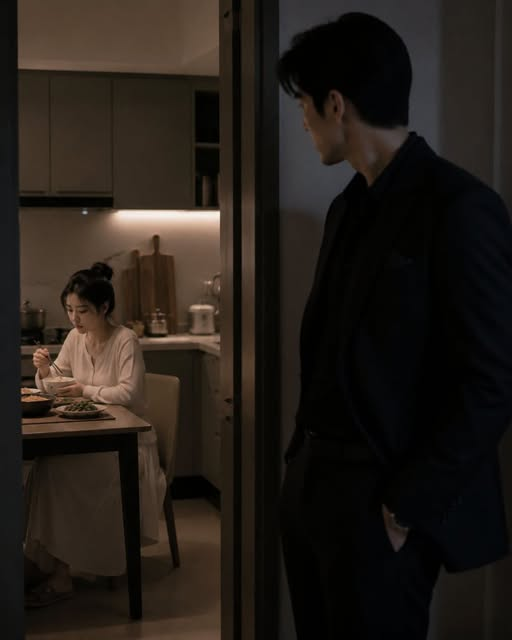
I stood outside that kitchen window until Clara finished eating.
She rinsed her bowl.
Wiped the counter.
Then opened the refrigerator.
Inside were containers arranged neatly on two shelves.
One had my name written on it.
Another said Dad.
Another Lily.
Nothing said Clara.
She stared at them for a few seconds, closed the refrigerator and went upstairs.
I remained outside.
For the first time in six months, I understood something I should have noticed much sooner.
Clara had not become quiet because she was comfortable in my family.
She had become quiet because every complaint had taught her that nobody was going to choose her.
Especially me.
I entered the apartment ten minutes later.
My mother looked surprised.
“You’re back?”
“I forgot something.”
She smiled.
“Your wife already ate.”
I looked at her.
“What did she eat?”
The smile remained.
“Food.”
“What food?”
My father looked up from the television.
Lily stopped scrolling.
Mom’s expression changed slightly.
“Whatever was left.”
I nodded.
“Why wasn’t there meat?”
Silence.
“Why wasn’t there fish?”
My mother frowned.
“Ethan, what is this?”
“Why did Clara eat standing in the kitchen while all of you ate seven dishes at the table?”
Her face hardened.
“She comes home late.”
“That wasn’t my question.”
“Your father needs to eat early.”
“That wasn’t my question either.”
Lily finally spoke.
“Brother, don’t make this dramatic. Clara never complains.”
I turned toward her.
“That doesn’t mean she’s okay.”
She rolled her eyes.
“She’s an adult.”
“So are you.”
I pointed at the table.
“And somehow she cooks breakfast for you before work.”
Lily stopped.
I had noticed that much, at least.
Every morning there were sandwiches prepared.
Fruit cut.
Coffee ready.
I assumed Mom did it.
Now I wasn’t sure of anything.
Clara came downstairs wearing pajamas.
The moment she saw me, she froze.
“You came back?”
“Yes.”
My mother immediately said:
“Your husband is interrogating us because apparently we didn’t leave you enough dinner.”
Clara’s face changed.
Not relief.
Fear.
That hurt worse.
She looked at me.
“It’s fine.”
“No, it isn’t.”
“Ethan.”
“I saw you.”
Silence.
Her hands slowly tightened around the sleeves of her sweater.
“I saw what you ate.”
My mother stood.
“You were spying on us?”
I ignored her.
“How long?”
Clara looked at the floor.
“How long have they been giving you leftovers?”
“Don’t ask.”
“How long?”
Finally:
“About six months.”
I felt sick.
Six months.
I had eaten dinner with clients.
Ordered steaks to the office.
Complained about bad room-service pasta during business trips.
And my wife had been eating cold rice with hot sauce in the kitchen of the home I told everyone was hers too.
My mother snapped:
“She’s making it sound worse than it is.”
Clara flinched.
I saw it.
A tiny reaction.
But suddenly I knew it had happened many times before.
“What else?”
Clara shook her head.
“Nothing.”
I looked at my mother.
“What else?”
She crossed her arms.
“Don’t speak to me like I’m some criminal.”
“I’m asking what has been happening in my house while I’m gone.”
Mom laughed sharply.
“Your house?”
That sentence changed the room.
She continued:
“Your father and I sold our apartment to help you with the down payment.”
“You invited us to live here.”
“We raised you.”
“We sacrificed for you.”
“And now because your wife doesn’t get the best piece of fish, suddenly we’re monsters?”
My father whispered:
“Enough.”
Mom turned on him.
“You stay out of this.”
I looked at Clara.
She had gone completely still again.
Too still.
I asked:
“Did they ever tell you this wasn’t your house?”
She said nothing.
That was enough.
Lily suddenly stood.
“This is ridiculous.”
She pointed at Clara.
“She acts like a victim all the time.”
Clara looked at her.
“I don’t.”
“You don’t need to say it.”
“You walk around looking miserable so everyone feels guilty.”
I stared at my sister.
“What did she do to you?”
Lily laughed.
“She married you.”
I frowned.
“What?”
Mom said quickly:
“Lily, stop.”
But she continued.
“Before Clara came, you paid for my graduate school.”
“You helped Mom and Dad more.”
“Then suddenly everything became ‘we need savings’ and ‘Clara and I are planning our future.’”
I looked at her in disbelief.
“You’re twenty-four.”
“So?”
“So my marriage is not responsible for funding your entire adult life.”
Her face went red.
Mom immediately defended her.
“She’s your sister.”
“And Clara is my wife.”
The room went silent.
I realized, with shame, that perhaps I had never said those words firmly enough before.
Clara whispered:
“Ethan, please stop.”
I turned to her.
“Why?”
Her eyes finally filled.
“Because tomorrow you’ll go back to work.”
That sentence hit harder than anything else.
I stared at her.
She continued quietly:
“You’ll be gone until eight.”
“Your mother will still be here.”
“Your sister will still be here.”
“And I’ll be the one living with what you said tonight.”
Nobody moved.
There it was.
The whole truth.
I could defend her for twenty minutes and then disappear for fourteen hours.
She had learned that my protection came with office hours.
I asked:
“What happened when you complained before?”
Clara gave a small, tired laugh.
“You told me your mother was adjusting.”
I remembered.
Months earlier, Clara had said:
“Your mom doesn’t seem to like me living here.”
I answered:
“She gave up her own home to help us. Give her time.”
Another memory.
“Lily keeps taking my skincare without asking.”
I had said:
“She’s young. Don’t fight over little things.”
Another.
“Your mother went through our bedroom drawers.”
I had replied:
“She probably wanted to help organize.”
Every complaint.
Every time.
I had translated Clara’s discomfort into something easier for me to ignore.
I looked at my parents.
“You’re moving out.”
My mother actually laughed.
“What?”
“You heard me.”
Her face changed.
“This is my son’s house.”
“It is Clara’s and mine.”
“You can’t throw your parents onto the street.”
“I’m not.”
“You still own the apartment Uncle George rents from you.”
My father looked at Mom.
That was another surprise.
I frowned.
“You told me you sold it.”
Mom’s face went pale.
My father closed his eyes.
And suddenly another layer opened.
They had not sold their old apartment.
They had rented it out.
They moved into ours because I had assumed they needed help.
The rent from their apartment went into an account I knew nothing about.
I stared at my father.
“Is that true?”
He nodded.
I could barely speak.
“So you had somewhere to live this entire time?”
Mom snapped:
“We wanted to stay close to family.”
“No.”
I shook my head.
“You wanted my house without paying for one.”
Clara whispered:
“I knew.”
I turned.
“What?”
She looked exhausted.
“Your mother told me after the first month.”
“Why didn’t you tell me?”
Her eyes met mine.
“Because she said if I made you choose between your wife and your parents, I would lose.”
The room became completely silent.
I looked at my mother.
She did not deny it.
That was when something inside me finally hardened.
“Pack.”
“Ethan—”
“Tomorrow.”
My father stood.
“We can leave.”
Mom turned toward him.
“You’re agreeing with this?”
He looked older than I had ever seen him.
“I should have stopped this months ago.”
She stared at him.
Then at me.
Then at Clara.
“You’re choosing her over your mother?”
I answered:
“I’m choosing the home I promised to build with my wife.”
Mom’s face twisted.
“She turned you against us.”
“No.”
I shook my head.
“You did that yourselves.”
That night, Clara slept in the guest room.
I didn’t argue.
The next morning, I took the day off.
Another thing I should have done months earlier.
My parents packed.
Lily cried.
Not because she felt guilty.
Because she had to find somewhere else to live.
I helped her book a temporary rental.
I paid one month.
Then told her the rest was her responsibility.
She looked at me like I had betrayed her.
Maybe adulthood often feels that way the first time someone stops rescuing you.
My parents returned to their apartment after notifying the tenant properly and arranging the transition.
Nothing dramatic happened.
Nobody became homeless.
Nobody starved.
The world did not end because my wife stopped subsidizing three adults.
Then I opened our finances.
Really opened them.
Clara and I had separate salary accounts but one household account.
For six months, almost all groceries had been purchased by her.
Utilities too.
My parents had contributed almost nothing.
I found transfers from Clara to my mother.
One hundred dollars.
Two hundred.
Four hundred.
Again and again.
I showed Clara.
“What are these?”
She hesitated.
“Your mother said household expenses increased after I moved in.”
“You were already paying the grocery bills.”
“I know.”
“Why did you send more?”
“She said…”
Clara stopped.
“What?”
“She said a daughter-in-law who earns money but lets her husband support his parents is selfish.”
I closed the laptop.
I couldn’t look at another number.
Not yet.
I apologized that night.
Not with flowers.
Not with some dramatic speech.
I sat across from Clara at the kitchen table and said:
“I failed you.”
She looked at me.
I continued:
“You told me pieces of what was happening.”
“I made every piece smaller because dealing with it was inconvenient.”
Her eyes reddened.
“I thought if I worked hard enough, everyone would be comfortable.”
“And I didn’t notice you were the only person becoming uncomfortable so the rest of us could have peace.”
She said nothing.
Then I added:
“I’m sorry.”
Clara whispered:
“Do you think saying sorry fixes six months?”
“No.”
That surprised her.
“I think changing what happens next is the only part I still control.”
For the first few weeks after my family left, Clara barely changed.
That scared me.
She still came home quietly.
Still asked permission before buying small things.
Still saved the best food for me.
One Saturday, I found her standing in the supermarket holding a box of cherries.
She looked at the price.
Then started putting it back.
I took the box and placed it in the cart.
She frowned.
“They’re expensive.”
“So?”
“We don’t need them.”
“I know.”
She looked at me.
Then at the cherries.
And suddenly she started crying.
Right there between the fruit displays.
People stared.
I didn’t care.
She wiped her face, embarrassed.
“It’s stupid.”
“No.”
“It’s cherries.”
“I know.”
That was exactly why it hurt.
A box of fruit should never have felt like permission to exist inside your own marriage.
I started counseling.
Alone first.
Then Clara joined when she was ready.
I learned that “keeping everyone happy” was not the same as being kind.
Sometimes it was cowardice with better branding.
I had spent years avoiding conflict with my mother because she could turn any boundary into a story about abandonment.
Clara paid the price for that.
So I stopped.
When Mom called complaining that Clara had “stolen her son,” I said:
“No.”
When Lily asked me to pay another bill, I said:
“No.”
When relatives called Clara disrespectful for “breaking apart the household,” I said:
“You are welcome to house my family yourselves.”
The calls became much shorter after that.
My father apologized to Clara privately.
He told her:
“I saw things I should have stopped.”
She asked:
“Why didn’t you?”
He looked ashamed.
“Because your mother-in-law was easier to obey than confront.”
Clara nodded.
She understood that too well.
She accepted his apology.
But she did not immediately invite him back into our home.
That was fair.
Forgiveness did not require access.
Lily took longer.
Almost a year.
Then one afternoon she came over carrying a box.
Inside were skincare products.
Some were the same brand Clara used.
She put them on the table.
“I owe you these.”
Clara looked confused.
Lily swallowed.
“I took yours.”
“I know.”
“And Mom told me you could afford more.”
Clara said nothing.
Lily looked down.
“I knew it was wrong.”
That mattered.
Not blaming Mom.
Not blaming youth.
Not pretending she didn’t understand.
Just:
“I knew.”
Clara eventually accepted the apology.
They never became sisters.
But they stopped being enemies.
That was enough.
A year after the afternoon I came home early, I left work at 5:30 on purpose.
Not because a meeting was canceled.
Because I stopped treating arriving home before dark as a miracle.
I bought cherries again.
When I opened the door, Clara was in the kitchen.
There were only two plates on the table.
She looked at the box in my hand.
“You bought those again?”
“Yes.”
“They’re out of season.”
“I know.”
“Probably expensive.”
“Probably.”
She smiled.
Then reached for one before I even washed them.
That made me happier than it should have.
My mother and I eventually rebuilt a relationship.
Different from before.
She no longer had a key.
She called before visiting.
When we invited my parents to dinner, Clara sat at the table first.
Nobody waited until she finished serving.
Nobody gave her leftovers.
One evening, Mom tried to place the best piece of fish in my bowl automatically.
Then stopped.
She looked at Clara.
And placed it in the center instead.
Small thing.
Maybe meaningless to anyone else.
I noticed.
Clara did too.
Neither of us said anything.
Sometimes change is quiet.
People like to believe marriages collapse because of enormous betrayals.
Affairs.
Secret children.
Hidden bank accounts.
Sometimes they do.
But sometimes a marriage almost dies because one person keeps eating the leftovers.
Because nobody notices who is standing while everyone else sits.
Because a husband hears his wife say she is uncomfortable and translates it into:
She’ll manage.
That afternoon, I came home early because a meeting was canceled.
I thought I was surprising Clara.
Instead, I found out she had been living a completely different marriage from the one I believed we had.
I thought my home was peaceful.
She thought silence was the price of staying in it.
I thought my family had accepted her.
She had simply learned how little space she was allowed to occupy.
And the moment that broke me wasn’t the empty place at the dinner table.
It wasn’t the leftovers.
It wasn’t even seeing her cry.
It was when she said:
“Tomorrow you’ll go back to work.”
Because she was right.
For six months, I had always gone back to work.
So this time, I stayed.
Not for one afternoon.
Not for one argument.
I stayed long enough to finally become the husband I had assumed I already was.
And now, whenever there are cherries in the house, Clara never checks the price before eating one.
That is a very small victory.
But sometimes a marriage is rebuilt from exactly those.
