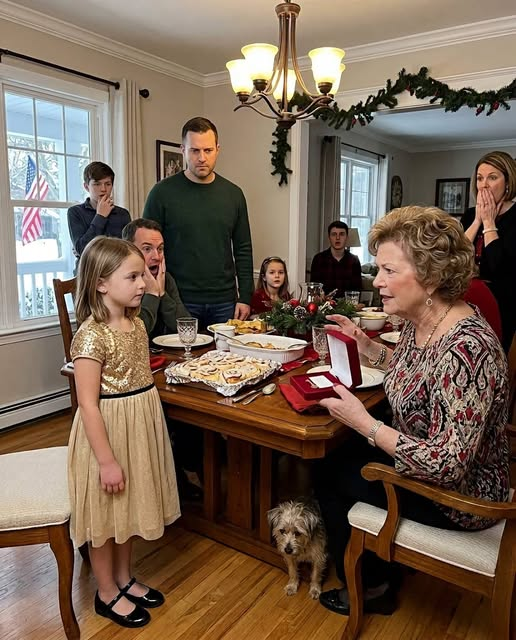
Inside the red velvet box sat a small brass key.
Underneath it was a folded card.
Lorraine snatched it up.
Her eyes moved across the first line.
Then the color disappeared from her face.
“No.”
Travis didn’t move.
“Read the rest.”
Lorraine looked at him.
“You wouldn’t.”
Every adult at the table had gone silent.
I stood beside Zia.
Her little hand found mine.
Lorraine looked down again.
The card read:
Mom, this is the spare key to the Cedar House.
Your right to live there ends January 31.
The notice has already been filed.
Do not blame Zia. This decision is mine.
—Travis
Lorraine screamed.
“You’re throwing your own mother out of her home?”
Zia flinched.
Travis immediately stepped between them.
“No.”
His voice was calm.
“I’m ending your free use of my house.”
That sentence changed the entire room.
One of Travis’s uncles frowned.
“Your house?”
Lorraine slammed the card onto the table.
“Don’t start.”
But Travis already had his phone out.
He opened a property record.
The Cedar House—the large lakefront home Lorraine had lived in for almost eight years—was not hers.
It had belonged to Travis’s father.
When he died, ownership passed to Travis through his estate.
Lorraine had been allowed to remain there indefinitely.
Rent-free.
Taxes paid.
Maintenance paid.
Utilities partly covered.
By Travis.
Lorraine had spent years telling everyone the house was “her inheritance.”
It wasn’t.
Travis looked around the table.
“Dad wanted Mom comfortable. So did I.”
Then he looked at Lorraine.
“But comfort was never permission to treat my daughter like she was contaminated.”
Lorraine’s eyes flashed.
“She is not your daughter.”
The room became colder.
Travis answered slowly:
“There.”
He pointed toward her.
“That sentence.”
Lorraine realized too late what she had said.
I felt Zia tighten beside me.
Travis crouched in front of her.
“Zia, go upstairs with Mom for a minute.”
She looked worried.
“Are you mad at me?”
His face softened immediately.
“Never.”
“Because I gave her the box?”
“No.”
He touched her cheek.
“The adults are handling the adult part.”
That mattered.
Zia had not been given the responsibility of evicting Lorraine.
She had only been given control over one thing Lorraine had spent years stealing from her:
Whether she had to stay silent.
I took her upstairs.
Behind us, Lorraine started shouting.
By the time I returned twenty minutes later, half the family had moved into the living room.
The Christmas brunch was over.
No one was eating.
Lorraine stood by the fireplace with her arms crossed.
“You planned this.”
Travis nodded.
“Yes.”
That surprised her.
“For how long?”
“Three months.”
I looked at him.
Even I hadn’t known everything.
Travis took a folder from his coat.
Inside were printed messages.
Birthday invitations where Lorraine had specifically asked us to leave Zia home because the event was “for real grandchildren.”
A family photograph schedule that listed:
Travis + wife. No Zia.
A message she had accidentally sent to Travis instead of her sister:
If they ever have a real child, maybe he’ll finally understand why I don’t want to confuse that girl about where she belongs.
I had seen some of them.
Not all.
Travis had kept records because six months earlier he had warned Lorraine.
One more deliberate exclusion and we would stop attending family gatherings.
She had promised to change.
Then came Christmas.
The candle.
To Travis’s Girl.
And the place card.
Guest.
Lorraine scoffed.
“This is ridiculous. She’s seven. She won’t even remember this.”
I spoke for the first time.
“She remembered last night.”
Lorraine turned toward me.
I continued:
“She asked whether she was only ‘Dad’s girl.’”
For a moment, Lorraine actually looked uncomfortable.
Then pride took over.
“Well, what do you expect me to call her? She has another father.”
Travis went very still.
“Her biological father died when she was two.”
“I know that.”
“And I’ve raised her since she was four.”
“That doesn’t change blood.”
Travis nodded.
“No.”
His voice became quiet.
“It reveals character.”
Lorraine’s face hardened.
She turned toward the relatives.
“Is nobody going to say anything? He’s throwing his mother out over a child that isn’t even his.”
That was when Travis’s sister, Megan, finally stood.
“Mom, stop.”
Lorraine stared at her.
Megan looked exhausted.
“You gave my kids iPads.”
Then she pointed upstairs.
“You gave Zia a candle and labeled her like somebody’s luggage.”
“I spent my own money.”
“That isn’t the point.”
Lorraine laughed bitterly.
“Everyone is suddenly so righteous.”
Then Travis placed one more document on the table.
“It gets worse.”
Lorraine stopped.
For years, Travis had deposited money into an account specifically for Christmas and birthday gifts for all the grandchildren.
He did it because Lorraine had complained that living on retirement income made holidays expensive.
That Christmas, he had transferred enough for equal gifts for every child.
Including Zia.
Lorraine had used Zia’s allocation too.
Just not on Zia.
The extra money had gone toward the older grandchildren’s cash envelopes.
Megan stared at the statement.
“You used his money?”
Lorraine said nothing.
“So the iPads weren’t even from you?”
Lorraine’s face flushed.
“I purchased them.”
“With Travis’s account.”
“I am his mother!”
Travis closed the folder.
“And that account is closed.”
Now Lorraine truly understood.
The house.
The holiday account.
The monthly support Travis quietly sent.
None of it had been owed to her.
He had provided it because he loved his mother.
She had mistaken generosity for permanent entitlement.
Her voice cracked.
“So this is it? You choose her over me?”
Travis looked toward the stairs where Zia had disappeared.
“No.”
He shook his head.
“You keep trying to make this a competition.”
“It isn’t.”
“She’s my daughter. You’re my mother.”
“You could have had both places.”
His eyes hardened.
“You’re the one who decided hers had to be smaller for yours to feel secure.”
Lorraine started crying.
Not elegant tears.
Real ones.
For years, tears had usually ended arguments.
Travis would soften.
Someone would change the subject.
I would tell myself keeping peace was best for Zia.
Not this time.
Lorraine moved toward him.
“I’m sorry.”
Travis nodded.
“I hope you mean it.”
Hope flashed across her face.
Then he continued:
“But the move-out date stays.”
Her expression collapsed.
“What more do you want from me?”
“Nothing.”
That was the part she couldn’t understand.
An apology did not automatically purchase access.
We left before noon.
Zia was quiet in the car.
Halfway home, she asked:
“Is Grandma homeless now?”
Travis looked at her in the mirror.
“No.”
“She has money, a pension, and other places she can live while she finds a new home.”
“Did I make her leave?”
“No.”
His answer was immediate.
“You did not cause this.”
She looked down at her shoes.
“But I gave her the key.”
“You gave her a box I asked you to give her.”
Travis pulled the car over.
Then he turned around so she could see his face.
“I need you to understand this.”
“Grandma’s choices caused the consequences.”
“Not you.”
Zia thought about that for a long moment.
Then:
“Can I still love her?”
My throat tightened.
Travis smiled sadly.
“Yes.”
“You can love someone and still need distance from them.”
That became our rule too.
Lorraine moved out in January.
She told relatives we had “thrown an elderly woman into the street.”
The story lasted until Megan started correcting people.
Then other relatives did too.
Apparently, once one person stopped protecting Lorraine’s version of events, others found their voices.
For six months, we had no contact.
Zia went to therapy for a while.
Not because anything was “wrong” with her.
Because we wanted her to have a place where she could talk without worrying that adult feelings were her responsibility.
Gradually, the careful laugh disappeared.
She stopped asking whether she was allowed to be in family photographs.
She stopped checking gift tags before opening presents.
Then Lorraine wrote her a letter.
Not to us.
To Zia.
We read it first.
For once, there were no excuses.
Dear Zia,
I treated you differently because I believed family was something decided by blood. I was wrong. Worse, I made you feel that the problem was you. It wasn’t.
You never needed to earn a place at our table.
I am sorry.
At the bottom she wrote:
I understand if you don’t want to see me.
That sentence was why we eventually allowed a supervised visit.
Not because Lorraine was entitled to one.
Because Zia wanted it.
They met at a bakery.
Lorraine brought no expensive gift.
Only a book Zia liked.
When she arrived, she hesitated.
Then said:
“Hello, granddaughter.”
Zia looked at Travis.
He smiled.
Then she looked back at Lorraine.
“Hi, Grandma.”
Nothing magically repaired itself.
Trust returned slowly.
Lorraine was never again allowed to control holidays.
She did not get unsupervised access simply because she apologized.
And whenever someone referred to Zia as Travis’s stepdaughter, Travis corrected them when it mattered.
“My daughter.”
Years later, I found the cheap vanilla candle while cleaning a closet.
I held it up.
“Throw it away?”
Zia was eleven by then.
She looked at the crooked old tag.
To Travis’s Girl.
Then she smiled.
“No.”
“Why keep it?”
She took the candle from me.
“Because Grandma was right about one thing.”
I raised an eyebrow.
Zia grinned.
“I am Travis’s girl.”
From the hallway, Travis shouted:
“I heard that!”
She laughed.
Then added:
“But I’m Mom’s girl too.”
I looked at my daughter.
The child Lorraine once treated like a temporary visitor had become completely certain of where she belonged.
And I finally understood what was really inside that little red box.
It wasn’t a weapon.
It wasn’t revenge.
It wasn’t even a key.
It was a boundary.
Lorraine believed family meant blood gave her permanent access, no matter how she behaved.
Travis taught all of us something better.
Family is not proven by who gets the most expensive Christmas present.
It is proven by who makes sure a child never has to wonder whether there is a place for her at the table.
