The final of the youth exhibition was held three days later.
The city art museum was packed.
Students.
Teachers.
Parents.
Reporters.
And because the competition was being streamed online, thousands of people were watching from home.
Nora stood beside my painting in a white dress.
Julian stood near her.
Of course he did.
When I entered with Chloe, Nora’s face changed.
Only for a second.
Then she smiled.
“Iris, you came.”
“I said I would wait for the result.”
Julian frowned.
“If you’re planning to embarrass Nora—”
“I’m here to watch an art competition.”
“That’s all?”
I looked at him.
“What else would I be here for?”
He had no answer.
The judges began evaluating the finalists.
When they reached my painting, the chief judge stopped.
He was an elderly professor named Elias Grant.
He studied the brushwork for nearly a minute.
Then asked Nora:
“When did you begin this piece?”
“Two months ago.”
“Do you have process photographs?”
Nora immediately produced them.
Sketches.
Color studies.
Draft compositions.
Everything looked convincing.
Sabrina smiled triumphantly from behind her.
Then Professor Grant asked:
“Would you object to technical verification?”
Nora’s fingers tightened.
“What verification?”
“All finalists are scanned before awards are issued. It checks previous restoration, altered signatures and unauthorized modifications.”
The blood drained from her face.
Julian noticed.
“Nora?”
She forced a laugh.
“Of course. I have nothing to hide.”
The painting was carried beneath an ultraviolet inspection lamp.
The auditorium lights dimmed.
For several seconds, nothing happened.
Then blue light washed over the canvas.
And beneath the final layer of paint, in the lower left corner, fluorescent letters appeared.
IRIS VALE — 04/17
The room exploded.
Someone gasped.
Chloe grabbed my arm.
Sabrina went completely still.
Nora stared at the painting as if it had betrayed her.
Professor Grant leaned closer.
There was more.
Under the ultraviolet light, several hidden marks became visible along the edge.
Dates.
Color notes.
A tiny symbol I had used since childhood.
The museum camera zoomed in.
The entire city could see it.
Professor Grant turned toward Nora.
“Explain.”
Her lips trembled.
“I…”
Julian looked at me.
Then at the painting.
“You put that there?”
“Yes.”
“When?”
“Before it disappeared.”
Nora suddenly burst into tears.
“Iris planned this!”
The room fell silent again.
She pointed at me.
“She knew I would use it! She wanted to trap me!”
Chloe laughed out loud.
“You realize that sentence requires admitting you stole it, right?”
Nora froze.
Too late.
Professor Grant’s expression became colder.
“You knew the painting belonged to Miss Vale?”
“No! That’s not what I meant.”
“Then why would she know you would use it?”
Nora’s crying became frantic.
Julian stepped toward her automatically.
“Nora, calm down.”
There.
Even now.
Even while she was being exposed publicly, Julian’s first instinct was still to comfort her.
In my previous life, that sight would have driven me insane.
I would have screamed.
Accused.
Demanded he believe me.
And every word would have made me look more like the villain the story required.
This time, I did nothing.
Professor Grant asked security to preserve the painting and contest materials.
Nora was disqualified.
The organizers opened an investigation into the forged sketches.
Sabrina was removed from her student committee position after admitting Nora had been allowed access to the storage room.
The livestream ended with my name restored as the painting’s creator.
Everyone expected me to look victorious.
I felt tired.
Outside the museum, Julian caught up with me.
“Iris.”
I kept walking.
He grabbed my sleeve.
“Wait.”
I stopped.
For the first time, he looked genuinely shaken.
“I was wrong.”
“Yes.”
He seemed surprised I agreed so easily.
“I thought…”
“That I stole my own painting?”
His face tightened.
“Nora showed everyone sketches.”
“And I told you that you had watched me paint it.”
Julian looked away.
“I didn’t want to accuse her without proof.”
I almost smiled.
“But you accused me without proof.”
Silence.
That was the difference he could not explain.
Finally he said:
“Nora has had a difficult life.”
There it was.
The excuse.
Always the same.
I nodded.
“I hope it improves.”
Then I left.
I thought the matter was over.
It wasn’t.
That evening, Nora disappeared from school.
The next morning, Julian learned she had locked herself inside her apartment and refused to answer anyone.
By noon, he was outside my family mansion.
In the rain.
Exactly like the dream.
My stomach went cold when the servant told me.
For a moment, I became the terrified girl who had awakened remembering an iron cage and black water.
Then I walked outside.
Julian was kneeling on the stone path.
His clothes were soaked.
My parents stood behind me.
His grandfather had already been notified.
Julian looked up.
“Iris.”
I knew what came next before he said it.
“I need you to agree to cancel our engagement.”
My mother inhaled sharply.
My father’s face darkened.
Julian continued:
“Nora is in a terrible state. Everyone at school is attacking her. She says she can’t stay here if you and I are still engaged.”
I almost laughed.
Even after everything, Nora had found a way to make my engagement part of her suffering.
Julian lowered his head.
“I owe her something.”
“No.”
He looked up.
“You don’t.”
He stared at me.
I continued:
“But I agree.”
The rain seemed to stop making noise.
My mother turned toward me.
“Iris?”
I looked at Julian.
“I agree to end the engagement.”
He clearly had prepared himself for resistance.
For tears.
For threats.
For me to become the woman from my dream.
Instead I said:
“I wish you happiness.”
His face changed.
“You’re serious?”
“Completely.”
That same evening, I accompanied my parents to the Blake residence.
Both families sat together.
Julian’s grandfather looked devastated.
“Iris, you don’t have to do this because that boy has lost his mind.”
“I know.”
“Then reconsider.”
“No.”
I removed the engagement bracelet Julian had given me when we were fifteen.
I placed it on the table.
“Mr. Blake, thank you for always treating me well.”
The old man’s eyes reddened.
“You’re still family to me.”
I smiled.
“Then remember me kindly.”
Julian sat across the room.
He watched me strangely.
Perhaps for the first time, he was realizing that an engagement could actually end.
He had always believed I would remain.
The childhood friend.
The fiancée.
The girl waiting exactly where he left her.
When the paperwork was signed, I stood.
Julian suddenly asked:
“What are you going to do now?”
I looked at him.
“Whatever I want.”
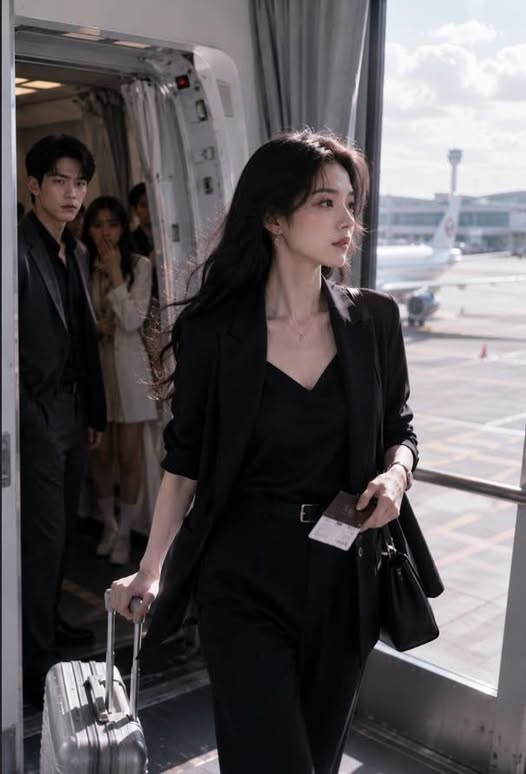
That night, at 11:40, I boarded a flight to London.
My parents came with me to the airport.
Not because we were running away.
Because months earlier, before the dream, I had received an invitation to attend a summer art program there.
I had planned to reject it because Julian hated long-distance relationships.
Now there was no relationship to protect.
Before security, my father asked:
“Are you sure you want to leave tonight?”
“Yes.”
My mother hugged me.
“Because of Julian?”
I shook my head.
“Because if I stay, everyone will spend the next month asking me what I intend to do about Julian and Nora.”
I smiled.
“I intend to do nothing.”
And I left.
The strangest part was that the world did not collapse without me.
My family did not go bankrupt.
My parents did not die protecting me.
Nobody dragged me toward an abandoned port.
Because the villain in that story had walked off the page before anyone could finish writing her ending.
In London, I painted.
At first badly.
Then obsessively.
I learned techniques I had never seen at home.
I met people who had no idea who the Blake family was.
No one introduced me as Julian’s fiancée.
No one compared me to Nora.
I was simply Iris.
Three months later, Chloe called.
“Do you want gossip?”
“No.”
“I’m telling you anyway.”
I laughed.
“Fine.”
Nora’s forged sketches had been traced to photographs taken from Julian’s phone.
My phone nearly slipped from my hand.
“What?”
Julian had photographed my work several times while visiting our house.
Nora had accessed the images when he let her use his tablet.
She traced them and created fake progress drawings.
The painting theft had never been a misunderstanding.
It had been planned.
Julian discovered it himself.
“And?”
Chloe hesitated.
“He broke up with her.”
I stared out my studio window.
Rain slid down the glass.
“Okay.”
“That’s all?”
“What do you want me to say?”
“I don’t know. Something dramatic.”
I smiled.
“That story isn’t mine anymore.”
Six months after I left, Julian came to London.
I found him waiting outside my exhibition.
He looked thinner.
Older.
He held no flowers.
At least he had learned something.
“Iris.”
“Julian.”
“I need five minutes.”
“You have five.”
He swallowed.
“I know everything.”
“Good.”
“Nora admitted she stole the painting.”
I said nothing.
“She said she wanted to prove she could take something from you.”
Still nothing.
“And I helped her.”
That made me look at him.
His voice dropped.
“Not knowingly. But I believed her because…”
“Because you wanted to.”
His face tightened.
“Yes.”
That answer was at least honest.
He stepped closer.
“I’m sorry.”
“I believe you.”
Hope appeared immediately.
Then he asked:
“Can we start again?”
“No.”
The hope disappeared.
“Iris, we grew up together.”
“I know.”
“I loved you.”
“Maybe.”
“I made mistakes.”
“Yes.”
His eyes reddened.
“Then why can’t you forgive me?”
“I can.”
He froze.
“I already did.”
“Then—”
“Forgiveness is not engagement.”
Silence.
I looked at him.
“In another life, Julian, I might have spent everything I had trying to make you choose me.”
He frowned at the strange wording.
I continued before he could ask.
“But I don’t want to be chosen by someone who needs another woman to betray me before he can recognize my worth.”
He had no answer.
I walked into the exhibition.
This time, he did not follow.
Years later, Old Light in the Rain Alley hung in my first solo gallery show.
I kept the ultraviolet signature.
Not because I still feared theft.
Because it reminded me of the moment I finally learned something important.
Truth does not always need shouting.
Sometimes you simply place it where it cannot be erased—
and wait for the light.
Julian eventually married someone else.
So did Nora, according to people who still cared enough to tell me.
I wished them both well.
From very far away.
The dream had shown me one possible future.
A future where I clung so tightly to a man who did not choose me that I became everything people accused me of being.
So when the same story began again, I changed only one thing.
I stopped fighting for the male lead.
And once I did, I discovered something the original story had never bothered to tell me:
The villain could leave.
She could buy a plane ticket.
She could become an artist.
She could love her parents without destroying them.
She could build a life that had nothing to do with the hero or heroine.
The night Julian asked to cancel our engagement, he thought he was choosing Nora.
Maybe he was.
But I was making a choice too.
I chose to walk out of the story before it could turn me into someone I no longer wanted to be.
And this time,
nobody got to write my ending except me.
