Rachel’s voice filled the hospital room.
“She’s not family today. She’s your burden.”
Then my mother laughed.
Not nervously.
Not uncomfortably.
She laughed like Rachel had said something clever.
My father’s voice followed.
“Leave her there for ten minutes. Maya needs to learn she can’t expect everyone to rearrange their lives for that child.”
I stopped breathing.
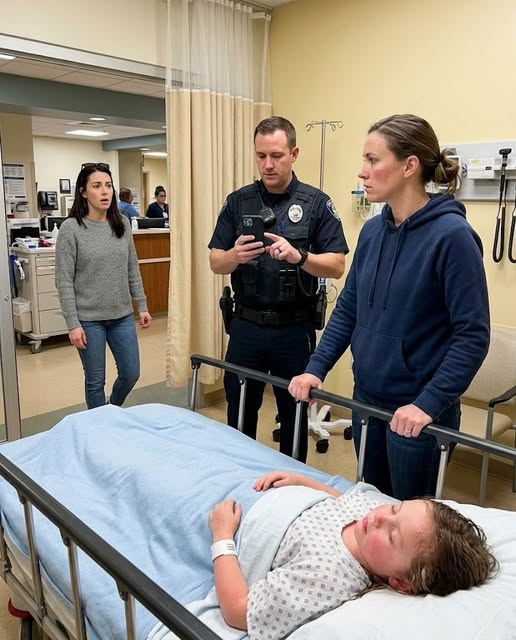
Officer Grant did not pause the recording.
Rachel again:
“She’ll cry for a while. She always cries. When we come back, maybe she’ll finally stop acting spoiled.”
My mother said:
“And maybe Maya will finally understand why nobody wants to babysit.”
The recording ended.
No one spoke.
Rachel’s face had gone completely white.
My father was staring at the floor.
My mother finally whispered:
“That sounds worse than it was.”
Officer Grant looked at her.
“How should it sound?”
She opened her mouth.
Nothing came out.
I looked at Rachel.
“Where did that recording come from?”
Officer Grant answered.
“Your vehicle.”
I had forgotten.
Six months earlier, after someone damaged my SUV in a parking lot, I had installed a security camera system with audio recording.
It activated automatically when motion was detected around the car.
The camera had captured everything.
Rachel parking.
My parents getting out.
The cousins running toward the park.
Ellie asking:
“Aunt Rachel, am I coming?”
Then Rachel answering:
“No. You stay here.”
Ellie’s small voice had asked why.
My father had said:
“Because your mother needs to stop treating you like the center of the universe.”
My hands began shaking.
Officer Grant continued.
“The footage also shows your daughter asking them not to leave.”
My mother suddenly cried.
“We were coming back!”
I turned toward her.
“You left a six-year-old alone in a locked car.”
“For a few minutes.”
Officer Grant corrected her.
“It was much longer than that.”
Rachel snapped:
“We didn’t know it would get that hot.”
The officer’s expression didn’t change.
“There was a heat advisory.”
“We forgot.”
“No,” I said.
Everyone looked at me.
I stared at my sister.
“You didn’t forget Ellie.”
Rachel frowned.
“What?”
“You talked about her.”
My voice stayed strangely calm.
“You discussed leaving her there.”
My mother reached for me.
“Maya, this is family. Don’t let one mistake—”
I stepped away.
That movement hurt her more than if I had screamed.
For thirty-three years, my mother had been able to touch my shoulder, lower her voice and make me feel guilty enough to surrender.
Not anymore.
Officer Grant asked them to step outside for separate interviews.
Rachel protested.
My father demanded a lawyer.
My mother started crying harder.
For once, none of it became my responsibility.
I stayed beside Ellie.
When she woke, she looked around.
Then saw me.
“Mom?”
“I’m here.”
Her eyes filled.
“I’m sorry.”
Something broke inside me.
“What are you sorry for?”
“Aunt Rachel said I make things hard for everybody.”
I sat beside her.
“You listen to me.”
She watched me.
“You did nothing wrong.”
“But Grandma said—”
“Grandma was wrong.”
It was the first time in my life I had ever said those words out loud.
And they felt like a door opening.
Ellie was discharged the following day with instructions to rest and follow up with her doctor.
I took her home.
Not to my parents’ house.
Not to Rachel’s.
Home.
Just us.
The investigation continued.
The recording mattered.
So did the witnesses.
A passerby had heard Ellie and alerted park staff.
Security footage showed my family returning to the parking area only after emergency responders had already arrived.
They had seen the commotion.
And instead of coming forward immediately, they left.
That detail ended every story they tried to tell afterward.
Rachel hired an attorney.
My parents insisted they had panicked.
Then came the family campaign.
Aunts called.
Cousins messaged.
My uncle sent:
Your parents made a terrible mistake, but they’re still your parents.
I replied:
And Ellie is still my daughter.
Then I blocked him.
My mother appeared at my house three days later.
I spoke to her through the doorbell camera.
“Maya, please open.”
“No.”
“I need to see Ellie.”
“No.”
“I’m her grandmother.”
“That didn’t protect her.”
Silence.
Then she said the sentence I had heard my entire life.
“You’re destroying this family.”
I almost laughed.
“No, Mom.”
I looked at her through the screen.
“I’m just refusing to let you use my daughter to hold it together.”
She started crying.
I ended the call.
Rachel was worse.
She sent me a long message explaining that she had always been expected to help with Ellie.
That I had become “entitled” after becoming a mother.
That everyone was tired of accommodating me.
I read every word.
Then replied:
You could have said no when I asked to borrow my car.
You could have said no to taking Ellie.
You chose something else.
She never answered.
Several weeks later, a temporary protective order restricted unsupervised contact between Ellie and the relatives involved while the case was reviewed.
I didn’t celebrate.
There was nothing satisfying about any of it.
My daughter had loved those people.
She asked about her cousins.
She missed my mother’s pancakes.
Sometimes she asked why Grandpa didn’t visit anymore.
I found a child therapist.
One afternoon, after a session, Ellie climbed into my lap and asked:
“Did Grandma leave me because I’m bad?”
I held her.
“No.”
“Then why?”
Because adults can be cruel?
Because my family had spent decades calling cruelty “teaching a lesson”?
Because I had ignored smaller warnings until something unforgivable happened?
I chose the answer she could carry.
“They made a very serious wrong choice.”
“Are they sorry?”
“I think some of them are.”
“Does sorry fix it?”
I looked at her.
“No.”
She thought about that.
Then nodded.
Children understand some things faster than adults.
Months passed.
Rachel eventually accepted responsibility as part of resolving the case against her.
My parents faced their own consequences for participating and failing to intervene.
The exact legal outcomes mattered less to me than one thing:
None of them could pretend it hadn’t happened.
Not anymore.
There was a recording.
Their own voices.
Their own laughter.
Their own choices.
My father wrote me a letter.
For the first time in my life, he did not blame me.
He wrote:
I taught you all your life that keeping peace mattered more than being right. I see now that I taught you to tolerate things you should never have tolerated.
I cried when I read it.
But I did not invite him back.
Forgiveness and access were not the same thing.
Rachel never apologized properly.
Her version always contained a “but.”
I’m sorry, but you depended on us too much.
I’m sorry, but Ellie can be difficult.
I’m sorry, but none of us expected—
Eventually, I stopped reading.
A year later, Ellie turned seven.
We had a small birthday party.
Six children.
Pizza.
A purple cake.
Too many balloons.
At one point, she ran across the backyard laughing so hard she nearly dropped her party hat.
I stood near the porch watching her.
One of the other mothers asked:
“Is your family coming?”
I looked at Ellie.
Then answered:
“My family is already here.”
For years, I thought family meant the people you kept forgiving because you shared blood.
People who insulted you, ignored boundaries, and then accused you of being dramatic when you objected.
That day in the hospital changed the definition.
Family was the person who heard Ellie crying and called for help.
The nurse who stayed beside her.
The officer who refused to let three adults rewrite what they had done.
The therapist who taught her that adults’ bad decisions were not her fault.
And me.
Especially me.
Because I finally understood that being a good daughter was never supposed to require being a bad mother.
I kept the recording.
Not because I wanted to hear it again.
I never did.
I kept it in the case file as proof of the day my family’s favorite weapon stopped working.
For decades, they had survived by changing the story.
You misunderstood.
You’re too sensitive.
It wasn’t that serious.
But this time, the truth had a voice.
Rachel’s.
My mother’s.
My father’s.
And when Officer Grant pressed play, they finally heard themselves the way I had heard them my entire life.
Cold.
Cruel.
Certain I would forgive them.
They were wrong.
Because the day they left my six-year-old daughter behind,
they didn’t teach me to stop depending on my family.
They taught me something much more important.
How to protect my child from them.
