The first name on the yellowed document was not Ta.
It was:
LAM DUC HANH.
Van Ninh’s father.
Her fingers froze.
Grandfather Ta stared at the paper as though he had seen a ghost.
Lawyer Chu spoke first.
“Twenty-four years ago, Ta Thi nearly collapsed because of a failed expansion.”
Mrs. Minh Lan immediately interrupted.
“That has nothing to do with Van Ninh!”
Lawyer Chu looked at her.
“It has everything to do with her.”
He opened the second document.
At that time, Van Ninh’s father had provided the capital that saved Ta Thi.
Not a normal loan.
In exchange, he received a large block of preferred shares and special voting rights.
But because Lam Duc Hanh had never wanted public control of the company, those rights were placed in a private trust.
The beneficiary named in that trust was his only daughter.
Lam Van Ninh.
Canh Tham went completely still.
“You’re saying…”
Lawyer Chu nodded.
“Mrs. Ta has always held the beneficial rights to nearly forty percent of the voting structure connected to this trust.”
Minh Lan laughed sharply.
“Impossible! She entered our family with nothing!”
Van Ninh slowly looked at her.
For three years, she had heard that sentence.
You came with nothing.
You have nothing.
If we throw you out, you leave empty-handed.
Lawyer Chu continued:
“Mr. Lam deliberately kept the arrangement confidential.”
“There was one protection clause.”
He placed the signed paper from the previous night on top.
“If Van Ninh’s marriage ended because of serious betrayal or deliberate abandonment during a medical emergency, the dormant voting proxy automatically returned to her direct control.”
Silence.
Canh Tham’s face lost all color.
The party.
To Man.
The hospital call.
His mother’s words.
Everything had become evidence.
Grandfather Ta struck his cane against the floor.
“You knew she was in the hospital?”
Canh Tham said nothing.
“Answer me!”
“Yes.”
“And you stayed at the banquet?”
His jaw tightened.
“Yes.”
The old man closed his eyes.
Then he looked at Minh Lan.
“And you told her losing the child meant it wasn’t worthy of our family?”
Minh Lan’s lips trembled.
“It was anger.”
Van Ninh finally spoke.
“No.”
Everyone looked at her.
“It was honesty.”
Her voice was weak from exhaustion, but steady.
“You finally said exactly what you thought of me.”
Minh Lan hurried forward.
“Van Ninh, we can discuss this.”
Yesterday she had ordered her to leave empty-handed.
Now she was speaking carefully.
Almost gently.
Van Ninh felt nothing.
That frightened her more than anger would have.
Canh Tham stepped toward the bed.
“What do you want?”
She looked at him.
“Right now?”
“Yes.”
“Rest.”
He froze.
“I mean about the company.”
“I know.”
She turned toward Lawyer Chu.
“Can they leave?”
Canh Tham stared at her.
“Van Ninh—”
“The doctor said I need quiet.”
Grandfather Ta was the first to turn toward the door.
“Go.”
Minh Lan protested.
“Father!”
“Did you not hear her?”
The old man’s voice cracked through the room.
“This hospital bed belongs to the woman you left alone last night.”
“Get out.”
For the first time since Van Ninh married into the Ta family, Minh Lan obeyed her.
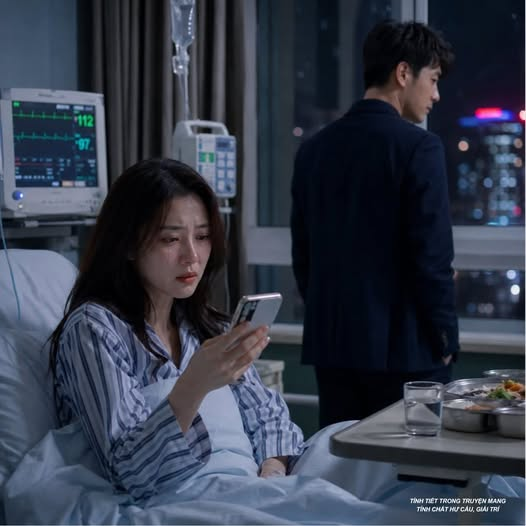
The doctor came in shortly afterward.
After another examination, he gave Van Ninh the first piece of good news she had received in two days.
The pregnancy had stabilized.
She still needed rest and careful monitoring.
But for now, the baby was safe.
Van Ninh covered her face and cried.
Not because of Canh Tham.
Not because of the company.
Because the tiny life she thought she might lose was still with her.
Three days later, she left the hospital.
She did not return to the Ta villa.
Lawyer Chu had already arranged temporary housing.
Canh Tham waited outside the hospital.
He had been there every day.
Van Ninh had refused every visit.
That morning, he finally stepped into her path.
“I want to see you.”
“You are seeing me.”
“Alone.”
“No.”
His eyes reddened.
“I didn’t know about the trust.”
“I know.”
“I didn’t marry you because of it.”
“I know that too.”
Hope appeared in his face.
Then Van Ninh continued:
“That makes what you did worse.”
He froze.
“If you had known I controlled something valuable, at least I could understand why you pretended to care.”
She looked directly at him.
“But you thought I had nothing.”
“And that was when you decided I could be treated however you wanted.”
Canh Tham lowered his head.
“I was wrong.”
“Yes.”
“To Man and I…”
“I don’t care.”
His head snapped up.
“She just returned. Mother arranged the banquet. I didn’t—”
“Canh Tham.”
Van Ninh interrupted quietly.
“I was in a hospital bed afraid for our child.”
“You knew.”
“You still chose the party.”
Everything else was decoration.
Whether he had kissed To Man.
Whether the relationship had become physical.
Whether his mother arranged it.
None of that changed the only fact that mattered.
When his wife called frightened and vulnerable, he had told her:
Don’t use the child to force me.
Van Ninh stepped around him.
Canh Tham did not follow.
The emergency shareholder meeting happened the following week.
Minh Lan arrived dressed impeccably.
Canh Tham sat beside her.
To Man’s father attended too.
So did every major director.
They expected Van Ninh to arrive emotional.
Maybe vindictive.
Instead, she entered wearing a simple black suit.
Lawyer Chu walked behind her.
The secretary confirmed the voting rights associated with the Lam trust.
The room changed instantly.
Van Ninh now controlled enough votes, together with two independent investors, to decide the company’s board structure.
Minh Lan leaned toward her.
“Van Ninh, we are family.”
Van Ninh looked at her.
“Yesterday I was an outsider.”
Minh Lan’s face stiffened.
“Don’t make business decisions because of personal emotions.”
That almost made Van Ninh smile.
The same woman who had organized a banquet to publicly replace her daughter-in-law was now asking her to separate business from personal feelings.
So Van Ninh did exactly that.
She did not liquidate Ta Thi.
Did not fire hundreds of employees.
Did not destroy projects.
She commissioned an independent audit.
The result arrived six weeks later.
Several transactions connected to Minh Lan’s relatives had bypassed normal procurement review.
To Man’s father had received favorable contracts without competitive bidding.
And Canh Tham had approved multiple related-party deals to maintain the alliance between the two families.
Nothing required melodrama.
The documents were enough.
Minh Lan lost her informal authority over company operations.
To Man’s family lost the contracts that could not survive independent review.
And Canh Tham was removed from several executive responsibilities pending restructuring.
At the meeting where the changes were announced, Minh Lan finally lost control.
“You’re destroying everything because my son doesn’t love you!”
Van Ninh remained seated.
“No.”
She closed the audit folder.
“I am stopping people from treating Ta Thi like a family wallet.”
Then she looked at Canh Tham.
“And I am divorcing your son because he doesn’t love me.”
Two separate problems.
Two separate solutions.
Canh Tham stared at her for a long time.
Then he asked:
“If I resign, will you reconsider?”
Van Ninh’s expression softened slightly.
“No.”
“If I cut contact with To Man?”
“No.”
“If my mother apologizes?”
“No.”
His voice broke.
“What do you want me to do?”
“Become better.”
Hope appeared again.
Van Ninh finished:
“For yourself.”
Not for her.
Not as payment for forgiveness.
Not as a bargain.
The divorce was finalized four months later.
Van Ninh did not leave empty-handed.
But neither did she take Ta family property.
She kept what had always legally belonged to her through her father’s trust.
Canh Tham’s personal assets remained his.
The marital property was divided according to law.
And the child, when born, would be supported by both parents.
Their daughter arrived safely months later.
Van Ninh named her An Nhi.
Canh Tham met her at the hospital.
This time, he was there.
He stood beside the crib and cried quietly.
“I’m sorry.”
Van Ninh knew he meant more than one thing.
She nodded.
“Be a good father.”
He looked at her.
“And us?”
“There is no us.”
His face fell.
But he did not argue.
That was the first sign that regret might actually change him.
Years later, Ta Thi was still operating.
Stronger than before.
Van Ninh never became the kind of chairwoman who occupied the company every day.
She appointed professionals.
Created stricter governance.
Then returned to building the investment company her father had originally intended her to inherit.
Minh Lan eventually asked to see her granddaughter.
Van Ninh allowed it under clear boundaries.
Not because she had forgotten.
Because forgiveness and access were not the same thing.
To Man disappeared from their lives after her family’s business alliance collapsed.
And Canh Tham never remarried quickly, as everyone expected.
Perhaps he finally understood that replacing a person was much easier than replacing what that person had quietly carried.
One afternoon, years later, he met Van Ninh after dropping An Nhi home.
He looked at the company magazine on her table.
Her photograph was on the cover.
LAM VAN NINH — CHAIR OF LAM CAPITAL
He smiled bitterly.
“I spent three years thinking you depended on the Ta family.”
Van Ninh looked at him.
“I did depend on something.”
“What?”
She glanced toward the room where their daughter was laughing.
“My belief that if I endured long enough, you would eventually treat me like family.”
Canh Tham lowered his eyes.
“That was the only thing I truly lost.”
“No.”
Van Ninh shook her head.
“You lost much more.”
He looked up.
“You lost the woman who would once have stayed even without money, status or power.”
That was the tragedy.
Not the shares.
Not the board seats.
Not the contracts.
When Van Ninh signed that paper in the hospital, the Ta family thought she had activated a financial weapon.
They were wrong.
The real thing she activated was her right to stop begging for a place in a family that had already decided she was replaceable.
The company survived.
The child survived.
Van Ninh survived.
And the people who had told her to leave empty-handed finally understood the cruel irony:
She had never entered the Ta family with nothing.
She had entered carrying a fortune, a future, and a heart willing to love them.
By the time they discovered all three,
the only thing they could no longer get back was her.
