My son.
The thought struck me so hard that I almost stood up.
Ly Muc was still in the village.
I had escaped.
But he had stayed.
For one terrible moment, I wanted to turn around.
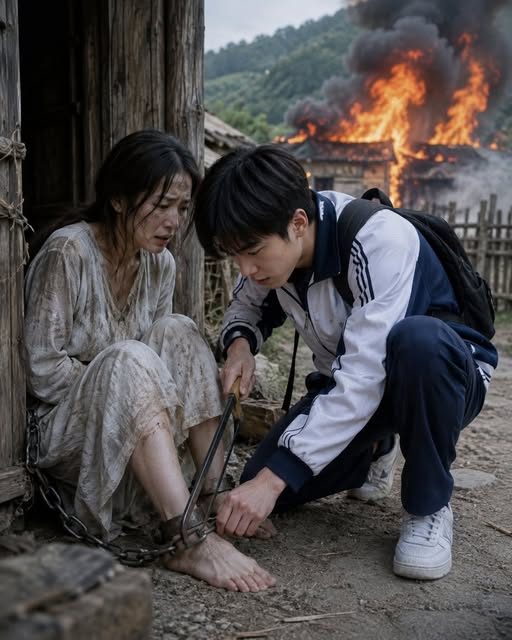
Then I remembered the last thing he had whispered while sawing through my chain.
“Mom, no matter what you hear, don’t come back.”
I forced myself forward.
Through the hidden trail.
Across wet rocks.
Past the cliff where I had once believed freedom was impossible.
Before dawn, I reached a mountain road.
A delivery truck found me walking barefoot along the shoulder.
The driver stopped.
At first, he seemed frightened by my appearance.
Then he saw the broken chain still hanging from my ankle.
His expression changed.
“Do you need the police?”
I burst into tears.
It was the first time in twenty years anyone had asked me what I needed.
“Yes.”
Two hours later, I sat inside a police station wrapped in a blanket.
An officer placed warm water in front of me.
“Your name?”
My mouth opened.
For twenty years, everyone had called me Tham Thanh.
That was the name Ly Man Thuong had given me.
But suddenly another name surfaced.
A name buried under mountains, fear and time.
“Shen Qinglan.”
The officer froze.
Then started typing.
Minutes later, the entire room changed.
Twenty years earlier, a twenty-two-year-old university student named Shen Qinglan had disappeared while traveling home.
Her parents had searched for years.
Her photograph had remained in a missing-person database.
That woman was me.
“Do you have family?”
I stared at the table.
“I don’t know anymore.”
Then I grabbed the officer’s sleeve.
“My son.”
“What about him?”
“He’s still there.”
Within hours, investigators began organizing an operation.
I gave them everything.
The village location.
The mountain paths.
The houses.
The names I remembered.
The women who had appeared over the years and then suddenly disappeared from sight.
And finally:
“Ly Muc.”
The officer looked at me.
“He helped you escape?”
“Yes.”
“Was the fire part of his plan?”
I shook my head immediately.
“No. He knew the celebration would create confusion, but the warehouse fire started during the banquet. He used the chaos.”
For the first time since escaping, I could breathe.
My son had not destroyed the village.
He had simply recognized the first opening fate had given us.
Then the officer asked:
“Why did he stay?”
I had no answer.
We discovered it that afternoon.
Police entered the village.
Ly Man Thuong had already accused Ly Muc of helping me.
But my son had prepared for that too.
When officers found him, he was sitting calmly in the village chief’s house.
Beside him was a backpack.
Inside were notebooks.
Names.
Dates.
Vehicle license numbers.
Photographs secretly taken over several years.
Copies of identity cards.
Records of money exchanged between villagers and outsiders.
And a small memory card containing conversations about women who had been brought into the mountains.
My seventeen-year-old son had been collecting evidence since he was fourteen.
When they brought him to the station, I ran toward him.
“Muc!”
He looked up.
For the first time that night, his calm expression collapsed.
“Mom.”
I hugged him.
He held me so tightly that neither of us could speak.
Finally, I pulled back.
“Why didn’t you run with me?”
His eyes reddened.
“If we both disappeared, they would chase us with everything they had.”
I stared at him.
“So you stayed?”
He nodded.
“They thought you couldn’t leave the mountain alone. I wanted them to believe I knew nothing.”
“You could have been hurt.”
“I know.”
I hit his shoulder once.
Not hard.
Then hugged him again.
“Don’t ever do that to me again.”
He laughed through tears.
“Okay.”
The investigation that followed changed everything.
The village was not simply one cruel household.
For years, several people had participated in buying, hiding or controlling abducted women.
Some villagers claimed they knew nothing.
Others claimed it was “tradition.”
The police did not care what they called it.
A crime remained a crime.
Several women were rescued.
Some had been there longer than I had.
Some no longer remembered where their original families lived.
For weeks, I gave statements.
So did Ly Muc.
Ly Man Thuong was arrested along with others involved in the trafficking network.
When he saw me again, he shouted:
“You belong to my family!”
Twenty years earlier, those words would have terrified me.
This time, police officers stood between us.
I looked directly at him.
“No.”
My voice did not shake.
“I never belonged to you.”
Then I turned away.
I never looked back.
But freedom brought another question.
Where would Ly Muc go?
Legally, he was the son of the man who had imprisoned me.
Emotionally, he was the child who had saved my life.
Some people asked whether seeing his father’s face in him made things difficult.
It didn’t.
Because when I looked at Ly Muc, I did not see Ly Man Thuong.
I saw the little boy who secretly slipped extra food into my room.
The twelve-year-old who pretended not to notice when I cried.
The fourteen-year-old who began asking why his mother had no identification papers.
The seventeen-year-old who earned admission to one of the country’s best universities—
and used the celebration of his own future to give me mine back.
“You’re still going to university,” I told him.
He stared at me.
“I can defer.”
“No.”
“But you just escaped. You need someone.”
“I need my son to live the life he earned.”
He lowered his head.
“I don’t want to leave you again.”
I touched his hair.
“You’re not leaving me.”
I smiled.
“You’re going forward.”
Three weeks later, another miracle happened.
The police located my parents.
They were alive.
Older.
Much older than the two people preserved in my memory.
My mother had kept my bedroom untouched for almost ten years after I disappeared.
My father had traveled across provinces following false leads until his health no longer allowed it.
When I entered their apartment, my mother stared at me.
Her lips trembled.
“Qinglan?”
I nodded.
She crossed the room and held me.
Twenty years disappeared in that embrace.
Then she noticed Ly Muc standing behind me.
He looked terrified.
More terrified than he had been in the mountain village.
“This is…” I began.
My voice broke.
“My son.”
My father walked toward him slowly.
Ly Muc immediately bowed.
“Grandfather.”
My father’s eyes filled with tears.
Then he placed both hands on the boy’s shoulders.
“You brought my daughter home.”
Ly Muc shook his head.
“She brought me into this world.”
My father answered:
“Then you saved each other.”
That became the truth our family lived by.
The trials took time.
The headlines called me “the woman chained for twenty years.”
I hated that description.
It made the chain sound like the most important thing about me.
It wasn’t.
Eventually, I stopped giving interviews.
I changed my identification back to Shen Qinglan.
I underwent treatment.
Learned how to use a smartphone properly.
Learned that supermarkets now had self-checkout machines.
Learned that my favorite singer from twenty years earlier had become a grandmother.
Some things made me laugh.
Others made me cry.
Freedom was not one glorious moment.
It was hundreds of small moments when I realized I was allowed to choose.
What to eat.
When to sleep.
Where to go.
Whether to close my own bedroom door.
The first time I locked it from the inside, I stood staring at the key for a long time.
Then I laughed.
A lock could keep someone out too.
The following September, our entire family accompanied Ly Muc to university.
At the gate, he carried one backpack.
My mother had packed enough food for six students.
My father kept pretending there was dust in his eyes.
Before entering, Ly Muc turned toward me.
“Mom.”
“Yes?”
“You know why I studied so hard?”
I smiled.
“To leave that mountain.”
He shook his head.
“To become someone strong enough that one day I could take you with me.”
I could no longer speak.
He hugged me.
Then added quietly:
“But you walked out yourself.”
I held his face between my hands.
“You opened the door.”
Years later, Ly Muc chose to study law.
When I asked why, he answered:
“Because some people live their entire lives believing nobody will ever come looking for them.”
He eventually worked with organizations helping trafficking survivors recover identification, find relatives and rebuild their lives.
And me?
I never became the woman I had been before the kidnapping.
That woman was twenty-two.
She had plans I could never completely recover.
So I stopped trying to become her.
I became someone new.
A mother.
A daughter returned after twenty years.
A woman who learned that survival had not made her weak.
One Lunar New Year, Ly Muc came home from university.
We sat at a table with my parents.
There were no chains.
No locked doors.
No man deciding whether I was allowed near the window.
Outside, fireworks lit the sky.
Ly Muc placed a bowl of longevity noodles in front of me.
Exactly like the night he had freed me.
I looked at him.
He smiled.
“Mom, eat.”
I picked up the chopsticks.
Twenty years earlier, a bowl of noodles had been placed in front of a prisoner.
That night, my son had hidden freedom behind it.
Now the same dish sat on my family’s table.
Warm.
Ordinary.
Safe.
I once believed Ly Muc’s university acceptance was the greatest thing that had happened to him.
I was wrong.
His greatest achievement was not escaping the mountain.
It was growing up inside a place that taught him cruelty was normal—and deciding, completely on his own, that it was wrong.
And my greatest victory was not the night the chain finally broke.
It was every morning afterward when I woke up and understood:
No one could ever put it back on me again.
