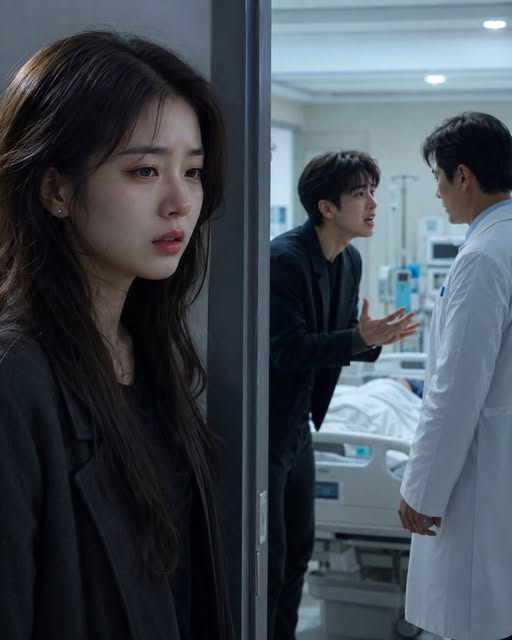
I stood barefoot outside the study door.
Daniel’s voice came through clearly.
“We have to remove the old records before Clara sees them.”
A man answered through the speaker.
“Daniel, hospital records don’t simply disappear.”
“Then find another way.”
“What exactly are you afraid of?”
Daniel was silent.
Then he whispered:
“If she finds out I knew all along, she’ll leave me.”
My hand went instinctively to my belly.
“And the twins?”
“She’ll take them too.”
I stepped backward.
For several seconds, I couldn’t breathe.
Not because something was wrong with my babies.
Because whatever Daniel was hiding had begun long before they existed.
The next morning, I went to the hospital alone.
Dr. Miller looked surprised.
“Where is your husband?”
“Working.”
I sat down.
“I want my complete medical file.”
Her expression changed.
“Clara…”
“Everything.”
She hesitated.
Then nodded.
“You have every right to your own records.”
That sentence told me Daniel had failed.
Whatever he had begged her to hide, she wasn’t going to become part of it.
She turned the monitor toward me.
“The twins are doing well.”
My eyes immediately filled.
“So they’re healthy?”
“At this stage, nothing in yesterday’s results suggests the problem your husband made you fear.”
Relief hit me first.
Then anger.
“What did he want hidden?”
Dr. Miller was quiet.
“There was a discrepancy when we reviewed the historical fertility records.”
I frowned.
“What discrepancy?”
She opened an old report.
Twenty years earlier.
The first year Daniel and I had tried to conceive.
I recognized the clinic name immediately.
We had spent nearly six years going there.
Blood tests.
Hormone treatments.
Procedures.
Month after month of negative results.
I had believed my body had failed us.
Daniel had held me while I cried.
At least in the beginning.
Dr. Miller pointed to one line.
“Your husband’s original testing showed a severe fertility problem.”
I stared at her.
“No.”
“Clara—”
“That’s impossible.”
My voice shook.
“They told us my results were the problem.”
She pulled up another record.
A corrected report filed under restricted access.
Daniel’s name.
Daniel’s signature.
And beneath it, acknowledgment that he had been informed privately.
My hands went numb.
“He knew?”
“Yes.”
“For how long?”
“Almost twenty years.”
I stopped breathing.
The room disappeared.
Every appointment returned.
Every injection I had endured believing I was the reason we had no child.
Every family gathering where Daniel’s mother had sighed and told me:
“Some women simply aren’t meant to be mothers.”
Every time I apologized to my husband.
Every time I told him:
“You deserve someone who can give you a family.”
And Daniel had always answered:
“Don’t say that.”
I had thought it was love.
Now I knew it had also been guilt.
“But how am I pregnant now?”
Dr. Miller hesitated.
“Your husband underwent corrective treatment approximately eighteen months ago.”
I stared at her.
“He never told me.”
“I understand.”
“Why would he do that now?”
“That is something you need to ask him.”
I already knew.
Two years earlier, Daniel’s father had suffered a stroke.
Afterward, he became obsessed with grandchildren.
He had repeatedly told Daniel:
“What is all this money for if there is nobody after you?”
Shortly after that, Daniel suddenly became interested in trying again.
At forty-five, after years of telling me we should accept a childless life, he began buying supplements, arranging vacations around my cycle and talking about “one last miracle.”
I had thought hope had returned.
Instead, he had known the entire time that something had changed.
I left the hospital with copies of everything.
Daniel came home that evening carrying two tiny knitted hats.
Pink.
Blue.
He smiled when he saw me.
“I bought something stupid.”
I placed the old medical report on the table.
The smile disappeared.
For several seconds, Daniel did not move.
Then:
“Clara…”
“Twenty years.”
His face went white.
“Let me explain.”
“Twenty years.”
I pushed the report toward him.
“You watched me blame myself for twenty years.”
“It wasn’t that simple.”
“Then make it simple.”
He sat down.
When we were newly married, Daniel had been terrified of becoming a father.
His company was failing.
His own father had been harsh and controlling.
Daniel convinced himself he would become exactly the same kind of man.
When the first fertility tests came back, the doctor told him his chances were extremely low.
He panicked.
Instead of telling me, he asked that we receive the results separately.
Then, when one of my own tests showed a minor issue that could affect conception, Daniel allowed me to believe that was the main reason.
“You didn’t correct them?”
His eyes filled.
“No.”
“And then you watched me undergo treatment.”
“I thought eventually we would stop.”
“You thought I would stop.”
He said nothing.
I laughed.
“You let me believe my body was broken because you were too afraid to tell me the truth.”
“I was ashamed.”
“And I wasn’t?”
My voice finally rose.
“Do you know how many times your mother blamed me?”
“I defended you.”
“No!”
I stood.
“You comforted me afterward.”
“That is not the same thing.”
He lowered his head.
I asked the question that hurt most.
“Why the corrective treatment eighteen months ago?”
Daniel remained silent.
“Your father?”
His jaw tightened.
Partly.
But there was more.
He had turned forty-eight.
Several friends had children leaving for university.
Suddenly the empty house he had once wanted began frightening him.
“I changed my mind.”
I stared at him.
“You changed your mind.”
“Yes.”
“So after twenty years, you decided you wanted children.”
His voice cracked.
“I wanted them with you.”
“And you still didn’t tell me.”
“I was afraid you would hate me.”
“I would have.”
He closed his eyes.
“But at least I would have hated you with the truth.”
That silenced him.
I took off my wedding ring.
Daniel immediately stood.
“Clara, no.”
“You begged my doctor to hide this from me.”
“I panicked.”
“You tried to hide my own medical history.”
“I was afraid of losing you.”
I looked at my belly.
“No.”
“You were afraid of consequences.”
That was different.
He stepped closer.
“Please don’t make a decision tonight.”
“I already did.”
His face collapsed.
“You’re pregnant.”
“Yes.”
“With our children.”
“Yes.”
“Then don’t destroy our family over something I did twenty years ago.”
I stared at him.
“Something you were still trying to hide yesterday.”
He had no answer.
I moved into my sister’s house three days later.
Not forever.
Just long enough to think without Daniel’s guilt filling every room.
He called every day at first.
Then, when I stopped answering, he learned to send one message instead.
Are you and the babies okay?
I replied:
Yes.
Nothing more.
The pregnancy continued under close medical supervision.
Daniel attended appointments only when I invited him.
At the first one, he sat three chairs away from me.
When we heard both heartbeats, he cried.
So did I.
But grief and love can exist together.
That was something Daniel needed to learn.
I filed for divorce during my seventh month.
He did not fight it.
At mediation, he said:
“I’ll give Clara whatever she wants.”
I looked at him.
“I don’t want everything.”
I wanted a fair division.
A stable home for the children.
A clear parenting plan.
And one condition:
“No lies about our history.”
One day the twins would ask why their parents were divorced.
I would not teach them to hate their father.
But neither would I help Daniel rewrite what happened.
Emily and Noah were born safely.
Daniel was at the hospital.
Not beside my bed.
In the waiting area.
That was my choice.
When I finally allowed him inside, he approached the bassinets with trembling hands.
“They’re perfect.”
I looked at him.
“They’re children.”
He smiled through tears.
“Right.”
Not miracles he owned.
Not heirs.
Not proof that he had fixed something.
Children.
People he would have to earn relationships with.
And to his credit, he did.
Daniel became a better father than I expected.
Perhaps because this time he understood what silence could cost.
He changed diapers.
Took night shifts.
Learned pediatric appointments.
Showed up.
Not perfectly.
But consistently.
A year after the divorce became final, he asked me:
“Do you think there’s ever a chance for us?”
I looked at the twins sleeping in their stroller.
“No.”
His expression tightened.
“I’ve changed.”
“I know.”
“I tell you everything now.”
“I know.”
“I’m in therapy.”
“I know.”
He swallowed.
“Then why?”
Because forgiveness was not a time machine.
Because the man standing in front of me had changed, but the woman who had spent twenty years apologizing for infertility that was never hers had changed too.
“I’m glad you became better.”
I smiled sadly.
“But I don’t owe you marriage as a reward for finally becoming honest.”
Daniel looked down.
Then nodded.
“Okay.”
That was when I knew his change was real.
He accepted no.
Years passed.
Emily had my stubbornness.
Noah had Daniel’s ridiculous habit of concentrating with his tongue slightly between his teeth.
Our family became something different from the one I had imagined at twenty-six.
Separate homes.
Shared birthdays.
Two Christmas mornings.
Occasional disagreements.
But no lies.
When the twins were old enough to understand, Daniel told them himself.
Not every medical detail.
Only the truth that mattered.
“I hid something important from your mother because I was ashamed.”
Emily frowned.
“That was bad.”
“Yes.”
“Did Mom forgive you?”
Daniel looked at me.
“Eventually.”
Noah asked:
“Then why didn’t you get married again?”
Daniel smiled.
“Because forgiveness doesn’t mean someone has to give you back what you lost.”
I said nothing.
He had finally learned.
For twenty years, I believed my womb was the empty room in our marriage.
It wasn’t.
The emptiest place had been the space where truth should have lived.
I had carried shame that belonged to Daniel.
Daniel had carried fear and called it protection.
And when our twins finally came, he almost made the same mistake again.
He tried to protect the family by hiding the truth.
Instead, the truth was the only thing that gave any part of our family a chance to survive.
Not the marriage.
That ended.
But something healthier came after it.
Daniel became a present father.
I became a woman who no longer apologized for things that were never hers to carry.
And Emily and Noah grew up knowing that love does not require silence.
The day I overheard Daniel begging the doctor, I thought the terrible result must be about my babies.
It wasn’t.
The twins were fine.
The result that destroyed our marriage was twenty years old.
And in the end, the cruelest thing Daniel had hidden from me was not that he had been the reason we struggled to have children.
It was this:
I had spent half my life believing I was the broken one—while he stood beside me knowing I never was.
