“Please,” Martha whispered. “Don’t open it.”
That was the first honest emotion I had seen on her face.
Not concern.
Fear.
I looked at Clara.
“Proceed.”
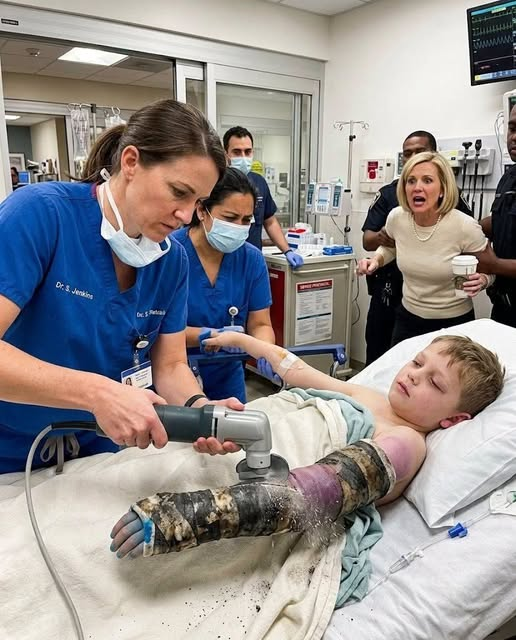
The cast saw started.
Martha screamed.
“You don’t understand!”
Security held her back while Clara carefully worked along the fiberglass.
When the outer shell finally separated, the room recoiled.
The padding beneath was soaked, contaminated and clearly far older than Martha had claimed. The smell intensified so sharply that one nurse stumbled backward.
But that was not what made Clara gasp.
Something small dropped from between the layers and landed on the sterile sheet covering the floor.
A hospital identification bracelet.
Not ours.
I bent down without touching it.
NATHAN HARRIS.
AGE: 8.
MERCY CHILDREN’S HOSPITAL.
The date was six weeks earlier.
I looked at Martha.
“You said he broke his arm a month ago.”
She stopped struggling.
Nobody spoke.
Marcus picked up a clear evidence bag.
“There’s something else.”
A folded piece of paper had been trapped beneath the outer padding.
It was damaged, but several words were still readable.
URGENT ORTHOPEDIC FOLLOW-UP REQUIRED.
And beneath that:
RETURN IMMEDIATELY FOR FEVER, SWELLING, DISCOLORATION OR WORSENING PAIN.
Every symptom Nathan had now.
Martha’s face went white.
I turned to her.
“You already took him to another hospital.”
“No.”
The word came too fast.
“Martha.”
“They exaggerate everything.”
“You were given follow-up instructions.”
“He was fine!”
Nathan made a weak sound from the bed.
I turned immediately.
His eyes had opened.
His lips barely moved.
“Mom said… don’t tell.”
The room changed.
Not loudly.
Not dramatically.
But every adult inside it understood those four words.
Clara moved closer to him.
“You’re safe here, sweetheart.”
Martha shouted:
“Stop questioning my son!”
I looked at security.
“Take her outside.”
“You can’t!”
“Yes, we can remove you from the treatment room if you interfere with emergency care.”
She was escorted into the hallway.
And for the first time since Nathan arrived, he stopped watching the door.
Imaging showed what the cast had hidden.
The original fracture had not healed correctly.
There were signs of serious infection.
And there were older injuries too.
Not one.
Several.
Different ages.
Different stages of healing.
I called our pediatric specialist, surgery and the hospital social worker.
Then I called child protective services.
Nathan’s blood pressure remained dangerously low.
There was no time for family explanations.
The priority was keeping him alive.
Before he was taken upstairs, I stood beside him.
His eyes were half closed.
“Dr. Sarah?”
“Yes?”
“Am I in trouble?”
My throat tightened.
“No.”
“For ruining the cast?”
“No.”
“For getting it dirty?”
“No, Nathan.”
I leaned closer.
“You are not in trouble.”
He stared at me as if nobody had ever said those words to him before.
Then he whispered:
“Mom says doctors ask too many questions.”
I almost looked toward the hallway.
Instead I asked:
“What happened to your arm?”
His eyes closed.
“I fell.”
I waited.
Children who have been frightened into silence do not always tell the truth because a kind adult asks once.
So I did not pressure him.
“That’s okay.”
His eyes opened again.
“You don’t have to tell me right now.”
Something in his face relaxed.
Then the surgical team took him.
Martha demanded to leave with him.
She threatened lawyers.
She called her husband.
She called someone she said was “important in the hospital system.”
None of that changed anything.
Nathan was critically ill.
And because there was now concern for his safety, she could no longer simply remove him.
Two detectives arrived that afternoon.
So did a child-protection investigator named Elena Ruiz.
Elena had the calmest voice I had ever heard.
She sat with Martha for almost an hour.
Then she came to find me.
“The other hospital confirmed everything.”
“What happened?”
“Nathan arrived there six weeks ago with a fracture.”
“His mother said he fell from playground equipment.”
“They placed the original cast and scheduled follow-up.”
“She never returned.”
I looked toward the operating floor.
“And this cast?”
Elena’s mouth tightened.
“Not the original.”
My stomach dropped.
“What?”
“The hospital uses a different fiberglass system.”
Someone had removed the medical cast.
Then replaced it.
At home.
Why?
The answer came from Nathan’s father.
His name was David Harris.
He arrived just before midnight looking terrified.
Unlike Martha, he did not come in angry.
He came in shaking.
“Where is my son?”
Elena stopped him.
“When did you last see Nathan?”
“Two months ago.”
That made no sense.
“You live together?”
David’s face crumpled.
“Not anymore.”
He and Martha had separated quietly several months earlier.
Nathan stayed mostly with her.
David had been traveling for work and said Martha repeatedly canceled his weekends, claiming Nathan was sick, busy or visiting relatives.
“She sent pictures.”
He pulled out his phone.
The photographs were always from the shoulders up.
Nathan smiling weakly.
Nathan under a blanket.
Nathan supposedly sleeping.
Never his arm.
David stared at me.
“Is he going to live?”
“He is receiving intensive treatment.”
It was the only honest answer I could give then.
David covered his face.
“I should have gone over there.”
Elena asked:
“Did Nathan ever tell you he was afraid at home?”
His hands dropped.
“Once.”
My chest tightened.
“When?”
“Last year.”
“He said Martha’s boyfriend got angry.”
Now everything became colder.
“Boyfriend?”
David nodded.
A man named Grant.
According to David, Grant had moved in not long after the separation.
Elena wrote the name down.
“Why wasn’t that mentioned earlier?”
“Martha told everyone Grant was just a family friend.”
Within hours, the investigation changed direction.
Nathan survived the night.
Then the next one.
By the third day, his fever was falling.
The infection had been severe, but the surgeons had managed to save his arm.
Recovery would take time.
Physical therapy.
More procedures.
Monitoring.
But he was alive.
That was enough.
The first time I saw him awake and fully alert, he was watching cartoons with Clara.
His father sat in the corner.
Nathan looked at me.
“They took the bad cast away.”
“Yes.”
“Can I never wear that one again?”
“Never.”
He smiled.
A tiny smile.
But real.
Then Elena came in.
She did not ask about the fracture immediately.
She asked about school.
His favorite food.
His dog.
His teacher.
Twenty minutes passed before Nathan finally said:
“Grant gets mad when I make noise.”
David went rigid.
Elena remained calm.
“What happens when Grant gets mad?”
Nathan looked at his father.
Then at me.
Then down at the blanket.
“The stairs.”
Nobody moved.
“He said I fell down the stairs.”
My skin went cold.
Nathan continued carefully.
“Mom said if I told Dad, Grant would go away and it would be my fault.”
David began crying.
Nathan looked frightened.
“I’m sorry.”
His father crossed the room.
“No.”
He crouched beside the bed.
“No, buddy.”
“You never have to apologize for telling the truth.”
That was the first time Nathan cried.
Not loudly.
He simply reached for his father.
And David held him.
The police investigation later established a much clearer timeline.
Nathan’s arm had been injured during an incident at home.
Martha took him to Mercy Children’s, but gave doctors a false explanation.
When medical staff requested further evaluation and follow-up, she became frightened that questions would expose what was happening in the house.
She missed the appointments.
When the original cast became damaged, she and Grant did not return to the hospital.
They tried to conceal the problem themselves.
Nathan became sicker.
They still waited.
Until he became too ill to hide.
Grant was arrested as the investigation developed.
Martha also faced charges related to neglect and obstruction.
Those outcomes were decided by investigators and courts.
Not by me.
My job had been simpler.
Open the cast.
Treat the child.
Tell the truth about what we found.
Nathan did not return to Martha’s home.
After the court reviewed the case, he was placed with David while child-protection services continued supervision.
David changed jobs so he could remain in Denver.
He attended every appointment.
Every therapy session.
Every school meeting.
Six months later, Nathan walked into our emergency department carrying a small cardboard box.
I panicked for half a second.
Then he smiled.
“I’m not sick.”
Clara came around the nurses’ station.
“What’s in the box?”
Nathan opened it.
Cupcakes.
On top of each one was a tiny blue sugar decoration shaped like an arm cast.
Clara stared.
“Is that supposed to be funny?”
Nathan grinned.
“Yes.”
We all laughed.
David stood behind him.
“He insisted.”
Nathan handed me one.
“My arm works now.”
He lifted it proudly.
Not perfectly.
But enough.
Then he said:
“Dad says I can play baseball next year if my doctors say okay.”
“That sounds like a good goal.”
He nodded.
At the door, he turned around.
“Dr. Sarah?”
“Yes?”
“Thanks for not listening to my mom.”
The entire nurses’ station went quiet.
I swallowed.
“You’re welcome, Nathan.”
He waved.
Then left.
For years afterward, people in the ER remembered Trauma Room 2 because of the smell.
Because of the cast.
Because seasoned nurses had recoiled when it came apart.
But that was not what I remembered.
I remembered Martha whispering:
“Don’t open it.”
Because that sentence contained the entire story.
She was not afraid of what the cast would reveal medically.
She was afraid of what would happen when someone finally looked closely.
That night taught me something I never forgot:
Sometimes neglect survives because everybody accepts the first explanation.
The polished parent.
The clumsy child.
The old injury.
The missed appointment.
One excuse stacked on another until the truth disappears underneath.
Nathan nearly died inside that silence.
But once the cast came off, the hiding ended.
The most frightening thing in Trauma Room 2 was never what had been concealed beneath the fiberglass.
It was how many adults had needed the truth to stay covered—and how much courage it took one eight-year-old boy to finally let someone see it.
