I left home six days later.
No dramatic goodbye.
No shouting.
No final family dinner.
Just one suitcase, my bow case and a train ticket to the national training center.
My mother discovered I was leaving when she saw my luggage by the front door.
“What is this?”
“Training camp.”
Her expression changed.
“I already canceled that.”
“I restored my application.”
“You had no right.”
I looked at her.
“I turned eighteen last week.”
For the first time, that sentence meant something.
Lucas came downstairs.
“You’re seriously leaving Emma before the state competition?”
Emma stood behind him.
Her face immediately crumpled.
“But who will help me with my medicine?”
Mom looked at me as if the answer were obvious.
I almost gave in.
That old reflex was powerful.
Then I remembered four empty chairs.
“I wrote everything down.”
I placed Emma’s schedule on the table.
“Dad knows her medication. Lucas has a car. Mom knows her meals.”
My mother stared at me.
“You know they’re busy.”
“So am I.”
Silence.
Nobody in my family seemed prepared for those three words.
Adrian arrived twenty minutes before my taxi.
He was holding another bouquet.
White roses this time.
“Lily, don’t leave angry.”
“I’m not angry.”
That confused him.
“I wanted to apologize.”
“You can.”
His voice softened.
“I’m sorry I missed the ceremony.”
I nodded.
“And I’m sorry I gave Emma your flowers.”
“Okay.”
Hope appeared in his eyes.
Then he asked:
“When will you be back?”
“Six months.”
His face fell.
“Six months?”
“If I qualify.”
“And us?”
Us.
For years, I had imagined hearing that word from him.
Now it sounded strangely late.
“There is no us, Adrian.”
His face went white.
“I thought…”
“I know.”
I picked up my bow case.
“You thought I would wait.”
Then I left.
National camp was brutal.
Not because anyone treated me cruelly.
Because for the first time, nobody cared that I was “the strong sister.”
Nobody knew Emma.
Nobody knew my parents.
Nobody knew Adrian.
They knew my scores.
My discipline.
My mistakes.
If my arrow landed outside the ten-ring, nobody said:
“It’s okay. You’ve sacrificed enough for your family.”
They said:
“Again.”
I loved it.
The first month, I ranked twelfth.
The second, eighth.
Then fifth.
By the final qualifying tournament, there were three places available.
I entered the last round in fourth.
One arrow remained.
My hands were sweating.
I thought about the coming-of-age ceremony.
Then I stopped.
That was the moment I understood I did not need pain to shoot well.
I didn’t need to prove anything to people who weren’t there.
I breathed.
Raised the bow.
Released.
Ten.
When the final scores appeared, my name was third.
LILY HARPER — NATIONAL TEAM.
My coach hugged me.
“You did it.”
For a few seconds, I couldn’t speak.
Then I cried.
Not because my family had failed me.
Because I had finally kept a promise to myself.
My phone contained fifty-seven messages when I turned it back on.
Mom.
Dad.
Lucas.
Adrian.
Even Emma.
They had watched the livestream.
My father wrote:
We’re so proud of you.
I stared at it.
Then laughed bitterly.
Proud.
Now.
When there was a national flag beside my name.
When strangers were applauding.
When my “hobby” had become impressive enough to mention.
I answered only:
Thank you.
My mother called immediately.
“When are you coming home? Your father wants to organize a celebration.”
“I’m not.”
“What?”
“Training continues next week.”
“But the whole family wants to see you.”
“I wanted the whole family to see me six months ago.”
She became silent.
Then defensive.
“Are you going to punish us forever for one ceremony?”
“No.”
I looked around the training center.
“I’m simply not rearranging my life every time you suddenly decide I matter.”
Then I hung up.
Emma was the first person to change.
Not dramatically.
Slowly.
One evening she called me.
“I quit ballet.”
I sat up.
“What happened?”
“I don’t like competing.”
“But Mom said—”
“I know what Mom said.”
Her voice became small.
“I liked ballet when I was little.”
“Then everyone started treating it like my entire identity.”
For the first time, I wondered whether being the favorite had trapped Emma too.
She continued:
“I’m sorry about your ceremony.”
I said nothing.
“And the flowers.”
“You knew they were mine?”
Silence.
“Yes.”
That hurt.
“I wanted them anyway.”
At least she told the truth.
“I was jealous.”
“Of me?”
“You could do things alone.”
I almost laughed.
“You think I wanted to?”
“No.”
Her voice cracked.
“I understand that now.”
I didn’t forgive everything that night.
But it was the first real conversation we had ever had as sisters.
Not princess and caretaker.
Not fragile one and strong one.
Just two girls raised badly in different ways.
My parents took longer.
Dad apologized first.
Not because I became successful.
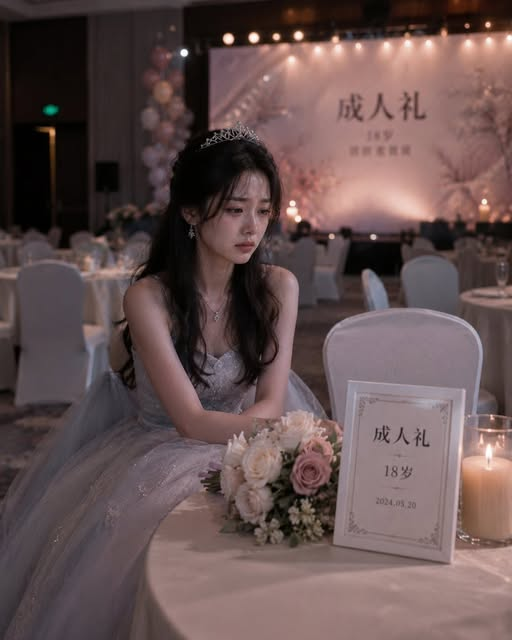
Because one night he finally watched the video from my coming-of-age ceremony.
Mrs. Bennett had kept a recording.
He saw the four empty chairs.
He saw me looking toward the doors every time they opened.
He saw my teacher walk onto the stage when nobody else did.
My father called afterward.
“I didn’t know it looked like that.”
I closed my eyes.
“It felt worse.”
He cried.
For once, I let him.
“I failed you.”
“Yes.”
He did not say:
But Emma needed us.
He did not say:
You were stronger.
He simply said:
“I’m sorry.”
That apology mattered.
My mother’s came almost a year later.
She had lost something first.
Control.
Emma refused to return to ballet.
Lucas moved out.
I stopped coordinating everyone’s schedules.
Suddenly Mom had nobody left who automatically adjusted themselves around her decisions.
When we finally met, she said:
“I thought loving you meant trusting you could handle disappointment.”
I stared at her.
“That isn’t love.”
“I know.”
“You kept giving me pain because I was good at surviving it.”
Tears filled her eyes.
“I know that now too.”
I nodded.
We rebuilt slowly.
With boundaries.
No one signed forms for me.
No one canceled plans in my name.
No one volunteered my time.
And if my family needed help, they learned to ask instead of assign.
Adrian was different.
He kept trying to return to the version of our relationship that existed only in his head.
When I came home after my first international tournament, he was waiting at the station.
Flowers again.
I laughed.
“You really need another strategy.”
He smiled nervously.
“I missed you.”
“I know.”
“Can we start over?”
I looked at him.
“You chose Emma that night.”
His face fell.
“She was scared.”
“And I was standing alone under a stage light.”
“I know.”
He lowered the flowers.
“I was wrong.”
“Yes.”
“But people make mistakes.”
“They do.”
Hope returned.
Then I continued:
“And sometimes the consequence is that the person you hurt stops wanting the same future.”
He stared at me.
“You don’t love me?”
I thought about it.
“Not the way I used to.”
That was the truth.
The Lily who waited for Adrian had disappeared somewhere between the empty chairs and the training center.
He nodded slowly.
Then handed me the bouquet anyway.
“For qualifying.”
I accepted it.
That was all.
Not every apology needs to restart a love story.
Three years later, I wore my country’s colors at an international championship.
When I stepped onto the range, my family was in the stands.
All of them.
Mom.
Dad.
Lucas.
Emma.
Mrs. Bennett.
Even Adrian, several rows away with friends.
This time, nobody had been begged to come.
Nobody had been reminded.
They chose to be there.
I won silver.
For five minutes, I was disappointed.
Then I looked at the medal.
Second in the world.
The girl whose seven years of training had once been dismissed as a hobby had represented her country on an international stage.
I laughed.
Silver suddenly seemed beautiful.
After the ceremony, reporters asked why I had chosen archery.
I could have told them about my family.
The empty chairs.
The canceled camp.
But I didn’t want my greatest accomplishment permanently attached to their worst mistake.
So I answered:
“Because when I’m standing at the line, nobody else can release the arrow for me.”
That became my favorite sentence.
Years later, I joined a national sports program that trained young athletes and represented the country at international events.
That became my way of serving.
Not because I had been abandoned.
Not because I wanted to prove my family wrong.
Because I had discovered something I loved enough to give my best years to.
At one youth ceremony, I noticed a girl standing alone after receiving her first national-team jacket.
Everyone else had family taking photographs.
She didn’t.
I walked over.
“Want a picture?”
Her eyes widened.
“With you?”
“With your jacket.”
I smiled.
“That’s the important part.”
I took the photo.
Then stayed until her coach arrived.
That night, I thought about Mrs. Bennett stepping onto the stage for me when nobody else did.
Sometimes one person showing up does not erase the people who didn’t.
But it can remind you that you are still worth showing up for.
My family eventually learned that.
So did I.
On my eighteenth birthday, I believed the worst thing that could happen was four empty chairs.
I was wrong.
The worst thing would have been spending the rest of my life sitting beside them, waiting for people who had already shown me where I ranked.
So I stopped waiting.
I picked up my bow.
I signed my own name.
And I walked toward the life they had tried to cancel for me.
My family called me “the strong one” because it made neglecting me easier.
Years later, I finally understood what strength actually meant.
It wasn’t enduring whatever people gave me.
It was choosing where my next arrow would go—and refusing to let anyone else aim my life for me.
