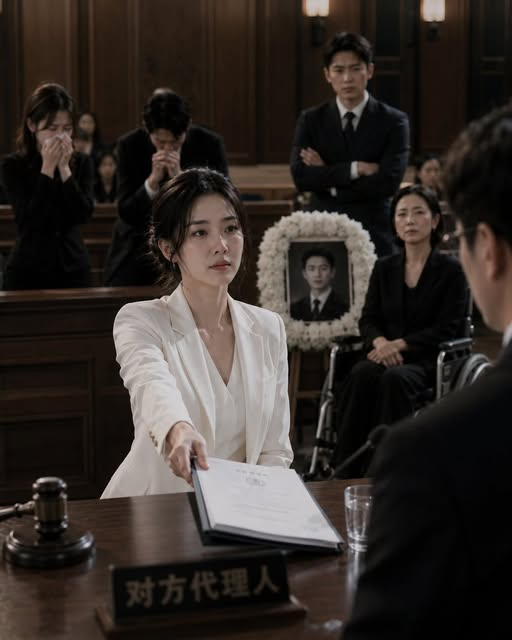
Attorney Collins did not pull out a photograph.
He pulled out a notarized copy of my university admission letter.
My real admission letter.
Dated four years earlier.
The one I had never received.
Ethan stood so quickly that his chair scraped across the courtroom floor.
My mother whispered:
“No.”
Mr. Collins looked toward the judge.
“Your Honor, before this case proceeds any further, the defense needs to address a fundamental issue.”
The prosecutor frowned.
“What issue?”
Mr. Collins placed a second document beside the first.
“Whether the woman who has been using the name Clara Bennett for the last four years is actually Clara Bennett.”
The courtroom erupted.
Olivia stopped crying.
Completely.
No trembling.
No weak breathing.
No frightened little girl.
Just silence.
The judge struck the gavel.
“Order.”
Mr. Collins continued.
“Four years ago, my client was admitted to Northwestern University under her own name.”
My mother covered her mouth.
“The admission notice was intercepted at the Bennett home.”
“The associated identity documents were then used by another member of the household.”
He turned.
Toward Olivia.
“She enrolled as Clara Bennett.”
Olivia suddenly shouted:
“That’s a lie!”
For the first time, the wheelchair moved backward because she pushed it herself.
The judge stared at her.
Mr. Collins calmly opened another folder.
“Enrollment photograph.”
A picture was displayed.
Olivia.
My name beneath it.
CLARA BENNETT.
Then another.
Scholarship award.
My name.
Olivia’s photograph.
Another.
Law school application.
Another.
Internship paperwork.
Another.
Payroll records.
For four years, Olivia had lived a life built from my identity.
The prosecutor looked stunned.
Even the victim’s family had stopped looking at me.
My father rose halfway.
“This has nothing to do with the accident.”
Mr. Collins turned toward him.
“It has everything to do with the accident.”
Then he placed one final document on the evidence table.
A driver’s license record.
My name.
Olivia’s photograph.
The same identity used when the car involved in the fatal crash had been registered for temporary access to a law-firm parking garage.
The judge’s expression hardened.
“Sit down, Mr. Bennett.”
My father sat.
This time, he did not look at me.
The prosecutor requested a recess.
During those twenty minutes, my mother cornered me in the hallway.
“What have you done?”
I almost laughed.
“What have I done?”
She grabbed my arm.
“You are destroying Olivia’s future.”
I looked at her hand.
She released me.
“My future was destroyed four years ago.”
“You could have gone to another school.”
“There it is.”
Her face changed.
“You still think the problem was losing a university place.”
“It wasn’t.”
“It was learning my own family believed my name belonged to whichever daughter needed it more.”
My mother began crying.
“You don’t understand. Olivia was sick.”
“She was adopted late. She always felt insecure.”
“She needed something that made her feel equal.”
“So you gave her my life?”
“We thought it would only be temporary.”
Four years.
A bachelor’s degree.
Law school.
An internship.
Scholarships.
A professional record.
Temporary.
I stared at her.
“Who intercepted the letter?”
She said nothing.
“Mom.”
Her eyes moved toward Ethan.
That was when I understood why he had stood up.
My brother had done it.
Court resumed.
The prosecution no longer treated me as the obvious driver.
They had seen enough to know the identity issue could contaminate nearly every piece of evidence bearing my name.
Mr. Collins asked permission to introduce material connected directly to the crash.
First came traffic-camera footage.
A black sedan entered the intersection at 11:48 p.m.
It struck the victim.
It continued without stopping.
The driver’s face was not perfectly clear.
But the next camera caught the vehicle three blocks later.
Then another.
At 11:56 p.m., the car entered the underground garage of Olivia’s apartment building.
The footage showed someone getting out.
Olivia.
Walking.
No wheelchair.
No hospital gown.
No weakness.
She stumbled once, caught herself against the car and looked back toward the damaged front bumper.
The courtroom went dead silent.
Olivia gripped the wheelchair armrests.
“That isn’t me.”
The prosecutor stood.
“Ms. Moore—”
“It isn’t!”
The judge warned her to remain silent.
Mr. Collins introduced the next record.
Olivia’s phone location.
It traveled with the car.
Mine did not.
My phone had been at work.
Twenty-one miles away.
Clocked into the hospital where I worked nights as an administrative assistant after losing the university place that should have been mine.
There were security logs.
Coworkers.
A parking record.
And a video of me entering the building hours before the crash.
I had an alibi so strong it should have ended the case before it began.
Except somebody had spent four years making sure official systems believed Olivia was Clara Bennett.
Then came the final evidence.
The family group chat.
My breath caught.
Mr. Collins had obtained it through lawful discovery after one relative preserved messages my family believed had been deleted.
The first message was from Ethan.
Sent twelve minutes after the crash.
Olivia, stop calling Mom. Leave the car downstairs. I’ll handle it.
Then my father:
Do not speak to police until we decide what to say.
Then my mother:
Clara has already had problems with her records. If the car is tied to her name, maybe we can say she was driving.
The victim’s mother made a sound I will never forget.
Not a scream.
Something quieter.
The sound of realizing her son’s death had been treated like a family inconvenience.
I looked at my parents.
For the first time, they were afraid of me.
Not because I was powerful.
Because I had stopped protecting them.
The judge did not decide the entire case that day.
Real trials do not end because one folder makes everyone gasp.
But the prosecution immediately requested that the charges against me be dismissed while the evidence was reassessed.
The investigation shifted.
Olivia was no longer treated as the tragic younger sister.
She became a suspect.
So did Ethan.
So did my parents.
Not for the same crimes.
And not because they were related to her.
Because evidence suggested they had helped conceal both the identity theft and the aftermath of the crash.
As we left the courtroom, the victim’s mother stopped me.
I froze.
For months, she had believed I killed her son.
Now she looked exhausted.
“I said terrible things to you.”
“You thought I was responsible.”
Her eyes filled.
“They told us you were.”
I looked toward my family.
“So did I.”
She nodded.
Then walked away.
That was enough.
The truth about my university admission came out piece by piece.
Ethan had intercepted the letter.
Olivia had failed to get into the school she desperately wanted.
My mother had panicked.
She said Olivia would “collapse” if she had to watch me succeed while she stayed home.
So they came up with a plan that should have sounded impossible.
Except impossible things become surprisingly easy when several adults decide the victim is the person least likely to fight back.
They redirected mail.
Used copies of my identity documents.
Created explanations when photographs did not match older records.
At first, they intended only to get Olivia through enrollment.
Then she performed well.
Scholarships followed.
Then law school.
By that point, exposing the lie would have destroyed too many things.
So they kept going.
And I?
I had been told the university rescinded my admission.
My parents said there had been an administrative error.
My mother told me:
“Maybe this is a sign you weren’t meant to go.”
I believed her.
For almost a year.
Then Mrs. Patel, my former guidance counselor, contacted me.
She had found an old copy of the admission record.
That was when I started investigating.
Quietly.
For four years.
People later asked why I waited.
Why not expose Olivia immediately?
Because when I first discovered the truth, I had almost nothing.
One old letter.
One counselor’s suspicion.
A family united against me.
And Olivia had already built an official identity around my name.
So I documented.
Every record.
Every contradiction.
Every institution.
Mr. Collins helped me understand what could actually be proven.
I changed my legal identification.
Locked my credit.
Reported the identity misuse.
And waited while investigators traced what had happened.
The crash did not create my case.
It simply forced my family to make one final mistake:
They tried to use the stolen identity to send me to prison.
That made hiding everything impossible.
Olivia eventually pleaded guilty to charges connected to the fatal crash and the identity fraud.
The sentence was decided by the court.
Not me.
I did not celebrate.
A twenty-six-year-old man was still dead.
Nothing about that was victory.
Ethan also faced legal consequences for his role in concealing evidence and helping maintain the false identity.
My parents were investigated for the parts they had played.
Their lives did not vanish overnight.
But the story they had told themselves did.
That everything had been done for family.
That Olivia was too fragile to face consequences.
That I was strong enough to absorb them.
The law did not recognize “Clara can handle it” as a defense.
Neither did I anymore.
My mother visited me once after the trial.
She looked ten years older.
“Olivia keeps asking for you.”
“I’m not going.”
“She says she’s sorry.”
“Good.”
My mother stared at me.
“That’s all?”
“What would you like me to do?”
“Forgive her.”
I smiled sadly.
“You still haven’t learned.”
Her face tightened.
“Learned what?”
“You are still assigning me work so Olivia can feel better.”
Silence.
“She apologizes because it is right.”
“Not because I owe her relief afterward.”
My mother began crying.
“I lost both my daughters.”
“No.”
I looked at her.
“You lost one daughter when you decided the other one was entitled to her name.”
She flinched.
I continued:
“And you can decide what you do with the years you still have.”
That was not forgiveness.
But it was not revenge either.
It was a boundary.
My university admission was reinstated in a form nobody could have imagined four years earlier.
The school acknowledged the fraud and offered me the opportunity to enroll.
I was twenty-six by then.
Older than most incoming students.
Working full-time.
Tired.
For one week, I considered saying no.
Then I looked at the original admission letter.
The one my brother had hidden.
The one my mother had helped replace with a lie.
And I enrolled.
Not because I needed to recover the exact life I lost.
That life was gone.
I enrolled because, for once, I wanted the decision to belong to me.
I studied public policy.
Not law.
Olivia had taken enough of that world for me to want another direction.
Four years later, I graduated.
Mrs. Patel attended.
Mr. Collins attended.
Two coworkers from the hospital attended.
And in the front row was the mother of the man Olivia had killed.
We had not become close.
Pain does not always turn strangers into family.
But she had written me a year earlier.
My son lost his future. You nearly lost yours. I hope you use yours well.
When I crossed the stage, I saw her stand.
For once, the people in the chairs had chosen to be there for me.
My family once believed my name was something transferable.
A document.
A student account.
A scholarship application.
A driver’s license.
Something they could hand to Olivia because she needed it more.
Then, when the worst happened, they tried to transfer something else too.
Her guilt.
They sat in court and asked me to say yes.
To accept prison.
To carry the final consequence of four years of lies.
But they misunderstood the reason I smiled when the judge asked for my plea.
I had not been waiting four years for revenge.
I had been waiting four years for a room where evidence mattered more than who cried hardest.
And when that room finally came, I did not need to scream.
I only needed to say one word.
Not guilty.
They had stolen my university place.
My records.
My opportunities.
Nearly my freedom.
But there was one thing they could never permanently give to Olivia.
My name.
Because eventually, I stood in a courtroom, claimed it back—
and made everyone who had used it finally answer under their own.
