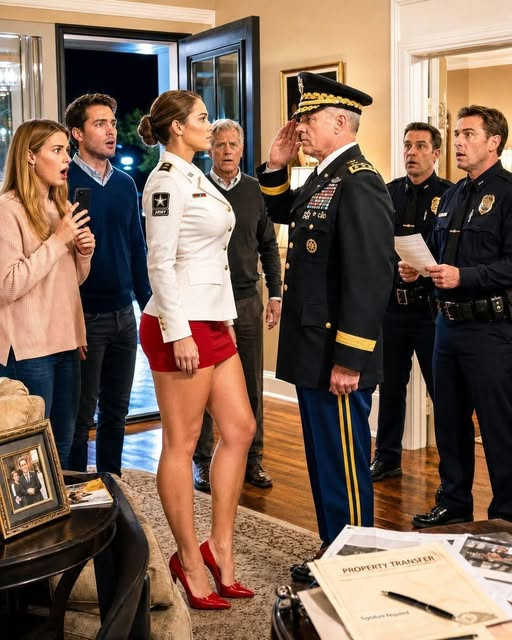
The four-star general turned toward the officers.
“Before you take her anywhere, I suggest you verify the complaint.”
My mother’s smile disappeared.
Tiffany stared at him.
The officer holding the paperwork frowned.
“Sir, this is a civilian matter.”
“Correct.”
The general’s voice remained calm.
“And I have no authority to interfere with it.”
Then he looked at me.
“But I do have evidence relevant to what you’ve been told.”
He introduced himself as General Marcus Hale.
He was in Denver for a joint-defense conference. I was scheduled to accompany his staff to a secure briefing later that evening, and his convoy had come to collect me from the address I had provided.
That explained the SUVs.
It did not explain the salute.
Brad finally found his voice.
“Why did you salute her?”
General Hale looked at him.
Then at my family.
“You think that patch tells you everything about her?”
Tiffany’s face stiffened.
“She said she works on a base.”
I almost laughed.
I had never said that.
She had decided it for me.
The general answered:
“Major Evelyn Bennett serves on my strategic planning staff.”
My father’s face changed.
But General Hale wasn’t finished.
“And the salute was not because of her rank.”
The room went silent.
He looked at me.
“Major Bennett is also a recipient of the Medal of Honor.”
Tiffany’s phone slipped slightly in her hand.
Her livestream was still running.
For five years, I had never told them.
Not because I was ashamed.
Because the circumstances surrounding that medal belonged to people other than me too, and I had never wanted the worst day of several lives turned into family entertainment.
My mother whispered:
“That’s impossible.”
General Hale’s expression hardened.
“No, ma’am.”
Then he turned back to the police.
“But none of that determines whether Major Bennett committed a civilian crime.”
That sentence mattered.
My uniform did not make me above the law.
My medal did not make my family guilty.
Evidence did.
The officer looked down at the complaint again.
“What exactly do you have?”
General Hale’s aide stepped forward with a folder.
“Certified travel and duty records.”
My stomach tightened.
The officer read the complaint aloud.
My parents had accused me of stealing property from my grandmother’s estate shortly before disappearing five years earlier.
Jewelry.
Documents.
Cash.
They claimed I had returned tonight after threatening them repeatedly over the property.
According to the complaint, I had been “avoiding contact with law enforcement” because of my military service.
I looked at my father.
“You told them that?”
He wouldn’t meet my eyes.
The officer continued.
One alleged theft had supposedly happened at 2:30 p.m. on a specific date five years earlier.
General Hale’s aide handed him a certified record.
At that exact time, I had been on another continent under official orders.
Not traveling.
Not on leave.
Not anywhere near Colorado.
The officer’s expression changed.
Then I spoke for the first time.
“You should also look at Tiffany’s livestream.”
My sister went pale.
“What?”
“You’ve been recording since I arrived.”
She immediately reached for the screen.
The officer stopped her.
“Don’t delete anything.”
Her hand froze.
The video showed me entering quietly.
It showed Tiffany mocking me.
My parents telling me not to embarrass them.
Brad laughing.
It did not show me threatening anyone.
More importantly, the stream had started before I arrived.
The timestamp proved it.
Then I opened my phone.
“I also photographed something twenty minutes ago.”
I showed the officer the documents in my father’s office.
Grandma’s property.
A transfer packet.
A notarial acknowledgment.
My name.
And a signature block I had never agreed to sign.
The officer looked toward the office.
Then toward the thick folder Mason—no, the stranger helping my father—had left on the desk.
“Who prepared those documents?”
Nobody answered.
The notary did something interesting.
He moved toward the door.
An officer stepped in front of him.
“Sir, stay here.”
My mother exploded.
“This is ridiculous! That property belongs to the family!”
I finally looked at her.
“Grandma left it to me.”
“You abandoned us!”
“I served.”
“Same thing!”
The room became completely still.
Even Tiffany looked at her.
My mother seemed to realize what she had said.
Too late.
My father finally spoke.
“You were gone five years, Evelyn. Tiffany stayed. She helped us. Your grandmother’s property should go to the child who remained part of this family.”
“That wasn’t your decision.”
“It should have been.”
I looked toward the office.
“So you were going to make it your decision with paperwork.”
He said nothing.
That silence was enough to make the officers take a much closer look.
Nobody was dramatically handcuffed in the living room that night.
Real investigations do not always move at the speed of family revenge fantasies.
The officers separated everyone.
They documented the papers.
They took statements.
They preserved Tiffany’s livestream.
And when they discovered that the complaint used dates that conflicted with verified records, the question changed.
It was no longer:
What had Evelyn done?
It became:
Why had this complaint been filed at all?
I gave my statement.
Then General Hale’s convoy took me to the briefing.
Before I left, Tiffany followed me onto the porch.
“Evelyn.”
I stopped.
Her eyes were red.
“You’re really a major?”
Of all the things she could have asked.
“Yes.”
“And the medal?”
“Yes.”
“Why didn’t you tell us?”
I almost smiled.
“Would you have listened?”
She flinched.
Then whispered:
“Are you going to take Grandma’s house from me?”
I looked at her.
“It was never yours.”
That was not cruelty.
It was the first honest sentence our family had spoken about the property in years.
The investigation lasted months.
What it uncovered was worse than a single bad decision.
My grandmother’s will had been clear.
The small rental property she owned outright went to me.
A separate investment account was divided between Tiffany and me.
My parents received other assets.
Nobody had been left destitute.
But after Grandma died, my parents convinced themselves I did not deserve my share because I was absent.
They rented my property without telling me.
Then began treating the income as family money.
When I finally announced that I was coming home, they panicked.
Brad had introduced my father to a man who claimed he could “clean up” complicated property records.
That was the stranger in the office.
The plan was to create documents suggesting I had previously agreed to transfer the property to Tiffany.
The false police complaint served another purpose.
If I protested, my family could portray me as the estranged daughter who returned only because she wanted money and became threatening when confronted.
Tiffany’s livestream was supposed to prove how “unstable” I was.
Instead, it recorded everyone else.
Brad eventually admitted enough to protect himself.
The notary denied knowing the documents were fraudulent.
Investigators decided what they believed based on records, not family speeches.
My parents and the others involved faced charges connected to attempted forgery, false statements and the estate scheme.
I did not control the prosecution.
I did not ask General Hale to make calls.
The Army stayed out of it except for providing records when lawfully requested.
That mattered to me.
I had spent five years serving institutions built around rules.
I was not going to return home and use a uniform to bypass them.
The strangest part was the family reaction after my identity became public.
Relatives who had laughed that night suddenly began sending messages.
We always knew you’d do something important.
No, they didn’t.
Your parents must be so proud.
They weren’t.
Why didn’t you tell us about the medal?
Because none of them had asked where I had actually been.
They only asked why I wasn’t more like Tiffany.
My mother called three weeks later.
“I saw your photograph online.”
I said nothing.
“You were standing beside the Secretary of Defense.”
“Yes.”
Her voice softened.
“You looked beautiful.”
That made me sadder than an insult.
“Mom, I came home without medals because I wanted to know whether you could be proud of me without them.”
Silence.
“You walked into that party already expecting us to fail.”
“No.”
I looked out my apartment window.
“I walked in hoping I was wrong.”
She began crying.
For once, I did not rush to comfort her.
Tiffany took longer.
Her engagement to Brad ended during the investigation.
Not because I destroyed it.
Because when she learned he had helped arrange the questionable paperwork without telling her everything, she finally understood that he had viewed our family exactly as she had viewed me:
As useful pieces in his own future.
She came to see me almost a year later.
No livestream.
No makeup.
No performance.
“I was jealous of you.”
I raised an eyebrow.
“You thought I was a disgrace.”
“I needed you to be.”
That surprised me.
She looked down.
“You disappeared into a life I couldn’t see.”
“Everyone praised me for staying close to Mom and Dad.”
“Then whenever Grandma talked about you, she looked proud.”
Her eyes filled.
“I hated it.”
“So when Dad said the property should be mine, I agreed.”
“Even though you knew Grandma left it to me.”
“Yes.”
At least she finally said it.
“I’m sorry.”
I believed she was.
That did not mean I handed her the property.
I sold the house two years later.
Part of the proceeds went into the investment account Grandma had intended for me.
Another part funded a scholarship in her name for children from military families.
Tiffany received nothing from that property.
Not as punishment.
Because it had never been hers.
My parents eventually resolved their case and paid restitution connected to money taken from the property.
Our relationship never returned to what it had been.
Maybe that was healthy.
I stopped trying to earn the affection of people who only became curious about my life after a four-star general walked into the room.
They learned pieces slowly.
That I had spent years in assignments I could not discuss.
That I had been promoted.
That the patch Tiffany mocked was a unit patch, not my rank.
That the medal everyone suddenly cared about was something I almost never wore outside required ceremonies.
Once, my father asked:
“Why aren’t you proud of it?”
“I am.”
“Then why hide it?”
I thought carefully.
“Because the medal represents one moment.”
“My life is larger than the worst day that earned it.”
He nodded.
For the first time, he did not argue.
Five years after that night, Grandma’s old photograph sat on the desk in my own home.
The same silver frame that had vanished from my father’s office.
Investigators found it boxed with some of the estate papers.
I kept it.
In the photograph, Grandma was standing beside me on the day I left.
Her hand was on my shoulder.
I remembered what she had whispered after everyone else went inside.
You don’t have to become impressive to deserve a place here.
I had forgotten that sentence for years.
My family had too.
The night I came home, Tiffany laughed at the patch on my shoulder.
My parents called me an embarrassment.
The police arrived because people who shared my blood had filed a complaint designed to make me look guilty before I could expose what they were doing.
Then General Hale walked through the door and saluted me.
Everyone thought that was the moment the story changed.
It wasn’t.
The salute did not make me worthy.
Four stars did not erase five years of contempt.
A medal did not suddenly make my grandmother’s wishes more valid.
The documents were valid before the general arrived.
The truth was true before my family respected me.
And I had been their daughter before anyone in that room discovered what I had accomplished.
The real change came when I finally stopped believing that I needed to prove any of those things to deserve my place at the table.
So I built a different table.
And this time, nobody needed a rank, a medal, or a famous man walking through the door to be treated with dignity.
