Daniel took another step toward Liam.
“Give me that phone.”
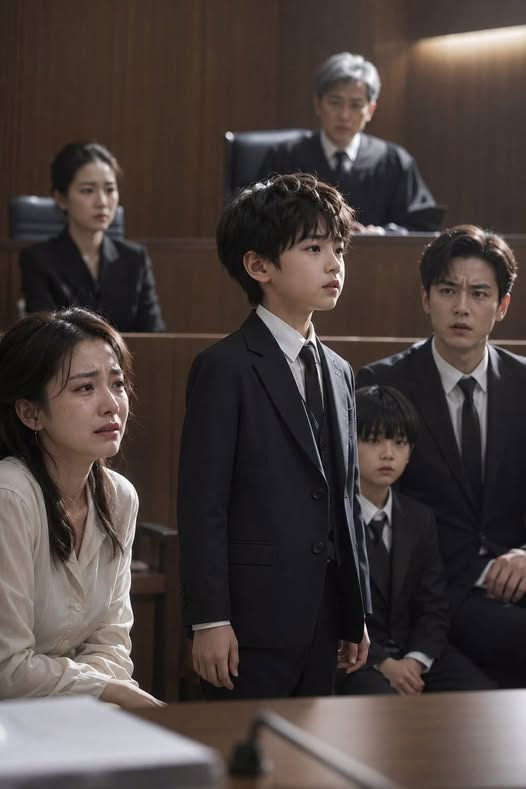
The judge’s voice cut through the courtroom.
“Mr. Whitman, sit down.”
Daniel froze.
For the first time that morning, the perfect expression slipped from his face.
Liam held the old phone against his chest.
His small hands were trembling.
I wanted to run to him.
To tell him he didn’t have to carry this.
But the judge spoke gently.
“Liam, nobody is going to take it from you. Can you tell me what is on the phone?”
My son nodded.
“Recordings.”
Daniel’s lawyer immediately stood.
“Your Honor, we strongly object to introducing material collected by a nine-year-old without context—”
“We’ll determine admissibility properly,” the judge said. “Sit down.”
Then he looked at Liam again.
“Why did you record your father?”
Liam swallowed.
“Because nobody believes Mom when Dad says she’s crazy.”
My heart shattered.
Not because of Daniel.
Because my child had understood far too much.
Noah began crying silently beside him.
Liam continued.
“Dad talks differently when Mom isn’t there.”
Daniel’s face had gone completely white.
The judge ordered a recess.
A court officer took possession of the phone.
The children were moved to a private room with the court-appointed child specialist.
I followed them to the door, but Liam stopped me.
“Mom.”
I turned.
“I’m sorry.”
I stared at him.
“For what?”
“For not telling you.”
I crouched in front of him.
“You have nothing to apologize for.”
“But I thought if I told you, you’d confront Dad.”
He looked down.
“And then he’d delete everything.”
That was when I realized this had not begun yesterday.
“How long?”
“Since Christmas.”
Six months.
My nine-year-old son had been quietly collecting evidence because the adults around him had failed to make him feel safe enough to speak.
I hugged him.
Not tightly.
Just enough for him to know I was there.
“You don’t have to protect me anymore.”
Liam’s voice cracked.
“I wasn’t only protecting you.”
He looked toward Noah.
“I was protecting us.”
The hearing resumed two hours later.
The children did not return to the courtroom.
I was grateful.
They had already done enough.
The judge had listened to several recordings privately with counsel present.
Daniel no longer looked confident.
His lawyer no longer looked at me like I was a stain.
The first recording was played.
Daniel’s voice filled the courtroom.
Calm.
Almost casual.
“If the judge asks, you say you want to stay with me.”
Then Liam:
“But I want Mom.”
A pause.
Daniel again:
“Then your mother will lose everything. Do you understand? She doesn’t have money like I do. If you choose her, I can make sure you barely see her.”
My hands began shaking.
The next recording was worse.
No shouting.
No dramatic threats.
Just manipulation.
Daniel telling Noah that my crying meant I was sick.
Telling Liam that good sons protected their father from embarrassment.
Promising new computers, travel and a larger bedroom if they “made the right choice.”
Then one sentence changed the entire case.
“Your mother doesn’t need to know what happens in this house. Adults have ways of making problems disappear.”
That was the sentence Liam had interpreted as me disappearing from their lives.
Daniel’s attorney stood.
“My client was speaking emotionally during an extremely difficult divorce.”
The judge looked at her.
“Your client also testified this morning that he had never discussed custody preferences with the children.”
Silence.
Daniel had lied under oath.
Then the court-appointed specialist delivered her preliminary findings.
The children did not describe me as perfect.
That almost made me cry with relief.
They said I got tired.
That sometimes I burned dinner.
That I cried in the bathroom after the divorce.
That once I forgot to sign Noah’s permission slip.
Normal failures.
Human failures.
But when asked who cooked for them, took them to school, attended appointments, helped with homework and stayed home when they were ill—
the answer was always me.
When asked about Daniel, Liam said:
“Dad buys us things.”
Noah said:
“Dad gets angry if Mom calls when we’re with him.”
Then came the part I never expected.
The specialist produced school attendance records.
Emergency contacts.
Medical records.
Parent-teacher meeting logs.
For nearly nine years, Daniel’s name appeared on almost everything.
But my signature appeared on nearly every actual visit.
His lawyer had spent the morning describing me as unemployed.
The evidence described something else.
I had been working.
Just without a salary.
The judge did not issue a dramatic final ruling that afternoon.
Real custody cases did not work like television.
Instead, he entered temporary orders.
The children would remain primarily with me while the court completed its evaluation.
Daniel’s unsupervised overnight visits were suspended temporarily.
Both parents were ordered not to discuss litigation with the twins.
A guardian ad litem was appointed.
And Daniel was ordered to preserve every message, email and device relevant to the case.
Outside the courtroom, he finally approached me.
“Elena.”
I kept walking.
He moved in front of me.
“You turned my sons against me.”
I stared at him.
“Your son brought the phone.”
“Because you poisoned him.”
“I didn’t even know the phone existed.”
His mouth opened.
Then closed.
He knew that part was true.
“You’re enjoying this.”
“No.”
That surprised him.
I looked through the courthouse windows toward the room where my children were waiting.
“My nine-year-old thought he had to secretly record his father to protect his mother.”
My voice shook.
“There is nothing about that for me to enjoy.”
Daniel looked away.
For the first time, shame appeared on his face.
But shame was not accountability.
The investigation lasted four months.
And little by little, the version of our marriage Daniel had built began collapsing.
He had told the court I refused to work.
Emails showed I had been offered a management position six years earlier.
Daniel had asked me not to take it because the twins were small.
He wrote:
We don’t need your salary. I need you focused on the boys and the house.
He had told the court I was financially irresponsible.
Bank records showed household spending remained within the budget he himself established.
He had told the court that I isolated myself from society.
Messages showed how often he complained whenever I tried to attend professional events or meet old colleagues.
And then my lawyer found the document that made even Daniel’s attorney stop defending the original strategy.
Three months before filing for divorce, Daniel had hired a private consultant to estimate what custody arrangement would minimize his support obligations and maximize his control of marital assets.
The report included one recommendation:
Emphasize spouse’s prolonged absence from workforce and emotional dependence.
That was the moment I finally understood.
Daniel had not simply noticed that I was vulnerable after ten years outside my profession.
He had planned to use the vulnerability our marriage had created.
His attorney eventually withdrew several of the more aggressive claims.
A new lawyer took over.
Daniel stopped calling me unstable.
He stopped pretending I had neglected the twins.
Because every time he exaggerated, another record contradicted him.
The final custody hearing happened almost seven months after Liam pulled that phone from his pocket.
This time, the boys were not asked to choose between us in open court.
The child specialist had already interviewed them repeatedly.
Her recommendation was clear.
I would receive primary physical custody.
Daniel would have structured parenting time, gradually expanding if he complied with counseling and stopped involving the children in adult disputes.
We would share certain legal responsibilities, but major decisions would include safeguards so neither parent could use money or access as a weapon.
Daniel stared straight ahead as the ruling was read.
I did not celebrate.
He was still their father.
My children loved him.
Painfully, complicatedly, imperfectly.
I never wanted them to believe that loving him meant betraying me.
Afterward, Liam asked me:
“Did we win?”
I knelt in front of both boys.
“No.”
He frowned.
“Then what happened?”
“We made sure everyone heard the truth.”
Noah looked worried.
“Do we still see Dad?”
“Yes.”
“Are you mad?”
“At you?”
“No. At Dad.”
I thought carefully.
“I’m hurt by what he did.”
Then I added:
“But you’re allowed to love him.”
Both boys became quiet.
That mattered more than any court order.
Because Daniel had tried to make them choose sides.
I refused to finish the job for him.
Life after the divorce was not glamorous.
The rented apartment really was small.
I returned to work gradually.
At first, part-time bookkeeping for a friend.
Then financial administration.
Two years later, I completed a certification I had abandoned when the twins were born and accepted a full-time position.
We bought a secondhand dining table.
Noah chose terrible yellow curtains.
Liam insisted on assembling his own bookshelf and somehow put one shelf backward.
It wasn’t the mansion.
It was home.
Daniel changed too.
Not immediately.
At first, he treated counseling like another court requirement.
Then one evening, nearly a year later, he called.
“I need to tell you something.”
“What?”
“Liam asked me if I was going to make you disappear again.”
I closed my eyes.
Daniel’s voice broke.
“I didn’t realize he believed me.”
“You said it to frighten him.”
“I know.”
Silence.
Then:
“I’m sorry.”
I had heard apologies from him before.
This one sounded different.
Not because it healed anything.
Because it asked for nothing.
No reconciliation.
No reduced consequences.
No forgiveness on demand.
Just acknowledgment.
“I hope you tell Liam that,” I said.
“I will.”
Over time, his relationship with the boys improved.
Slowly.
He stopped buying expensive gifts every time he felt guilty.
He started showing up.
School concerts.
Soccer practice.
Dentist appointments.
Ordinary things.
The work nobody applauds.
Years later, when Liam was sixteen, we were cleaning out an old drawer and found the phone.
The same cracked screen.
The same scratched case.
He held it for a long time.
“Do you want to keep it?” I asked.
He shook his head.
“No.”
Then he smiled faintly.
“I don’t need it anymore.”
We had the stored evidence archived with the legal records.
Then he handed me the device.
I removed the battery for recycling.
That was all.
No dramatic destruction.
No trophy.
It had already done its job.
That night I thought about the woman I had been in court years earlier.
Shaking.
Crying.
Terrified that because I didn’t have Daniel’s money, I would lose the two people who mattered most.
Daniel had believed the same thing.
He thought the mansion would defeat the apartment.
That money would defeat care.
That a calm suit and a polished story would defeat ten years of ordinary motherhood.
But children remember ordinary things.
Who knows the medicine.
Who waits outside the classroom.
Who notices when they are pretending not to be scared.
Who comes back after turning off the light because they heard one more whisper of “Mom?”
Daniel’s biggest mistake was thinking Liam had been too young to notice.
He noticed everything.
And when the adults finally asked him for the truth—
he brought receipts.
Not to destroy his father.
Not really.
To stop his mother from being destroyed by a story that was never true.
Years later, Liam once apologized again for recording Daniel.
I told him the same thing I should have understood from the beginning:
“You were a child. Protecting the family was never supposed to be your job.”
He looked at me.
“Then whose job was it?”
I smiled.
“The adults’.”
And that was the lesson Daniel and I both carried forward.
The judge had asked my sons where they wanted to live.
But the most important thing Liam gave the court was not an address.
It was the truth.
And the truth was simple:
I had never been the unstable mother Daniel described.
I was simply a woman he had spent years making smaller—
until the child he thought wasn’t watching finally stood up and made everyone see me clearly.
