My mother opened the door.
Daniel stood outside holding a box of expensive baby clothes.
Margaret was beside him, wearing the expression of someone who had already decided how the conversation would end.
Behind them were Daniel’s father and older sister.
A delegation.
They had not come to apologize.
They had come to collect me.
“Clara,” Daniel called past my mother. “We’ve come to take you home.”
Then he saw inside.
And stopped.
My father was sitting at the dining table sterilizing bottles.
My mother had a pot of soup on the stove.
A woman from the postpartum support center was showing me exercises recommended during my recovery.
And I—
I was sitting at my laptop in a clean blouse, presenting quarterly figures to six people on a video conference.
My daughter slept peacefully in a bassinet beside me.
The house was quiet.
Warm.
Organized.
Nobody was shouting.
Nobody was telling me that mothers had to endure.
Nobody was waiting for me to collapse before deciding whether I deserved help.
I muted my microphone.
“Why are you here?”
Daniel stared at the screen.
“You’re working?”
“Yes.”
“But the baby…”
“Is sleeping.”
Margaret immediately stepped forward.
“Enough pretending. Pack your things. A married woman cannot stay at her parents’ house forever.”
I looked at her.
“Ninety days ago, you said you had no obligation to take care of me.”
Her expression hardened.
“I didn’t give birth to you.”
“Exactly.”
I nodded.
“And I have no obligation to live with you.”
Daniel frowned.
“Clara, Mom didn’t mean it like that.”
“She meant exactly what she said.”
I closed my laptop.
“And so did you.”
My mother moved aside.
Daniel entered.
He looked around as if searching for evidence that I had suffered without him.
Instead, he saw fresh flowers.
A stocked refrigerator.
Baby supplies organized by size.
Medication reminders on the board.
My daughter’s pediatric appointments written neatly on a calendar.
Then his eyes fell on several boxes near the staircase.
“What are those?”
“My things.”
“You’re moving back?”
“No.”
For one second, hope crossed his face.
Then I finished:
“I rented an apartment.”
His smile vanished.
Margaret laughed.
“With what money?”
I turned toward her.
That question told me everything she had always believed about me.
Before pregnancy, I had worked as a project manager for a medical technology company.
When the pregnancy became difficult, Daniel convinced me to resign.
“You can return later,” he said.
“My salary is enough.”
It had sounded caring then.
Now I understood how dangerous it had been to let one person become my entire financial bridge to the world.
Three weeks after leaving, my former director called.
She had heard I was staying with my parents.
Not why.
Just that I was available.
She offered me remote work on a six-month consulting project.
I accepted.
Then another client followed.
By the time Daniel appeared at my parents’ house, I was earning again.
Not enough to become suddenly wealthy.
Enough to breathe.
Enough to rent a small two-bedroom apartment.
Enough to know that I did not have to return because diapers cost money.
I answered Margaret:
“My salary.”
Daniel stared at me.
“You went back to work without discussing it with me?”
I almost laughed.
“Discussing it?”
“We’re married.”
“Yes.”
I stood.
“And somehow being married meant I needed your permission to work, but you didn’t need my agreement before leaving me alone with a newborn.”
His father finally spoke.
“Daniel, perhaps you should apologize first.”
Margaret turned on him.
“For what? Clara is the one who took the baby away!”
I looked at her.
“I took my daughter somewhere I could recover safely.”
“She belongs with her father.”
“She has a father.”
I turned toward Daniel.
“He simply had to decide whether he wanted to behave like one.”
His face changed.
“I worked every day.”
“So did millions of parents.”
“I was tired.”
“So was I.”
“My mother was there!”
“That was the problem.”
Silence.
Daniel looked toward the bassinet.
“Can I see her?”
“Yes.”
That surprised everyone.
I had never intended to keep my daughter from him.
Daniel washed his hands and walked over.
He stared down at her.
Three months had changed her.
She was rounder now.
More alert.
Her tiny fingers opened and closed in her sleep.
Daniel whispered:
“She’s gotten so big.”
“You missed a lot.”
His eyes reddened.
He reached toward her, then stopped.
“Can I hold her?”
I nodded.
For the first time since he arrived, he stopped acting like a husband who had been disobeyed.
He simply became a father who realized his child had continued growing without him.
When he handed her back, he asked:
“Clara, can we talk alone?”
We stepped onto the back porch.
He immediately said:
“I know I handled things badly.”
“That’s a very small description.”
He swallowed.
“I thought you would come back after a few days.”
“I know.”
“How?”
“Because you told me.”
You’ll be back in two days.
He looked away.
“I was angry.”
“No, Daniel.”
I shook my head.
“You were certain.”
He looked at me.
“You were certain I couldn’t manage without you.”
That was worse.
He sat down.
“I should have helped more.”
“Yes.”
“I should have told Mom to leave if she wasn’t going to help.”
“Yes.”
“I should have taken time off.”
“Yes.”
Every answer seemed to make him smaller.
Then he whispered:
“Come home.”
“No.”
His eyes snapped toward me.
“I just admitted everything.”
“And I heard you.”
“Then what else do you want?”
There it was.
As though an apology were a key.
As though saying the correct words meant the old door automatically reopened.
“I don’t want anything from you.”
He stared.
I went inside and returned with an envelope.
He recognized the law firm immediately.
His face went pale.
“Clara.”
“Divorce papers.”
“No.”
“Read them first.”
“We have a baby.”
“Yes.”
“And she deserves two parents who behave like adults, even if they don’t live together.”
He stood.
“You’re breaking up our family over forty-two bad days?”
I looked at him.
“No.”
“I’m ending a marriage because those forty-two days showed me exactly what would happen whenever I became inconvenient.”
He had no answer.
The divorce took months.
Daniel fought it emotionally, not legally.
He sent flowers.
He apologized.
He stopped allowing Margaret to interfere.
He learned the baby’s feeding schedule.
He started attending appointments when appropriate.
He became more involved.
And that was good.
But every improvement brought the same question from relatives:
“Now that Daniel has changed, won’t you go back?”
No.
Because his becoming a better father did not automatically make him the husband I wanted again.
Margaret changed more slowly.
For a long time, she insisted she had done nothing wrong.
Then one afternoon Daniel left our daughter with her for three hours while he handled an emergency at work.
Three hours.
When he returned, Margaret was exhausted.
“She cried almost the entire time!”
Daniel apparently looked at her and said:
“Clara did this day and night while recovering from surgery.”
Margaret stopped complaining.
Weeks later, she called me.
Her voice was awkward.
“I didn’t understand.”
I waited.
“How hard it was.”
“No.”
“You didn’t.”
She whispered:
“I’m sorry.”
I accepted the apology.
I did not invite her to move into my new home.
Those were different things.
A year after I packed that suitcase, my daughter took her first steps in my apartment.
My parents were there.
Daniel was there too.
We had learned how to share important moments without pretending the marriage still existed.
She took three uncertain steps toward me.
Then turned and stumbled toward Daniel.
He caught her and laughed.
I smiled.
There had been a time when I believed divorce meant I was taking her father away.
I was wrong.
Leaving had forced Daniel to finally become one.
Not a man who came home, held the baby for ten minutes and handed her back when she cried.
A father.
He learned.
He showed up.
He did the work.
And I learned something too.
Help is not weakness.
Rest is not laziness.
Motherhood does not require disappearing.
Years later, Daniel once asked me:
“If I had washed the bottles that night, would we still be married?”
I thought about it.
“No.”
He seemed surprised.
“It was never about three bottles.”
It was about being feverish and still being expected to manage.
About recovering while everyone else behaved as though the baby were solely my responsibility.
About asking my husband for one small act of partnership and hearing him explain why nobody owed me anything.
“The bottles were just the moment I stopped arguing with what our marriage had become.”
He nodded slowly.
That was the last time he asked.
On my forty-second day after giving birth, Daniel told me:
“My mother has no obligation to take care of you.”
Eventually, I realized he had been right about one thing.
Margaret did not owe me servitude.
But Daniel had owed me partnership.
And I owed myself enough dignity to stop begging for it.
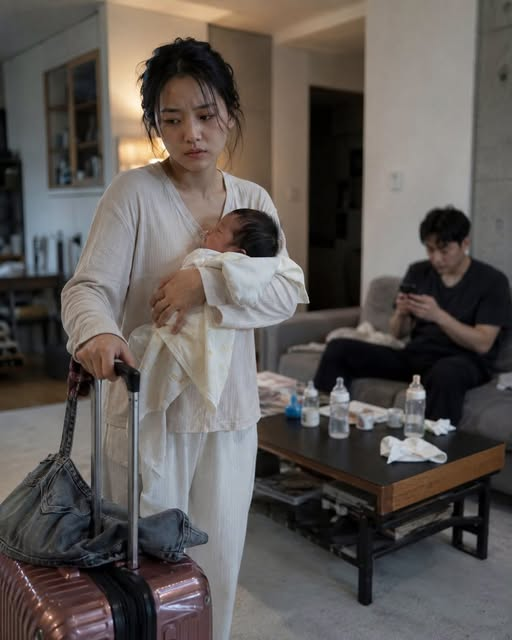
So I packed one suitcase.
I carried my baby through the door.
Daniel thought I would return in two days.
Instead, ninety days later, he came looking for the exhausted woman he had left behind.
She wasn’t there anymore.
Because that suitcase had never been a threat.
It was the first thing I packed for a life in which I finally understood:
I did not need someone to “serve” me.
I needed a family that knew how to show up.