The flight attendant stood beside the first-class curtain, visibly shaken.
“Miss Collins, there’s a pregnant passenger having severe pain.”
Behind her, the husband’s voice broke through again.
“Please! Somebody help her!”
I stood.
Not because he begged.
Not because she had taken my seat.
Because whatever kind of person she was, the baby had done nothing to me.
As I passed him in the aisle, he stared at me.
“You’re a doctor?”
“Yes.”
His face changed.
Thirteen minutes earlier, I had apparently been a selfish young woman making drama over a cheap seat.
Now he moved aside so fast he almost hit another passenger.
His wife was curled against the window, crying and clutching the armrest.
The arrogance was gone.
Only fear remained.
“My stomach keeps tightening,” she whispered. “Something’s wrong.”
I crouched beside her.
“What’s your name?”
“Laura.”
I froze for half a second.
Laura Bennett.
That was the name Dr. Harris had mentioned.
Before boarding, my colleague had sent me a short message:
One of my patients with a complicated pregnancy may be on your flight. She has been medically cleared, but if the crew asks for a doctor, call me immediately.
I had never seen Laura before.
Until she occupied seat 15A.
I looked at her husband.
“How many months?”
“Almost seven.”
Laura suddenly grabbed my wrist.
“Please don’t let anything happen to my baby.”
I looked directly at her.
“I’m going to help you.”
Then I turned to the crew.
“Contact ground medical support and tell the captain we may need an early landing.”
The husband paled.
“Is it that serious?”
“I don’t know yet.”
That answer frightened him.
But unlike him, I was not going to pretend certainty simply because certainty sounded comforting.
I asked Laura a series of questions, checked her general condition and coordinated with the airline’s medical support.
Then I called Dr. Harris through the aircraft connection.
The moment he heard Laura’s name, his voice became serious.
“Emma?”
“Yes.”
There was a pause.
“You found her.”
“She found my seat.”
Under any other circumstances, that might have been funny.
It wasn’t then.
We spoke briefly.
When I ended the call, Laura was staring at me.
“You know Dr. Harris?”
“We work together.”
Her eyes widened.
“He’s my doctor.”
“I know.”
The husband looked between us.
Then remembered the message I had sent before takeoff.
The one he had never seen.
The one saying:
I believe the person you told me about is also on this flight.
His face became completely white.
Laura began crying harder.
Not from humiliation anymore.
From fear.
“Am I going to lose the baby?”
“No one has said that.”
I kept my voice steady.
“We’re going to get you evaluated as soon as possible.”
The captain announced a diversion several minutes later.
Nobody complained.
The passengers who had judged me earlier were suddenly very interested in their own shoes.
The worst part was the seat.
Laura had insisted on sitting by the window because she claimed pregnancy entitled her to whatever made her comfortable.
Now, whenever the crew needed access, two people had to move.
Her husband finally seemed to understand the absurdity.
“This was your seat,” he whispered to me.
“Yes.”
“And we took it.”
“Yes.”
His face burned.
“I’m sorry.”
I looked at Laura.
She was frightened enough already.
“This conversation can wait.”
That silenced him.
Because apparently basic decency was something he had expected from me even after offering none himself.
The aircraft landed early.
Medical staff met us.
Laura was transferred for evaluation.
Her husband followed.
Before disappearing through the terminal doors, he turned toward me.
“Dr. Collins.”
I stopped.
“Thank you.”
I nodded.
“Go with your wife.”
And that should have been the end.
But it wasn’t.
The following morning, Dr. Harris called me.
“Laura is stable.”
I released a breath I had not realized I was holding.
“And the baby?”
“Doing well.”
Nothing catastrophic had happened.
She had developed symptoms serious enough to require evaluation and observation, but treatment had helped and both mother and baby were stable.
Good.
That was all I wanted to hear.
Then Harris laughed.
“What?”
“You never told me she stole your seat.”
“I didn’t think it was medically relevant.”
“She told me everything.”
I closed my eyes.
“Of course she did.”
“She wants your number.”
“No.”
“Emma.”
“I helped because she needed medical attention.”
“That doesn’t mean I need to become part of her life.”
He laughed again.
“Fair.”
Then his tone became more serious.
“She’s embarrassed.”
“She’ll survive that too.”
Three days later, an envelope arrived at my hotel.
Inside was a handwritten letter.
No expensive gift.
No dramatic excuse.
Just several pages from Laura.
She wrote that she had spent months using pregnancy as an automatic argument because people usually surrendered rather than challenge her.
Better restaurant tables.
Shorter lines.
Seats she preferred.
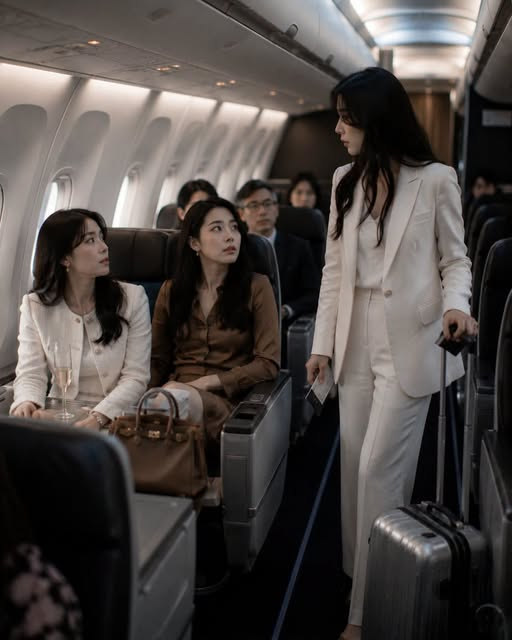
She had convinced herself that because pregnancy was difficult, every request became a right.
Then she wrote:
When I saw you at my seat, I thought you were being selfish for asking me to move. Thirteen minutes later, you were the person holding my hand while I was terrified.
I kept reading.
My husband told me he said you were a bad person for wanting the seat you paid for. I am ashamed that neither of us even asked whether you needed it.
Then:
The doctors told me the window seat did not cause what happened. I know that. I’m not trying to turn this into some punishment from the universe.
That sentence made me respect her more.
She understood.
Her medical scare was not karma.
Pregnancy complications were not moral lessons.
The lesson came from everything around it.
Her behavior.
Her husband’s arrogance.
Their assumption that kindness could be demanded instead of requested.
At the bottom she wrote:
Thank you for helping me even after I treated you badly.
I folded the letter.
That was enough.
Her husband apologized too.
Less elegantly.
He called the airline and asked whether he could reimburse my upgrade.
The airline contacted me.
I declined.
The eighteen hundred yuan had turned out to be money well spent.
Not because Laura suffered.
I would never wish that on anyone.
It had bought me peace when arguing would have accomplished nothing.
And, accidentally, it had also bought me a front-row seat to something I already knew from years of negotiations:
People reveal themselves fastest when they believe social pressure guarantees they will get what they want.
Laura believed saying “I’m pregnant” ended the discussion.
Her husband believed shaming me would make him look protective.
Neither of them expected me simply to walk away.
Two months later, I received one final photograph.
Dr. Harris sent it with Laura’s permission.
Laura was smiling beside her husband.
Still pregnant.
Still doing well.
Underneath, Harris wrote:
She specifically requested the aisle seat for her next flight.
I laughed so loudly that my colleague turned around.
“What happened?”
“Nothing.”
I put the phone away.
“Someone finally learned to read a boarding pass.”
The colleague looked confused.
I didn’t explain.
The woman who stole my seat had expected a fight.
Instead, I upgraded.
She thought that meant she had won.
Thirteen minutes later, when she genuinely needed help, neither her pregnancy nor our argument mattered.
I helped because that was the right thing to do.
And afterward, when she apologized, I accepted because an apology offered without excuses deserves to be heard.
But I never accepted her original argument.
Pregnancy deserves consideration.
Compassion.
Patience.
Sometimes accommodation.
What it does not give anyone is ownership of another person’s seat, time, property or dignity.
That day Laura learned something.
So did her husband.
And maybe the passengers who stared at me did too.
Sometimes the person who refuses to make a scene is not weak.
Sometimes she simply knows there is a better seat waiting beyond the curtain.
