Vaughn stared at me.
For once, his perfectly controlled expression cracked.
“How do you know that?”
Above his head, the words returned all at once.
Who told her? My mother? Impossible. Did I say it while drunk? I don’t get drunk. Did someone find the letters? Burn the letters. No, don’t burn them. They’re all I have.
I almost laughed.
“Letters?”
His face went even whiter.
“What letters?”
The subtitles immediately betrayed him.
Excellent. She can read minds. That is somehow less terrifying than admitting I wrote her forty-seven letters and never sent one.
“Forty-seven?” I asked.
Vaughn slowly sat down.
“Odessa.”
“Yes?”
“Can you actually read my thoughts?”
I nodded.
He closed his eyes.
Above his head appeared:
Think about quarterly reports. Taxes. Concrete. Anything except how beautiful she looks in that dress.
I covered my mouth.
He opened one eye.
“You saw that too?”
“Yes.”
For the first time in my life, Vaughn Ashford looked genuinely embarrassed.
Then I asked the question that mattered.
“If you loved me, why were you marrying Saskia?”
The humor disappeared.
He stood.
“My father proposed an alliance with the Marin family three years ago.”
“I know.”
“No. You know the version your parents told you.”
He walked to a cabinet and removed a document.
“I requested you.”
My hands stopped.
“What?”
He placed the agreement in front of me.
The first draft contained one name.
Odessa Marin.
Not Saskia.
I stared at it.
Vaughn continued.
“Your father told me you refused.”
“I never knew.”
“He said you were in love with someone overseas and would rather leave the family than marry me.”
The subtitles appeared again.
I spent three weeks pretending that didn’t destroy me. It destroyed me.
I looked back at the papers.
“Then how did Saskia replace me?”
“Your parents proposed her.”
“Why?”
Vaughn’s expression hardened.
“I think we should ask them.”
We returned to the ballroom together.
My father’s face changed the moment he saw the document in my hand.
My mother stood.
“Odessa, whatever he told you—”
“Why did you tell Vaughn I rejected him?”
Silence.
Saskia was gone.
Hundreds of guests remained.
And suddenly, no one seemed interested in leaving.
My father tried to regain control.
“This is not the place.”
Vaughn took the microphone.
“I disagree.”
His thoughts were less diplomatic.
He forced her into a wedding dress four hours ago. He no longer gets privacy.
I almost smiled.
My father finally admitted it.
Ten years earlier, when the Ashford family first began doing business with ours, Vaughn had noticed me.
Not Saskia.
Me.
Years later, when he formally asked for a marriage alliance, my parents had panicked.
Saskia had always been the daughter they presented publicly.
She attended galas.
She entertained clients.
She had been prepared to become the “successful” Marin daughter.
I was the one handling contracts, restructuring debt and quietly repairing whatever Saskia abandoned.
My mother’s voice dropped.
“If you married into the Ashford family, who would stay and help us?”
The words hit harder than I expected.
“You kept me because I was useful.”
My father immediately said:
“We needed you.”
“No.”
I looked at him.
“You needed my work.”
That was the difference.
Vaughn’s face became colder.
Then his lawyer entered the ballroom.
He had apparently been waiting outside the entire time.
Vaughn said:
“Since there is no wedding, the Ashford investment agreement will be canceled.”
My father turned pale.
“You can’t.”
“I can.”
“The Marin company will collapse!”
Vaughn looked at me.
Not at him.
“Only if Odessa chooses not to save it.”
My parents both stared at me.
And suddenly I understood.
For the first time, the decision was mine.
My father stepped toward me.
“Nien Niem, think about your mother. Think about the employees.”
I had heard that argument my entire life.
Think about Saskia.
Think about the family.
Think about the company.
Fix it, Odessa.
Always fixes everything.
I looked at the guests.
Then at the wedding dress they had forced onto me.
“I’ll help the employees.”
My father exhaled.
Then I finished:
“But not you.”
His expression froze.
During the next month, Vaughn’s team and I separated the healthy divisions of Marin Industries from the debt my father had accumulated through reckless expansion.
The viable operations were acquired by a new company.
Employees kept their jobs.
Suppliers were paid.
My parents lost control.
For the first time in thirty years, my father no longer had a daughter available to quietly repair his decisions.
Saskia returned six weeks later.
Without her “true love.”
Apparently he had disappeared as soon as her credit cards stopped working.
She came to my apartment furious.
“You stole Vaughn.”
I stared at her.
“You ran away from your own wedding.”
“He was supposed to wait for me!”
“Why?”
She had no answer.
Then she said something almost impressive.
“Because everyone always does.”
That was Saskia’s tragedy.
Our parents had spent her entire life teaching her that consequences belonged to someone else.
Usually me.
Not anymore.
She eventually left the city.
My parents sold their house and moved somewhere smaller.
We did not stop being family.
But I stopped being their emergency solution.
And Vaughn?
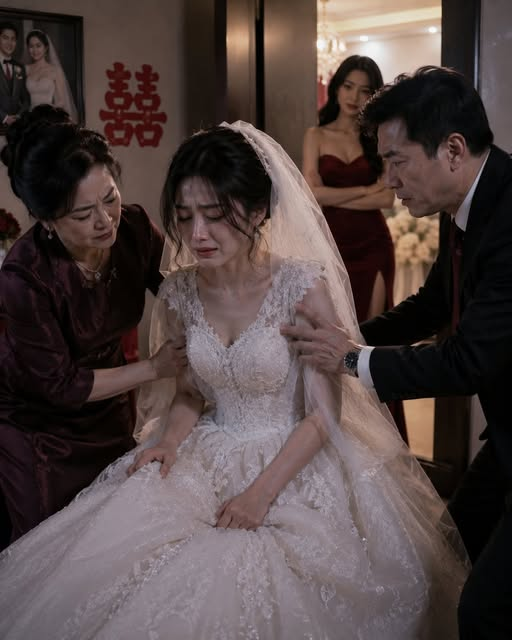
He did something nobody in my family had ever done.
He waited.
Three months after the failed wedding, he invited me to dinner.
Not a business dinner.
No lawyers.
No alliance.
No parents.
He placed a single envelope beside my plate.
“What is it?”
“Letter forty-eight.”
I stared at him.
His thoughts appeared immediately.
Don’t say it’s romantic. It sounded less ridiculous in my office. Actually it sounded ridiculous there too.
I laughed.
“You know I can still read your thoughts.”
“I’m painfully aware.”
“Do I get to read the other forty-seven?”
His face remained perfectly calm.
Above his head:
Absolutely not. I would rather surrender control of Ashford Holdings.
“So that’s a no?”
“A firm no.”
We did not marry that year.
That mattered to me.
I had almost been pushed into one marriage because two families needed a contract.
I refused to turn freedom into another rushed ceremony simply because this groom happened to love me.
We dated.
Normally.
Or as normally as possible when I could occasionally see sentences above his head.
Sometimes it was useful.
“What do you think of my presentation?”
“Excellent.”
Slide seven has too much text. Do not say that. She worked all night.
I raised an eyebrow.
“Slide seven?”
Vaughn sighed.
“I hate this ability.”
Other times, I wished I couldn’t read him.
Because his thoughts were almost painfully sincere.
She laughed today. Remember this moment.
She fell asleep in the car. Drive slower.
Don’t solve everything for her. Ask what she wants first.
That last one mattered most.
A year after Saskia’s abandoned wedding, Vaughn took me back to the same hotel.
The ballroom was empty.
No guests.
No flowers.
No contracts.
He stood beside the altar and held out a small ring box.
Then he stopped.
“You don’t have to say yes.”
Above his head appeared:
Please say yes. But only if you want to. If she says no, smile. Do not collapse dramatically.
I laughed so hard I nearly ruined his speech.
Then I looked at him.
“Vaughn.”
“Yes?”
“This time I came here voluntarily.”
His thoughts vanished.
For several seconds, there was nothing.
Then one sentence appeared.
She chose me.
I said yes.
We married months later.
Small ceremony.
My friends.
A few relatives.
No family companies negotiating behind closed doors.
My parents were invited as guests.
Nothing more.
Saskia did not attend.
And when Vaughn lifted my veil, he whispered:
“Are you sure?”
I nodded.
Above his head appeared:
Ten years. Don’t cry, Ashford. Everyone thinks you’re terrifying. Maintain standards.
I smiled.
“You’re about to cry.”
“I absolutely am not.”
He was.
And that was how the wedding my sister abandoned eventually gave me something I had never been allowed to have.
Not Vaughn.
A choice.
My parents had spent my entire life telling me that Odessa could fix everything.
They were right.
I fixed the company.
I fixed the mess Saskia left behind.
I even fixed the wedding.
But this time, I did it differently.
I stopped fixing everyone else’s life at the cost of my own.
And when I finally became Vaughn Ashford’s bride, it wasn’t because my sister ran away.
It wasn’t because our families demanded it.
It was because, for the first time in my life,
I was the one who chose to stay.
