The emergency-room doctor stared at the monitor.
His expression changed.
Then he looked at Mark and me.
“Sarah, the fall has caused a serious placental complication. Your baby’s heart rate is becoming unstable.”
My fingers closed around Mark’s hand.
“What does that mean?”
“It means we cannot safely wait.”
The room blurred.
“Is my baby going to die?”
The doctor did not give me a promise he could not guarantee.
“We’re going to do everything we can. But we need to deliver your baby now.”
Five years.
Five years of injections.
Appointments.
Losses.
Hope carefully rationed because too much optimism became dangerous.
And now, only minutes after my father decided my sister deserved a couch more than I deserved basic safety, strangers were rushing around me trying to protect the child I had fought so hard to have.
Mark bent down.
“I’m here.”
I looked at him.
“Don’t leave me.”
“I won’t.”
That was the last thing I remembered clearly before they took me away.
Our son was born that night.
Seven weeks early.
Tiny.
Fragile.
But alive.
His name was Noah.
When I woke properly, Mark was beside me.
He looked as if he had aged ten years.
“The baby?”
His face broke.
“He’s alive.”
I started crying.
“Can I see him?”
“Soon.”
I reached for Mark’s hand.
Then I remembered the stairs.
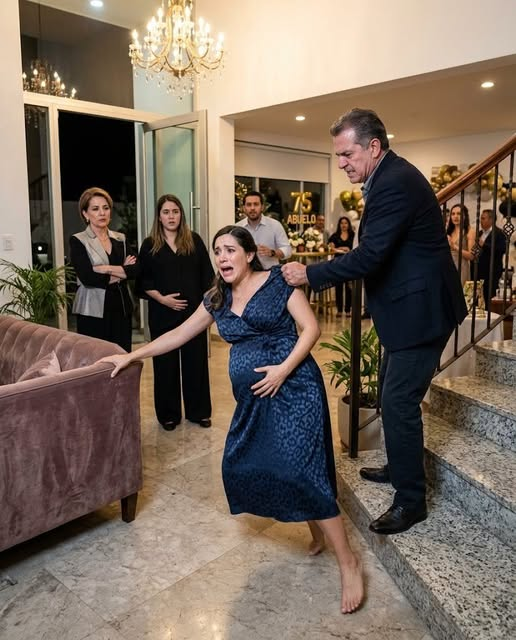
My father’s hand.
My mother shouting.
Chloe watching.
“What happened to them?”
Mark’s expression changed.
“Police are involved.”
I looked at him sharply.
“Mark…”
He understood.
At the party, in rage, he had threatened them.
Now his voice was controlled.
“I’m not touching anyone.”
He looked directly at me.
“I was furious. I said something I shouldn’t have said.”
Then he held up his phone.
“But your father put his hands on you in front of a room full of witnesses.”
“And the venue has cameras.”
That mattered.
Because by morning, my mother had already begun changing the story.
She told relatives:
Sarah slipped.
Sarah was emotional.
Sarah had been arguing.
Sarah exaggerated the bleeding.
Sarah created chaos at Dad’s birthday.
Everything except:
Her husband pulled his pregnant daughter from a couch beside a staircase.
My father’s version was even simpler.
“I barely touched her.”
The camera disagreed.
The footage showed him grabbing my shoulder.
Pulling me upright.
My balance failing immediately afterward.
It also showed something I had not noticed.
Before he touched me, Chloe had pointed toward me and said something to him.
The audio was faint.
But investigators later enhanced enough to understand it.
“Dad, make her move. She always gets what she wants because she’s pregnant.”
When I heard that, I felt strangely empty.
Not angry.
Not surprised.
Just finished.
Chloe visited the hospital two days later.
Mark met her in the hallway.
“You’re not going in.”
“I need to see Sarah.”
“No.”
“She’s my sister.”
He looked at her.
“You remembered that late.”
I heard their voices and told the nurse:
“Let her in.”
Mark hesitated.
“Are you sure?”
“Yes.”
Chloe entered alone.
Without makeup.
Without our parents.
She stood several feet from the bed and started crying.
“I didn’t know Dad would do that.”
I looked at her.
“But you wanted him to force me out of the seat.”
She covered her face.
“I was hurting.”
“So was I.”
“You don’t understand. After surgery—”
I almost laughed.
“No, Chloe.”
She stopped.
“You don’t get to explain pain to me as if yours automatically outranks mine.”
Her hands dropped.
“I was jealous.”
Finally.
Something honest.
She continued:
“Everything has been about your pregnancy for months.”
I stared at her.
“My pregnancy?”
“Grandpa asking how you are.”
“Relatives buying baby gifts.”
“Mom talking about your appointments.”
Her voice cracked.
“I had surgery because I wanted to feel better about myself, and nobody cared.”
I felt something colder than anger.
“So you wanted the eight-month-pregnant woman to stand so you could feel important.”
She started sobbing.
“I didn’t want you to fall.”
“I believe you.”
Hope appeared in her face.
I continued:
“But you wanted me put back in my place.”
The hope disappeared.
“That’s what this family has always done.”
When Chloe felt insecure, everyone adjusted.
When Chloe wanted something, I was told to be mature.
When I was in pain, my pain was “too much.”
When she was uncomfortable, the entire room had to move.
I looked toward the door.
“Please leave.”
“Sarah—”
“No.”
She left crying.
I did not call her back.
My grandfather arrived that evening.
He did not bring flowers.
He brought an envelope.
Inside was a copy of the venue’s security footage and a written statement he had already given to investigators.
I stared at him.
“You testified against Dad?”
“He assaulted my pregnant granddaughter at my birthday celebration.”
His voice shook.
“What else was I supposed to do?”
I looked away.
“For years?”
Grandpa went silent.
I continued:
“What were you supposed to do for years?”
He understood.
His face collapsed.
“I should have done more.”
“Yes.”
He sat beside me.
“I saw how Evelyn favored Chloe.”
“I saw your father always defend your mother.”
“I told myself you were stronger.”
I laughed softly.
“Everyone keeps using that word.”
He closed his eyes.
“Strong.”
“Independent.”
“Sensitive.”
“Dramatic.”
“All different ways of saying Sarah can take another hit.”
Grandpa began crying.
“I’m sorry.”
I believed him.
But I had learned something important.
An apology did not automatically restore access.
“I need time.”
He nodded.
“You’ll have it.”
And unlike my parents, he actually gave it to me.
Noah remained in neonatal care for several weeks.
Every day, Mark and I sat beside him.
We celebrated tiny victories.
Steadier breathing.
Small weight gains.
The first time I was allowed to hold him for more than a few minutes, I cried so hard a nurse brought me tissues without saying anything.
My mother tried to visit.
I refused.
She sent messages.
You’re punishing us over an accident.
Then:
Your father is devastated.
Then:
Imagine how this looks to everyone.
That last message told me she still understood nothing.
Even after nearly losing her daughter and grandson, she remained worried about appearances.
I blocked her.
The criminal investigation continued.
My father’s attorneys initially tried to describe what happened as an accidental fall during a family disagreement.
The video made that difficult.
Witnesses also came forward.
Including the elderly family friend who had looked down at his whiskey instead of intervening.
He visited me months later.
“I should have stopped him.”
“Yes.”
He nodded.
“I was a coward.”
It was remarkable how many adults became honest only after consequences arrived.
My father eventually accepted legal responsibility rather than continue fighting what the recording showed.
The court handled his sentence and restrictions.
I did not ask for maximum revenge.
I asked for protection.
No contact unless I approved it.
No access to Noah.
No surprise visits.
My mother remained furious with me for “breaking the family.”
I never argued.
There is no point explaining a broken family to someone who thinks silence is what held it together.
My grandfather made another decision.
My father had been heavily involved in managing several family investments.
Grandpa removed him from those responsibilities.
Not because I requested it.
Because, in his words:
“A man who cannot control himself around his own daughter has no business controlling anything for me.”
My father blamed me anyway.
I did not answer.
Chloe tried to reconnect after almost a year.
This time she did not begin with an apology.
She began with therapy.
She had moved out of our parents’ home.
Found her own apartment.
Taken a job with a different company.
Then she sent me one message:
I spent my whole life being rewarded whenever I made you smaller. I’m beginning to understand what that turned me into. You don’t owe me a relationship. I’m sorry.
I read it three times.
Then saved it.
I did not answer for another month.
Eventually, we met.
Neutral café.
One hour.
No hugging.
No pretending childhood had been good.
At one point Chloe whispered:
“Do you hate me?”
I thought about it.
“No.”
Her eyes filled.
“But I don’t trust you yet.”
She nodded.
“That’s fair.”
It was a start.
Not reconciliation.
A start.
Three years passed.
Noah became a loud, healthy little boy who believed every staircase existed solely so he could race Mark to the top.
The first time he visited Grandpa’s house, I nearly panicked when he ran toward those granite stairs.
Mark caught him.
Noah laughed.
I didn’t.
Grandpa saw my face.
A week later, railings and a safety gate appeared.
He never mentioned it.
That gesture meant more to me than flowers could have.
My mother never truly changed.
She occasionally sent birthday cards through relatives.
I returned unopened packages.
My father wrote one letter.
I read it.
He said:
I was angry. I never intended what happened.
I put the letter down.
Intent had become my family’s favorite hiding place.
Dad did not intend the fall.
Mom did not intend the danger.
Chloe did not intend the consequences.
But I had spent my entire childhood living beneath things nobody “intended.”
I did not need intention anymore.
I needed accountability.
So I did not respond.
On Noah’s fifth birthday, he sat at the kitchen table eating cake with both hands.
Mark looked at me.
“You okay?”
I nodded.
I was.
Not healed in some perfect movie-ending way.
I still disliked formal family parties.
I still froze when voices suddenly became sharp behind me.
But I had a home where nobody demanded that I surrender comfort to prove love.
And my son was growing up in a family where being loved did not depend on being easier than someone else.
That was enough.
Years earlier, my mother stood above me after the fall and shouted:
“Stop pretending! You’re making us look ridiculous!”
She thought the worst thing happening that night was public embarrassment.
She was wrong.
The worst thing was that, even then, I still wanted her to come down the stairs and become my mother.
She never did.
So eventually I stopped waiting.
My father’s violence did not destroy my child.
My mother’s cruelty did not determine my future.
Chloe’s jealousy did not force me to remain her lesser twin forever.
And the doctor’s terrifying words in the emergency room did not become the end of our story.
Noah survived.
I survived.
But something else did not.
The version of me who believed family had the right to hurt me simply because they were family.
That woman never came home from the hospital.
And for the first time in my life—
I was grateful she didn’t.
