Arthur did not let anyone leave the restaurant.
Not me.
Not the manager.
Not even his security team.
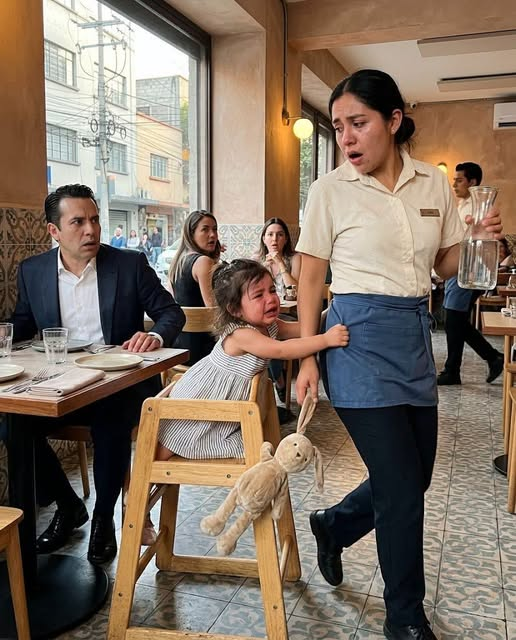
But he also did not touch Maya when she clung to my apron.
He simply stood there, staring at us as though the world had shifted beneath his feet.
Maya buried her face against me.
“Mom…”
Her third word was softer.
Almost exhausted.
I slowly crouched.
My hands were shaking.
“Sweetheart…”
I did not know what else to call her.
The old velvet rabbit lay on the floor.
I picked it up.
The moment I placed it against her chest, Maya stopped crying.
Then I froze.
There was a stitched blue crescent beneath one ear.
I knew that rabbit.
Not this exact one.
But the design.
Two years earlier, before giving birth, I had sewn a nearly identical rabbit from leftover velvet at the hotel laundry where I worked.
Blue crescent beneath the ear.
Because my mother used to tell me the moon watched over children when their mothers could not.
My baby’s rabbit had disappeared from the hospital room.
I had assumed the nurses threw it away after telling me my daughter was dead.
I looked at Arthur.
“Where did she get this?”
His voice came out almost inaudible.
“It was with her when they gave her to me.”
The restaurant disappeared.
I could hear only my own breathing.
Arthur took Maya home that night.
I did not go with them.
He offered.
I refused.
“I need answers before I walk into your house pretending anything.”
He looked as though the refusal hurt.
But he nodded.
Good.
The first thing he did correctly was listen.
By midnight, his attorney had requested records from St. Matthew Medical Center.
By morning, the hospital claimed several archived neonatal files had been “migrated incorrectly” after a system change.
Arthur called me at 8:17.
“They’re stalling.”
I was sitting at my tiny kitchen table.
“How do you know?”
“Because the hospital administrator called my mother before calling me back.”
I went cold.
“Your mother?”
“Yes.”
A long silence.
Then Arthur said:
“My family knew something.”
Two years earlier, Arthur’s wife, Isabelle Vance, had gone into labor at St. Matthew on the same night I did.
I had never heard her name.
Why would I?
I was a waitress with no insurance beyond a basic plan.
Isabelle Vance had arrived through a private entrance with a full medical team.
She died after complications.
That part had been public.
Everyone remembered the headlines.
BILLIONAIRE’S WIFE DIES AFTER GIVING BIRTH TO DAUGHTER.
Maya had supposedly survived.
Arthur had left the hospital a widower and a father.
I had left it believing I was neither wife nor mother.
My daughter’s father had died months before she was born.
A construction accident.
No wealthy family.
No second parent demanding records.
Just me.
Easy to erase.
That realization made me sick.
Three days later, Arthur’s lawyer found the first break.
Two infants had been registered within eleven minutes of each other.
Mine.
And Isabelle’s.
But the wristband numbers did not match the discharge paperwork.
One number had been manually corrected.
The other had been overwritten.
Then came something worse.
The physician who signed my baby’s death certificate had not been on duty that night.
He had retired eighteen months later.
Arthur found him.
He refused to speak.
Until Arthur’s attorney mentioned that the issue involved a potentially falsified neonatal record.
Then the retired doctor called back.
His voice shook.
“I signed what administration gave me.”
Arthur asked:
“Did you examine the child?”
Silence.
“No.”
That was the moment the story became something larger than suspicion.
Arthur asked me to meet him at his house.
I went.
Not because he was Arthur Vance.
Because Maya lived there.
The mansion was enormous.
Quiet.
Too clean.
Maya saw me from the staircase.
She stopped.
Then ran.
Not elegantly.
Not dramatically.
A two-year-old stumble-run with one sock sliding off her foot.
“Mom!”
My knees nearly gave out.
I caught her.
Arthur looked away.
He gave us the room.
I noticed that.
For almost an hour, Maya sat in my lap.
She did not suddenly become talkative.
She said only four words.
Mom.
Rabbit.
Water.
Stay.
The fourth destroyed me.
So I stayed.
Not forever.
That night.
The DNA results came six days later.
Arthur asked that we open them together.
I did not know why.
Maybe because neither of us wanted to be alone when the truth arrived.
The report was simple.
Clara Hayes: biological maternity confirmed.
I stopped breathing.
My daughter.
Alive.
Two years.
Birthdays I had missed.
First steps.
First teeth.
Fever.
Nightmares.
Every moment stolen from both of us.
I covered my face.
Arthur did not touch me.
Thank God.
Then he opened his result.
His face changed.
Arthur Vance: biological paternity excluded.
Silence.
Maya was not his daughter by blood.
I looked at him.
He was staring at the paper.
For two years, she had slept against his chest.
Called no one anything.
Held his finger in hospitals.
Waited for him at the door.
Whatever DNA said, that history did not disappear.
I whispered:
“I’m sorry.”
Arthur looked up.
“For what?”
“She’s not…”
“Don’t.”
His voice broke.
He stood and walked to the window.
Then:
“She is my daughter.”
I said nothing.
He turned.
“And she is yours.”
That was the first moment I understood we were not enemies.
Arthur confronted his mother the next morning.
Eleanor Vance arrived with two attorneys.
Elegant.
Controlled.
She looked at me as if I were an unfortunate accounting error.
Arthur placed the DNA reports on the table.
“What did you do?”
Eleanor did not answer immediately.
Then she said:
“I protected you.”
Arthur laughed once.
There was no humor in it.
“From what?”
“From losing everything at once.”
She looked at me.
“Isabelle’s baby did not survive.”
My chest tightened.
Arthur went completely still.
Eleanor continued.
“You had just lost your wife.”
“The board was already questioning succession.”
“The family trusts required a direct heir for certain control provisions.”
There it was.
Not love.
Not grief.
Control.
Arthur whispered:
“So you bought me a child?”
Eleanor’s face hardened.
“Do not use vulgar language.”
I stood.
“You told me my daughter was dead.”
For the first time, she looked directly at me.
“You had no husband.”
“No influence.”
“No support.”
Arthur slammed his hand against the table.
“Enough.”
Eleanor stopped.
He looked at his mother with something colder than rage.
“You decided Clara’s grief mattered less because she was poor.”
Eleanor said nothing.
That was answer enough.
The hospital’s former administrator eventually cooperated.
So did a retired nurse.
There had been money.
Pressure.
Altered records.
A false death notice.
A substitution arranged in the chaos after Isabelle’s death.
I did not need every detail.
The truth was already unbearable without making it more gruesome.
The authorities handled the rest.
The hospital opened an independent investigation.
Several people faced professional and legal consequences.
Eleanor was removed from the Vance family foundation and from every role involving Arthur’s daughter.
Arthur did not use his wealth to make the matter disappear.
He used it to preserve records.
Then stepped back and let the process move.
That mattered to me.
The hardest question was not legal.
It was Maya.
I was her biological mother.
Arthur was the only parent she consciously remembered.
Everyone expected a war.
There wasn’t one.
I refused.
So did Arthur.
A child was not a trophy returned to its rightful shelf.
A specialist helped us create a gradual plan.
I visited every day at first.
Then Maya spent afternoons with me.
Then nights.
Arthur remained part of her routine.
Bedtime video calls.
Breakfast twice a week.
Weekends.
He learned to knock before entering my apartment.
I learned not to feel threatened when Maya cried for him.
The first time she reached for Arthur instead of me after falling down, I went into the bathroom and cried.
Then I came back out.
Because her loving him did not mean she loved me less.
She had already lost enough adults.
I would not make her choose.
Arthur changed too.
The first month, he tried to buy everything.
A larger apartment.
Private security.
A car.
A trust.
I refused almost all of it.
Finally I told him:
“If you want to help Maya, ask what she needs.”
He looked confused.
“What does she need?”
“Consistency.”
That was cheaper.
And much harder.
So he learned.
He showed up.
On time.
Again.
And again.
And again.
A year later, Maya spoke constantly.
Apparently once she started, she intended to make up for lost time.
She called me Mom.
She called Arthur Dad.
Nobody corrected her.
One afternoon she asked:
“Do I have two houses?”
“Yes,” I said.
“Two beds?”
“Yes.”
“Two rabbits?”
Arthur smiled.
“Probably twelve.”
She considered that.
Then nodded.
“Good.”
For her, the world had become simple.
Adults had complicated it.
Children sometimes refused to.
Arthur and I did not fall in love immediately.
That would have cheapened everything.
For two years, we were simply Maya’s parents.
Not biologically together.
Not legally married.
Just two people bound by the same child and the same betrayal.
Then one evening, after Maya’s fourth birthday, Arthur stayed behind to wash dishes.
I looked at him.
“You know I have a dishwasher.”
“Yes.”
“You’re terrible at this.”
“Yes.”
“Then why are you doing it?”
He smiled.
“Because you cooked.”
I leaned against the counter.
He looked different outside the suits and security teams.
Less like Arthur Vance.
More like a tired man who had spent years rebuilding his idea of family.
He asked:
“Clara?”
“Yes?”
“Can I take you to dinner sometime?”
I stared at him.
“Without Maya?”
“Yes.”
“That sounds suspiciously like a date.”
“It is.”
I almost laughed.
Then:
“One dinner.”
He smiled.
“One dinner.”
It became more.
Slowly.
Carefully.
Years later, we married.
Not because Maya called me Mom in a restaurant.
Not because DNA forced us together.
Because after the truth destroyed both of our old lives, we built something new without stealing anyone’s choices.
Eleanor never returned to Maya’s life.
Arthur made that decision before I ever asked.
Some betrayals do not earn another seat at the table just because the person apologizes later.
On Maya’s sixth birthday, she asked me why she had two baby bracelets inside a locked memory box.
Arthur and I looked at each other.
Then I told her an age-appropriate version of the truth.
“There was a terrible mistake when you were born.”
Arthur added:
“And some adults made choices they had no right to make.”
Maya frowned.
“But you found me.”
I touched her cheek.
“Yes.”
She looked at Arthur.
“And Dad kept me?”
His eyes filled.
“Yes.”
She thought about it.
Then hugged both of us.
For her, that was enough.
For now.
Years earlier, an entire restaurant froze because a silent little girl looked at a random waitress and screamed:
“Mom, don’t leave me.”
People later called it a miracle.
It wasn’t.
The miracle was not that Maya recognized me.
The miracle was that once the truth came out, neither Arthur nor I repeated the sin that had started everything.
Nobody claimed ownership.
Nobody decided Maya’s future behind closed doors.
Nobody treated her like an heir, a scandal, or evidence.
She had already been stolen once by adults who believed money gave them the right to choose her family.
We refused to steal her from each other again.
And in the end, the darkest Vance family secret was not that Maya belonged to me by blood.
It was this:
They had believed a poor mother’s love could be erased with paperwork.
They were wrong.
Two years later, my daughter heard my voice, smelled the same lavender cream I had worn in the hospital—
and remembered enough to call me back into her life.
This time, when Maya said:
“Mom, please don’t leave me.”
I could finally answer:
“I won’t.”
