My mother’s smile disappeared.
My father slowly lowered his phone.
And Derek—
Derek simply stared at me.
For one second, I was thirty years old again, standing alone in doctoral robes while strangers applauded because the two people whose faces I had searched for were hundreds of miles away by choice.
Then the applause around me grew louder.
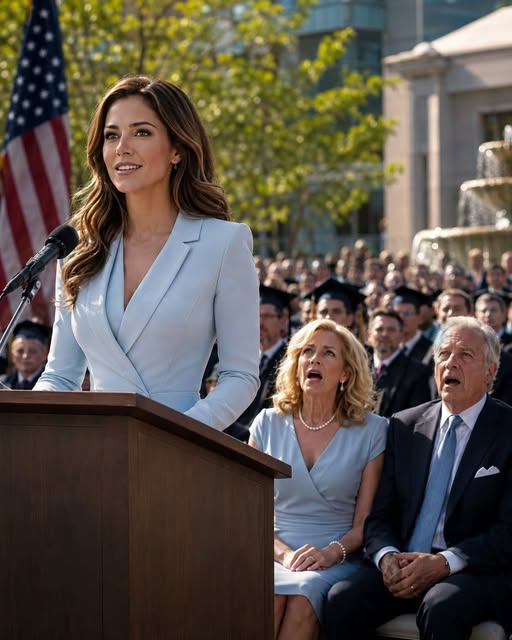
I reached the podium.
I unfolded my speech.
And began.
“Two years ago, on the morning before I defended my doctoral dissertation, I received a message from someone I loved very much.”
The stadium quieted.
I looked down at the page.
“They told me that eight years of research had been a waste.”
My mother’s hand moved toward her mouth.
“They told me my graduation was not worth traveling for.”
Dad turned toward her.
She stared straight ahead.
“And they told me there would be another graduation someday—one that mattered more.”
Derek’s face changed.
I did not name them.
I did not have to.
This was not their trial.
It was my story.
I continued.
“For years, I believed success would finally become real when the right people applauded.”
“I was wrong.”
I told the graduates about Solar Reach.
Not the valuation.
Not the headlines.
The failures.
The prototypes that died after three days.
The investor who laughed and told us rural microgrids would never produce attractive margins.
The first clinic whose refrigerator stayed cold through the night.
The shopkeeper who sent us a photograph because he could finally remain open after sunset.
The girl who told one of our engineers that electricity meant she no longer had to finish her homework before dark.
Then I looked across thousands of graduates and families.
“Some of the most important work you will ever do may look unimpressive to people who cannot yet see its value.”
“Do it anyway.”
My father’s eyes were wet.
I continued.
“You may spend years waiting for someone to say they are proud of you.”
“Build something you are proud of before they do.”
The stadium became completely still.
“And if the people you love do not show up for your moment, do not confuse their absence with proof that the moment did not matter.”
That sentence almost broke my voice.
Almost.
But I had already crossed one Stanford stage alone.
I could cross this one too.
I finished with:
“Your life becomes much larger when you stop asking people who misunderstand your purpose for permission to pursue it.”
Then I stepped away from the podium.
The applause rose.
This time, I did not look toward Section 114.
I looked at the graduates.
Derek was standing.
Clapping.
So were the people around him.
A few seconds later, almost the entire section was on its feet.
Backstage, my hands finally began to shake.
My advisor from years earlier found me first.
She had been invited as faculty.
“You did well, Dr. Mitchell.”
The exact same words she had said after my defense.
I laughed.
Then she hugged me.
Only after she left did I see Derek approaching.
Still in his graduation gown.
For several seconds, neither of us spoke.
Then he said:
“You knew I’d be here.”
“Obviously.”
“You knew Mom and Dad would be here too.”
“Yes.”
His expression tightened.
“Was the opening about them?”
I looked at him.
“You know it was.”
He lowered his eyes.
Then said something I did not expect.
“I knew they didn’t go to your graduation.”
My chest tightened.
“I figured.”
“No.”
He shook his head.
“I mean I knew why.”
I stopped.
Derek looked ashamed.
“Mom told me she thought going would encourage you to keep making ‘impractical choices.’”
My stomach turned.
“She said that?”
“Yes.”
“And you said nothing?”
His silence answered.
That hurt differently.
Derek had been twenty-eight.
Not a child.
He had known.
He had simply accepted being the easier child to celebrate.
“I’m sorry,” he said.
I looked away.
“For what?”
“For liking it.”
That made me face him again.
His eyes were red.
“I liked being the one they bragged about.”
“I liked that Dad introduced me as the future businessman and you as the one who was ‘still figuring things out.’”
He swallowed.
“I knew it was unfair.”
“I just told myself it wasn’t my responsibility.”
For once, nobody was blaming our parents alone.
Derek was owning his part.
I appreciated that.
It did not erase it.
He asked:
“Are you angry that they came for me?”
“No.”
That surprised him.
“I’m glad they came.”
“I wish they had come for you too.”
I smiled faintly.
“That would have been nice.”
He looked toward the corridor where our parents were probably searching for us.
“You going to see them?”
“I assume they’ll find me.”
They did.
My mother appeared first.
She had been crying.
My father followed.
For several seconds, Mom only stared at me.
Then:
“Why didn’t you tell us?”
There it was.
Not congratulations.
Not we’re proud of you.
Why didn’t you tell us?
I almost laughed.
“Tell you what?”
“That you were the keynote speaker.”
“You knew I worked at Solar Reach.”
“We didn’t know it had become this big.”
My mother said it as though that explained everything.
I stared at her.
“That’s the problem.”
Her face changed.
“What?”
“You needed it to become big.”
“You needed a valuation.”
“A Stanford invitation.”
“Thousands of people applauding.”
“I needed none of those things for my PhD to matter.”
Dad stepped closer.
“Sarah, we made a mistake.”
I looked at him.
“Which part?”
He went quiet.
I continued.
“The part where you didn’t come?”
“The part where you called my work impractical?”
“Or the part where you decided Derek’s graduation mattered more before he had even started his MBA?”
Mom whispered:
“We were worried about you.”
“No.”
My voice remained calm.
“You were embarrassed by me.”
Her eyes filled.
“I didn’t mean it like that.”
“You literally wrote that it was embarrassing telling people I was still a student at thirty.”
Her face collapsed.
She remembered.
So did I.
Dad said:
“We thought you were sacrificing too much for something uncertain.”
“Yes.”
“I was.”
“That’s what research looked like.”
He lowered his head.
Mom reached for my hand.
I moved it gently away.
She froze.
“Sarah.”
“I’m not trying to punish you.”
That was important.
“I just don’t know how to let you walk into this moment and act like you were always part of it.”
“We’re your parents.”
“I know.”
“And I was your daughter when I graduated too.”
Silence.
Derek stood several feet away.
He said nothing.
He did not rescue them.
That was new.
Mom whispered:
“Are you saying you don’t want us in your life?”
“No.”
I shook my head.
“I’m saying you don’t get to skip the years that were inconvenient and arrive only when the story becomes impressive.”
Tears ran down her face.
“What can we do?”
I thought about it.
For years, I had imagined that question.
I had imagined giving them some impossible task.
Making them prove everything.
Instead I said:
“Start by learning what I actually do.”
Mom blinked.
“What?”
“Not the valuation.”
“Not the magazine articles.”
“What the technology does.”
“Who uses it.”
“Why I spent eight years studying it.”
Dad nodded immediately.
“We can do that.”
“Then do it.”
“And stop comparing us.”
I glanced at Derek.
“He earned today.”
“My success doesn’t make his smaller.”
“And his never made mine smaller either.”
Derek looked down.
Dad closed his eyes.
“We failed you there.”
“Yes.”
He did not argue.
That mattered.
A little.
Not enough.
But a little.
Then the announcement came for graduates to return to their sections.
Derek looked at me.
“I have to go.”
“Go graduate.”
He hesitated.
Then hugged me.
I let him.
Before leaving, he whispered:
“For what it’s worth, I’m proud of you.”
I smiled sadly.
“Say it before Stanford puts me on a stage next time.”
He laughed through tears.
“Deal.”
That evening, my parents had planned a huge dinner for Derek.
Private room.
Champagne.
Cake with his business-school crest.
I almost didn’t go.
Derek asked me to.
So I did.
Halfway through dinner, Dad stood to give a toast.
Derek stopped him.
“I want to say something first.”
Everyone turned.
He lifted his glass.
“Today was supposed to be my graduation.”
Mom smiled uncertainly.
Derek looked at me.
“And it still is.”
“But my sister taught me something today that I should have learned years ago.”
He paused.
“My family treated success like there was only enough pride for one child.”
“I benefited from that.”
“I didn’t cause all of it, but I also didn’t challenge it.”
My mother began crying again.
Derek continued:
“So this isn’t a toast to Sarah because her company is worth hundreds of millions.”
“It’s a toast to the sister who crossed a doctoral stage alone when I should have called her and said I was proud.”
He lifted the glass toward me.
“To Dr. Sarah Mitchell.”
This time, when everyone repeated my name, I cried.
Not because I had finally won.
Because my brother had finally stopped treating the family scoreboard like something worth winning.
My relationship with my parents did not heal over one dinner.
Mom overcorrected at first.
She started forwarding every Solar Reach article into the family chat.
I finally told her:
“You don’t have to become my publicist.”
She looked embarrassed.
Then started asking actual questions.
“How long do the batteries last?”
“What happens during rainy seasons?”
“Who maintains the systems after your team leaves?”
The first time she asked something technical, I stared at the phone.
Then answered for twenty minutes.
Dad visited one of our domestic field sites the following year.
He wore completely inappropriate shoes.
Complained about the heat.
Asked our engineers too many questions.
At the end, he stood beside one of our installations as the lights came on.
He said quietly:
“I should have come to your graduation.”
I looked at him.
“Yes.”
“I can’t fix that.”
“No.”
He nodded.
Then:
“But I can stop missing things now.”
That was better than another apology.
Two years after my keynote, I found the photograph from my PhD graduation.
I was standing alone in my robes.
No flowers.
No parents.
But behind me were three strangers cheering because I had just crossed the stage.
For years, I hated that photograph.
Now I framed it.
Not because loneliness was beautiful.
It wasn’t.
But because the woman in that picture had done something I didn’t understand at the time.
She kept walking.
She crossed the stage without the people she wanted in the audience.
Went home.
Ordered takeout.
Changed her email signature.
Then showed up for work.
Again.
And again.
Until the thing everyone called impractical began lighting communities after dark.
My parents eventually learned to be proud of me.
I’m glad.
But their pride was no longer the proof I needed.
That proof came much earlier.
It came the first night a clinic kept its medicine cold.
The first time one of our systems worked after months of failure.
The first engineer I hired.
The first community that stopped going dark at sunset.
And, strangely, it came from the graduation my parents refused to attend.
Because when I walked across that Stanford stage alone, I thought the empty seats meant nobody important had shown up for me.
Two years later, standing behind another Stanford podium, I finally understood:
I had shown up.
And that had been enough to build everything that came after.
